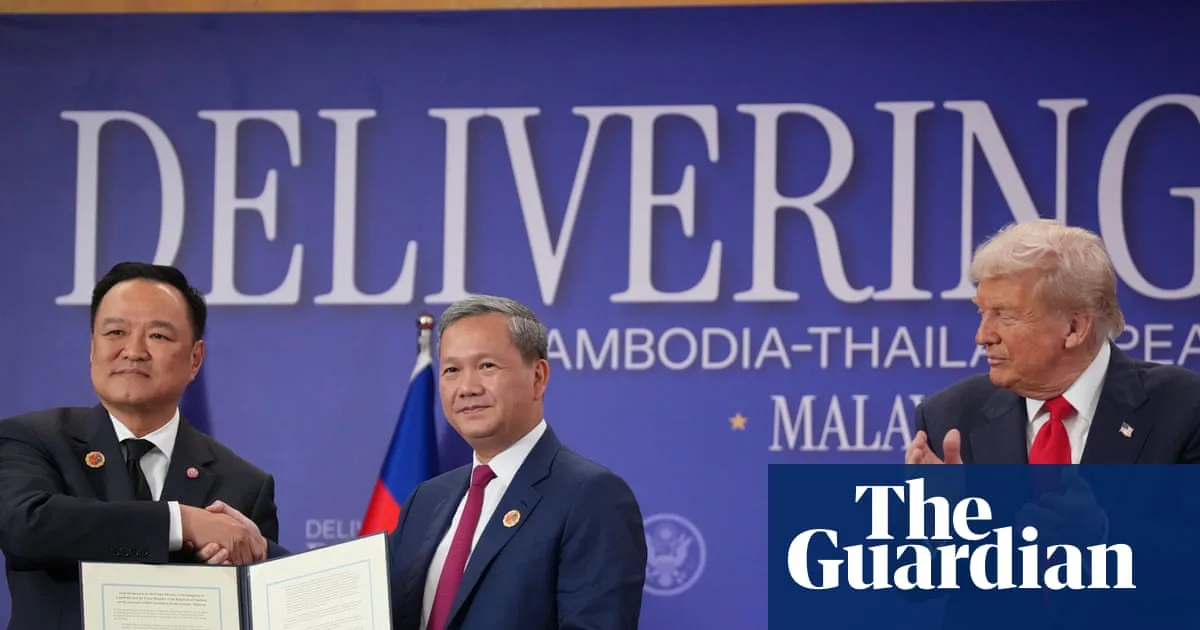
US President Donald Trump has overseen the signing of a ceasefire agreement between Thailand and Cambodia on the first day of a five-day Asia tour that includes stops in Malaysia, Japan, and South Korea. The ceremony took place in Kuala Lumpur on Sunday, ahead of the Asean summit, with Thai Prime Minister Anutin Charnvirakul and Cambodian Prime Minister Hun Manet signing an expanded ceasefire deal. The agreement aims to end a deadly five-day border conflict in July that killed at least 48 people and displaced about 300,000.
Trump helped broker the end of the worst border conflict between the two nations in recent history, warning that trade talks with the US could be jeopardised if hostilities continued. “The United States will have robust commerce and cooperation, transactions, lots of them, with both nations, as long as they live in peace,” Trump said. The deal includes the removal of heavy weapons from the border area, cooperation on landmine clearance, and Thailand's release of 18 detained Cambodian soldiers.
Trump has touted himself as a global peacemaker during his second term, and his involvement in the mediation efforts prompted Hun Manet to nominate him for the Nobel Prize, praising his “extraordinary statesmanship”. Trump also told reporters he intended to resolve the Afghanistan-Pakistan conflict “very quickly”.
In addition to the ceasefire, Trump engaged in a series of trade negotiations on Sunday. He met with Brazilian President Luiz Inácio Lula da Silva, and the US and Vietnam agreed to a framework for a trade deal limiting reciprocal tariffs to between zero and 20%. Trump also signed a trade agreement with Malaysia ensuring US access to critical minerals in exchange for a formalised 19% tariff on Malaysian goods. He expressed confidence in reaching a deal with Chinese President Xi Jinping ahead of their expected meeting on Thursday.
The Asia tour marks Trump's first visit to the region since taking office in January. His meeting with Xi is expected to cover trade, the Hong Kong dissident Jimmy Lai, and Taiwan. The US is Taiwan's most important supporter in its resistance to a Chinese takeover, despite Washington not formally recognising it as a country.