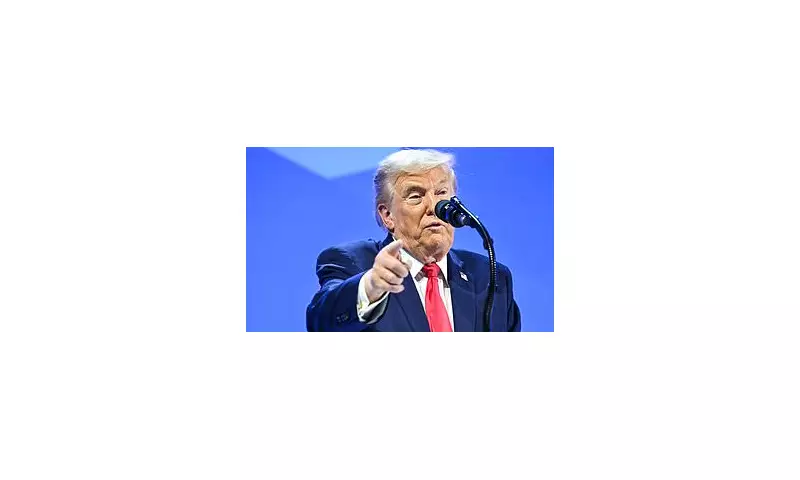
Former US President Donald Trump delivered a wide-ranging and provocative address at the World Economic Forum in Davos, Switzerland, doubling down on his long-standing desire to acquire Greenland while issuing stark warnings to European allies.
A Strategic Demand for Greenland
Trump reiterated his controversial view that the United States made a grave error by returning Greenland to Denmark after the Second World War. He framed the Arctic island as a critical asset for American and global security, describing it as a "uninhabited, underdeveloped big beautiful piece of ice" situated in a key strategic location between the US, Russia, and China.
"After the war we gave Greenland back. How stupid were we to do that?" Trump questioned the audience. "But we did it. How ungrateful are they now?"

He insisted that the US requires "full ownership" of the territory, not merely a lease or enhanced agreement, to properly defend it. "You need the ownership to defend it. You can't defend it on a lease," he stated, arguing it was essential for "strategic national security and international security."
Ruling Out Force, But Issuing a Warning
While the former President explicitly ruled out using military force to seize the island, his comments carried a clear undertone of pressure. "We probably won't get anything unless I decide to use excessive strength and force, where we would be, frankly, unstoppable," he remarked, before adding, "But I won't do that. Okay. Now everyone says, oh, good."
He presented the proposition to Greenland and Denmark as a simple ultimatum: "All the US is asking for is a place called Greenland. You can say yes, and we will be very appreciative. Or you can say no and we will remember."
Critique of NATO and European Policies
Trump's speech also revisited familiar themes regarding the NATO alliance and European domestic policy. He claimed personal credit for the alliance's continued existence and increased defence spending.
"You wouldn't have NATO if I didn't get involved in my first term," he asserted. "Until I came along, NATO was only supposed to pay 2 percent of GDP. The United States was paying virtually 100 percent of NATO. I got NATO to pay 5 percent. They weren't paying, and now they are paying."
He launched a broadside against European energy and immigration policies, suggesting the continent was "not heading in the right direction." He cited reports from friends who claimed certain European places were "not even recognisable" due to "unchecked mass migration," a situation he described in very negative terms.
Specific Rebuke for the United Kingdom
Trump took particular aim at the United Kingdom, criticising its energy strategy despite sitting atop the North Sea reserves. "Britain produces just one third of the total energy from all sources that it did in 1999," he claimed. "Think of that? One third, and they're sitting on top of the North Sea, one of the greatest reserves anywhere in the world, but they don't use it."
He linked this directly to high consumer prices, stating it was "one reason why their energy has reached catastrophically low levels with equally high prices."
A Call for a Stronger West
Despite the critical tone, Trump concluded by expressing a desire for European success, referencing his own Scottish and German heritage. "We believe deeply in bonds we share with Europe as a civilisation," he said, adding that he "wants Europe to do great."
However, he insisted that core issues must be addressed: "Energy, trade, immigration and economic growth must be central concerns to anyone who wants to see a strong and united West." He urged European nations to abandon what he called a destructive cultural shift of the last decade, warning, "They're destroying themselves. … We want strong allies, not seriously weakened ones."
The speech, blending geopolitical demands with domestic political critique, underscored Trump's continued focus on national security, alliance burden-sharing, and a vision of Western strength predicated on specific policy choices.