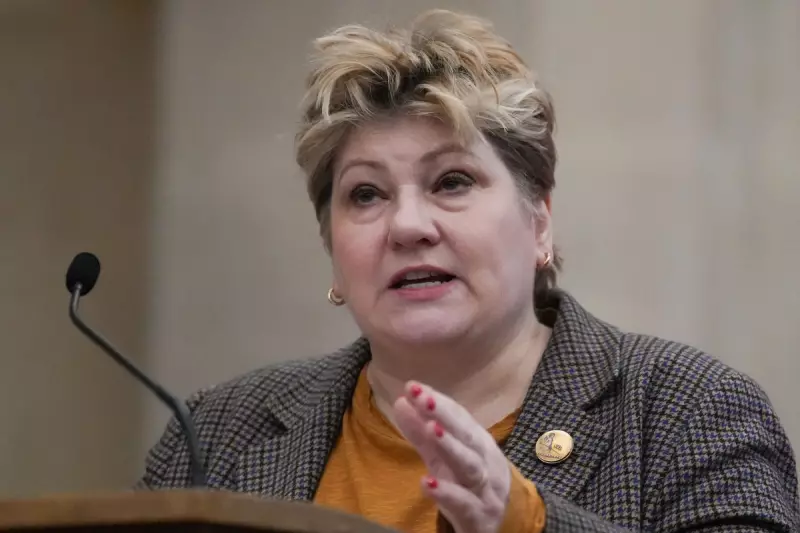
Dame Emily Thornberry has stated that the government's 'embarrassing' failures in the case of activist Alaa Abd El-Fattah could have been prevented if it had honoured its commitment to appoint a special envoy for detained British nationals.
Criticism of 'Serious Shortcomings' in Government Handling
The chair of Parliament's Foreign Affairs Committee highlighted what she termed 'serious shortcomings' in information sharing and due diligence. In a letter to Foreign Secretary Yvette Cooper, Dame Emily argued that a dedicated official, promised over a year ago, would have conducted essential background and social media checks.
She wrote that had an envoy been established following former Foreign Secretary David Lammy's 2024 commitment, 'such embarrassing failures of due diligence and information sharing would have been avoided.' The envoy's role, she stressed, would be to demonstrate that arbitrary detention of Britons is intolerable, boost family confidence, and enable a 'whole-of-government' approach to complex cases.

The Controversial Case of Alaa Abd El-Fattah
Alaa Abd El-Fattah, a blogger granted UK citizenship in December 2021, was imprisoned in Egypt on charges of spreading false news. His detention was deemed a breach of international law by UN investigators. After years of lobbying by both Conservative and Labour governments, he was pardoned by Egyptian President Abdel-Fattah el-Sisi in September 2025 and flew to the UK on Boxing Day.
His arrival was initially welcomed by politicians, including Prime Minister Sir Keir Starmer. However, controversy erupted when old social media posts from around 2010 resurfaced. In them, the activist appeared to call for violence against Zionists and the police. Downing Street labelled the posts 'abhorrent,' though accepted his subsequent apology as 'fairly fulsome.'
The revelations prompted calls from the Conservatives and Reform UK for his citizenship to be revoked, though legal grounds for such a move appear limited.
Broader Implications for Detained Britons Policy
Richard Ratcliffe, husband of Nazanin Zaghari-Ratcliffe—who campaigned for Mr El-Fattah's release—called the posts 'horrible and indefensible.' However, he emphasised that human rights must be applied universally, stating: 'You don’t just get them if you are good.'
Dame Emily Thornberry echoed this principle, telling the Press Association that while due diligence was crucial, 'we have an obligation to assist British citizens no matter who they are', particularly if unlawfully detained. She has now urgently reiterated her committee's recommendation for the immediate appointment of the long-promised envoy.
The government has been contacted for comment on the criticism and the status of the proposed envoy role.