Syrian Security Forces Expand Presence in Kurdish Northeast Under Landmark Agreement
Security forces affiliated with Syria's Interior Ministry have continued their strategic deployment into Kurdish-dominated regions of northeastern Syria this week. This movement forms a critical component of a carefully negotiated agreement between the Damascus government and the Kurdish-led Syrian Democratic Forces (SDF), marking a significant development in the complex security landscape of the war-torn nation.
Convoy Enters Qamishli Under Coordinated Security Measures
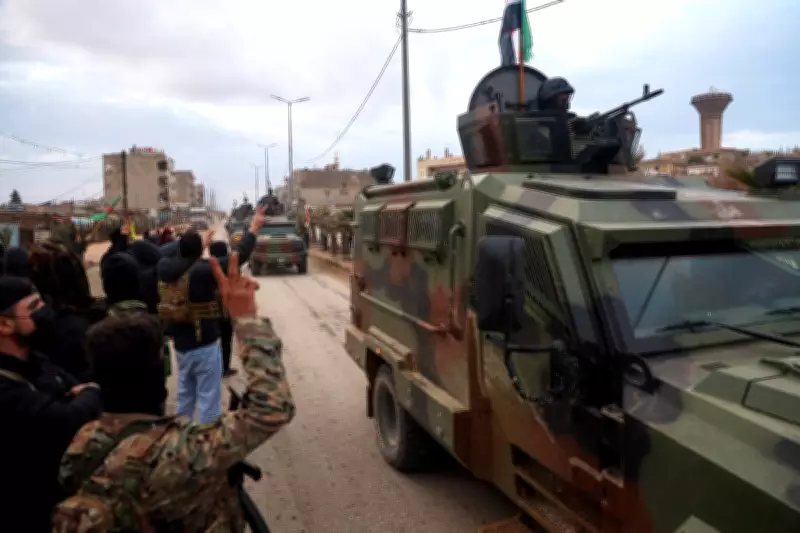
A substantial convoy of government security personnel entered the Kurdish-majority city of Qamishli, located in the countryside of al-Hasakah province, on Tuesday. This follows their initial entry into the region on Monday, demonstrating a phased implementation of the accord. In preparation for this deployment, security was visibly intensified along Amuda Street, the primary arterial road leading into Qamishli.
The streets of Qamishli presented an unusual scene, largely emptied due to a curfew imposed by the SDF. Shops remained shuttered, while heavily armed SDF personnel and local Kurdish security forces maintained a visible presence across major thoroughfares and intersections. Notably, some fighters had their faces covered, and several women were observed among the deployed forces. The urban landscape was dotted with yellow flags of the Kurdish People's Protection Units and standard Kurdish flags adorning closed storefronts.

Limited Mandate and Phased Integration Outlined by Officials
Under the specific terms of the agreement, the incoming security contingents, which report directly to the Interior Ministry, are granted a deliberately limited mandate. Their primary responsibilities are confined to:
- Securing state-affiliated institutions, including civil registry offices and passport departments.
- Providing security for the Qamishli airport.
- Restarting operational work at these vital facilities.
Nour al-Din al-Baba, spokesperson for the Syrian Interior Ministry, confirmed the ongoing coordination. "We are coordinating with the other side inside Qamishli for our forces to deploy inside the city," he stated. He further elaborated on the broader plan, noting, "There is a program and a time frame to finalize all of the deal's clauses, among them is taking over the vital facilities, including the crossings, the Qamishli airport and oil facilities, managing them and making them operational in the service of the Syrian people."
Local Kurdish Forces Maintain Overall Security Control
Despite the new deployments, local Kurdish authorities assert that they retain overarching security control within the city. Samer Ahmad, a member of the local Kurdish security forces, told the Associated Press while monitoring the situation in Qamishli, "All necessary measures have been taken, and our forces are ready to confront sleeper cells and those seeking to carry out acts of sabotage."
Ahmad provided details on the temporary nature of the arrangement, explaining, "The incoming (government) forces will be deployed at four points in the city of Qamishli, and their presence here will be temporary. God willing, in the coming period, once integration is completed, they will withdraw." This statement highlights the transitional and confidence-building aspect of the agreement.
Celebratory Reception in Tell Brak Amid Underlying Tensions
Prior to the Qamishli deployment, convoys of security force vehicles bearing Syrian flags received a notably enthusiastic welcome upon entering Tell Brak, east of Hasakah. This area serves as a focal point between Qamishli and Hasakah. Crowds lined the roads, waving Syrian flags and cheering the arrival. The atmosphere was punctuated by chants of "The Syrian people are one" through megaphones, celebratory gunfire, and traditional ululations from women.
Adel al-Ahmad, among those welcoming the convoy, expressed a common sentiment among some Arab residents: "We hope that the Arab Syrian army becomes the one in control, and we hope this happiness is spread across Syria, north to south to east to west." He voiced contentment over what he described as the liberation of several areas from SDF control.

Deep-Seated Community Concerns Persist
This military and political manoeuvring occurs against a backdrop of profound and longstanding community tensions. Arab residents in SDF-controlled territories have frequently voiced complaints of political and economic marginalisation. Conversely, many within Kurdish communities harbour deep fears of potential reprisals from government-affiliated fighters. These anxieties have been acutely sharpened by the widespread sectarian killings and retaliatory attacks that erupted across Syria in 2025, particularly in coastal and southern regions.
Another spectator, Wissam al-Motlak, summarised a perspective hopeful for change, stating, "We are happy with the entry of the internal security to Al-Hasakeh on the way to Qamishli." The continued deployment represents a fragile step in a complex process of integration and security realignment in northeastern Syria, with its ultimate success heavily dependent on managing these deep-rooted communal fears and aspirations.