Prime Minister Keir Starmer's landmark visit to Beijing has been interpreted by Chinese state media as a significant act of economic pragmatism from a British leader facing considerable domestic pressures. The trip, which marks the first by a UK prime minister to China in eight years, has been framed as a deliberate reordering of priorities, with business interests taking clear precedence over political disagreements.
A Strategic Shift in Sino-British Relations
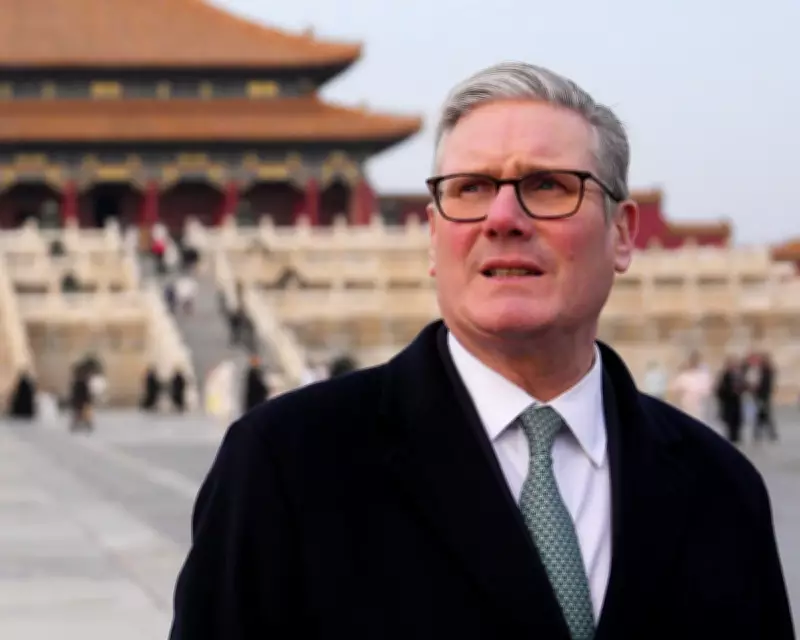
During his tour, which included a visit to the historic Forbidden City, Starmer articulated his desire for a "more sophisticated" relationship between the two nations. This diplomatic language was accompanied by concrete announcements of economic agreements designed to facilitate British businesses expanding their operations within the Chinese market. The presence of a substantial delegation comprising fifty business and cultural leaders underscored the commercial focus of the mission.
Media Interpretation: Economics Over Politics
State-affiliated media outlets were quick to analyse the visit's underlying motives. A social media account linked to the Beijing Daily explicitly contrasted the current approach with recent history, stating: "If the Sino-British relationship in the past few years has been characterised by 'politics taking precedence and economics taking a backseat', then this time it is more like a reordering of 'economics taking precedence and politics taking a backseat'."

This sentiment was echoed by commentary from China.org.cn, which portrayed Starmer's journey not as an ideological realignment or a return to the so-called "golden era" of relations, but as a functional necessity. The analysis suggested the visit was driven by mutual economic needs amidst global uncertainty, offering the UK "capital, orders, and growth momentum" while providing China with "stable expectations and strategic leverage over Europe."
Navigating Geopolitical Pressures
A notable aspect of the media coverage was the emphasis on Starmer's reported refusal to publicly pressure President Xi Jinping regarding China's ties with Russia. The state-owned Guancha news website highlighted that the Prime Minister did "not take the bait" from Western journalists, a move seen as crucial to maintaining the trip's constructive tone.
Academics and commentators within China provided further context, suggesting the UK's diplomatic adjustment was a forced recalculation. Professor Yin Zhiguang of Fudan University described it as a move to hedge against external risks, potentially alluding to the posture of the Trump administration, while also addressing internal economic sluggishness. Similarly, former Global Times editor Hu Xijin inferred that the UK's outreach was a reaction to recent global dynamics rather than a product of Chinese lobbying.
Collectively, the Chinese media narrative paints a picture of a beleaguered British government pragmatically seeking economic stability, thereby demonstrating a level of independent calculation in its foreign policy that is not entirely tethered to Washington's approach. The visit is framed as a mutual understanding where security issues, while acknowledged, are deliberately not allowed to dominate a commercially focused agenda.