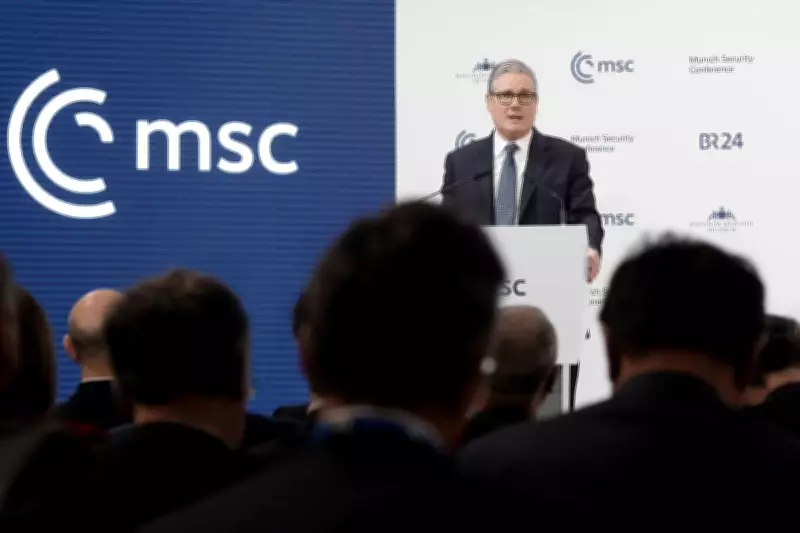
Starmer's Munich Address: A Call for European Unity and Military Readiness
Prime Minister Sir Keir Starmer delivered a robust defence of European security and British international leadership at the Munich Security Conference on Saturday 14 February 2026. In a speech that marked a clear departure from Britain's Brexit-era positioning, Starmer warned that Europe must be prepared to fight to protect its people, values, and way of life against growing threats.
Reaffirming NATO Commitment Amid Trump Doubts
Addressing concerns raised by US President Donald Trump about European allies' willingness to honour NATO's Article 5 collective defence clause, Starmer offered an unequivocal guarantee. "To all NATO members, our commitment to Article 5 is as profound now as ever," he declared. "Be in no doubt, if called on, the UK would come to your aid today."
This statement served as a direct response to Trump's recent questioning of whether European partners would answer an Article 5 call if made today. Starmer emphasised Britain's historical fidelity to NATO, referencing former foreign secretary Ernie Bevin's description of the alliance as "a spiritual union of the West."

Announcing Military Deployment to North Atlantic
In a significant demonstration of military commitment, Starmer announced that the UK will deploy a carrier strike group to the North Atlantic and High North region this year. The deployment, led by HMS Prince of Wales, will operate alongside US, Canadian, and other NATO allies in what Starmer described as "a powerful show of our commitment to Euro-Atlantic security."
This move comes following President Trump's controversial assertion earlier this year that he wants to take over Greenland, with European nations having rallied to Denmark's defence against suggestions of possible US annexation.
Warning of Russian Threat and Need for Readiness
Starmer delivered a stark assessment of the security landscape, stating that "Russia has proved its appetite for aggression" and warning that even after a potential peace deal for Ukraine, "Russia's rearmament would only accelerate."
"We must answer this threat in full," he insisted. "We must build our hard power, because that is the currency of the age. We must be able to deter aggression, and, yes, if necessary, we must be ready to fight."
Rejecting Brexit-Era Isolationism
In perhaps his most significant rhetorical shift, Starmer declared that "Britain is not the Britain of the Brexit years anymore." He called for closer security ties with Europe and less reliance on Donald Trump's United States, arguing that "there is no British security without Europe and no European security without Britain."
The Prime Minister also advocated for closer economic alignment with the European Union, suggesting the UK should "move closer to the single market" in certain areas where it benefits both sides. This message comes just months before the tenth anniversary of the Brexit referendum result.
Confronting Domestic Political Opposition
Starmer used the international platform to launch a fierce attack on Nigel Farage's Reform UK party, describing them as "pro-Putin" and warning that if they were in government, Britain "would be seen as a country that people couldn't do business with."
He also criticised both Reform UK and the Green Party as "the peddlers of easy answers on the extreme left and the extreme right," claiming they share a dangerous approach of being "soft on Russia and weak on NATO." In a chilling historical reference, he suggested their vision would see "the lamps go out across Europe once again," echoing Sir Edward Grey's remark before the First World War.
Denying Leadership Challenges
When questioned about whether he had narrowly avoided being toppled from leadership after calls for his resignation from Scottish Labour, Starmer firmly rejected the suggestion. "No, I reject that," he stated. "I ended the week much stronger than I started it, and that's a very good place to be."

He emphasised his government's unity on Ukraine, defence, security, and the need for stronger European relations, positioning himself as leading a Britain ready to reclaim its role as a decisive international leader rather than a nation turning inward.