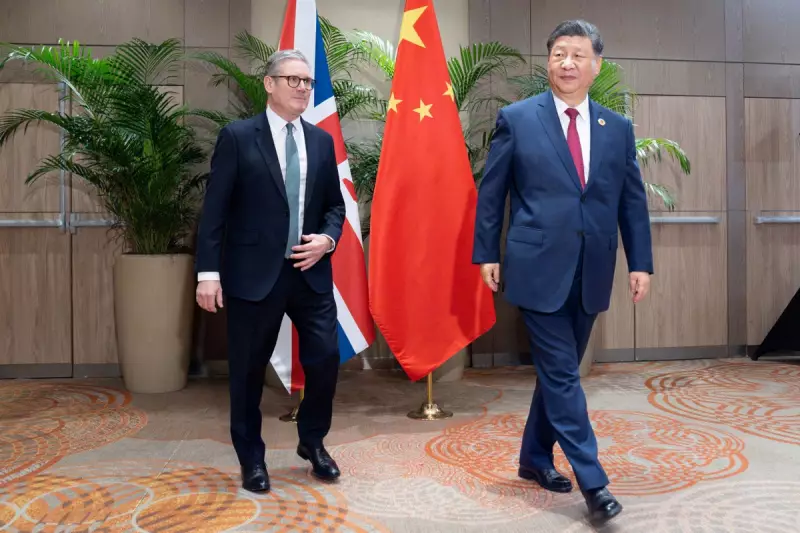
Prime Minister Touches Down in Beijing for Controversial Diplomatic Mission
Sir Keir Starmer has arrived in the Chinese capital for a contentious three-day official visit, asserting that constructive engagement with Beijing will ultimately enhance both Britain's economic fortunes and its national security framework. The Prime Minister travelled overnight on Tuesday accompanied by a substantial delegation exceeding fifty representatives from British commercial enterprises, sporting institutions, and cultural organisations.
Balancing Economic Cooperation with Security Imperatives
Despite facing significant pressure to address sensitive issues including alleged Chinese espionage activities, Sir Keir has firmly stated that economic collaboration will not be exchanged for compromises on national security. The visit represents a deliberate attempt to recalibrate the United Kingdom's relationship with the global economic powerhouse, which the Prime Minister characterised as having deteriorated from a "golden age to an ice age" in recent years.
Downing Street has emphasised that Sir Keir will maintain clear "guardrails" on security matters throughout the discussions, explicitly stating that economic cooperation will not be traded for national security concessions. The Prime Minister's official spokesperson reinforced this position, declaring that "sticking our heads in the sand and refusing to engage would be a staggering dereliction of duty" that would ultimately make British citizens less secure.

Contentious Background and Diplomatic Challenges
The diplomatic mission occurs against a backdrop of heightened tensions, including the collapse earlier this year of a trial involving two individuals accused of spying for China. Furthermore, in November, MI5 disclosed that Chinese intelligence operatives had allegedly posed as recruitment consultants on professional networking platform LinkedIn as part of what was described as a "widespread" operation targeting British parliamentarians.
Some Members of Parliament had urged the Prime Minister to cancel the visit entirely due to human rights concerns, particularly highlighting the imprisonment of Hong Kong pro-democracy activist and British national Jimmy Lai. These appeals were ultimately disregarded as Sir Keir proceeded with what marks the first visit by a British Prime Minister since Theresa May's trip in 2018.
The Intelligence and Security Committee issued a warning in December that previous governments had shown reluctance to prioritise security considerations regarding China, urging authorities to cease "dragging its heels" on whether to designate China to an enhanced threat category.
Strategic Rationale and International Context
Speaking ahead of his departure, Sir Keir articulated his vision for a "strategic and consistent relationship" with China, arguing that such an approach serves Britain's national interest. He criticised the previous Conservative administration's policy as "dogged by inconsistency" while acknowledging that challenges posed by China must not be ignored.
"For years, our approach to China has been dogged by inconsistency – blowing hot and cold, from Golden Age to Ice Age," Sir Keir stated. "But like it or not, China matters for the UK. As one of the world's biggest economic players, a strategic and consistent relationship with them is firmly in our national interest."
The Prime Minister's spokesperson highlighted that French and German leaders have visited China multiple times since 2018, whereas no British Prime Minister had undertaken such a visit during that period. The delegation accompanying Sir Keir includes representatives from prominent British institutions such as Jaguar Land Rover, Barclays, AstraZeneca, the Science Museum, and the National Theatre, alongside Business Secretary Peter Kyle and City Minister Lucy Rigby.
Navigating Complex International Dynamics
Complicating the diplomatic landscape is the potential reaction from the United States, where President Donald Trump has previously threatened imposing substantial tariffs on nations engaging with Beijing. Sir Keir addressed this delicate balancing act in remarks to Bloomberg before his departure, asserting "I'm often invited to simply choose between countries. I don't do that."

The visit follows several ministerial trips to China and coincides with recent approval for a new Chinese embassy in London. Since assuming office, the Labour government has pursued a thaw in relations with China, which remains Britain's third-largest trading partner and a crucial component of global supply chains across multiple sectors.
Sir Keir is scheduled to meet with President Xi Jinping on Thursday, where he is expected to address areas of disagreement while emphasising the importance of "frank and open dialogue" on divergent viewpoints. The Prime Minister's team has stressed that without meaningful diplomatic engagement, progress on global challenges including climate change and public health becomes significantly more difficult to achieve.