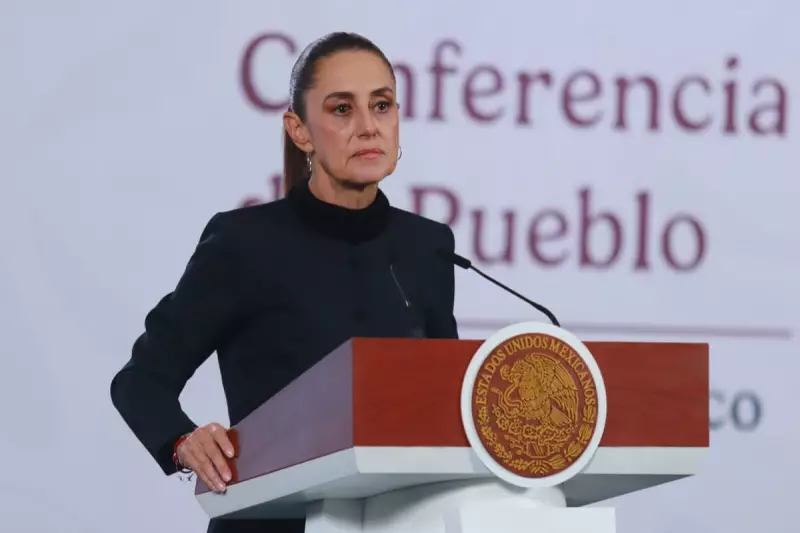
Sheinbaum Defends Cartel Extraditions as Sovereign Decision Amid US Pressure
Mexican President Claudia Sheinbaum has publicly defended the recent transfer of 37 Mexican drug cartel operatives to the United States, labelling it a "sovereign decision". This move comes as her administration seeks to alleviate mounting pressure from the Trump administration, which has demanded more aggressive action against drug-trafficking groups operating in Mexico.
Escalating Demands from Washington
Since Donald Trump returned to the White House, he has repeatedly asserted that Mexico is "run by cartels", urging Sheinbaum to take stronger measures. The threat of unilateral US action has intensified, particularly following the US military's extraction of Nicolás Maduro from Venezuela earlier this year and ongoing strikes on suspected drug-trafficking vessels in the Pacific and Caribbean.
Analysts warn that while these extradition flights serve as an effective pressure valve, their impact may be diminishing. Rodrigo Peña, a security expert, noted, "I think they will have to find other solutions, and the issue of Mexican politicians connected to criminal networks is going to have ever more weight. There will be more pressure on the president to confront these networks."

Legal and Diplomatic Complexities
The latest flight marks the third such transfer in the past year, involving high-level figures from notorious organised crime groups such as the Cartel Jalisco Nueva Generación and Cartel del Noreste. Among those extradited was Pedro Inzunza Noriega, a fentanyl trafficker who, in May 2025, became the first person charged with narco-terrorism by the US Department of Justice.
However, experts in Mexico have raised questions about the legal grounds for these flights, which bypass the usual extradition process. In response, Mexico's security minister, Omar García Harfuch, stated on social media that the individuals were "high impact criminals" who "represented a real threat to the country's security".
Broader Implications for US-Mexico Relations
The prospect of US military involvement on Mexican soil, particularly in joint operations to dismantle fentanyl laboratories, remains a sensitive issue due to historical US interventions. Sheinbaum has firmly rejected such proposals, emphasising national sovereignty.
Instead, her government has focused on extraditions and other measures, such as suppressing migrant flows at the US-Mexico border to assist the Trump administration's security agenda. Yet, as Diego Marroquín Bitar of the Center for Strategic and International Studies points out, "The security agenda is no longer separate from trade negotiations – and that could completely pollute or derail those negotiations." This is particularly relevant as the US-Mexico-Canada free trade deal undergoes renegotiation.
Peña added that the Trump administration's security policy is "so aggressive, so unilateral, so war-like" that it prioritises pressure over intelligence work. The cost of unilateral action in Mexico would be significantly higher than in Venezuela, given the potential political turmoil and the nearly trillion-dollar annual trade relationship between the US and Mexico.
Future Challenges for Sheinbaum
Marroquín further highlighted that the Trump administration expects more than just extraditions and border control. "I think what they want is for the Mexican government to go after politicians: people in power who are associated with these drug trafficking organisations. And the question is: 'Is Sheinbaum willing to go after them?' Because some of these people are going to be from her own party."
As tensions persist, Sheinbaum's ability to navigate these demands while upholding Mexican sovereignty will be crucial in shaping future bilateral relations and domestic security policies.