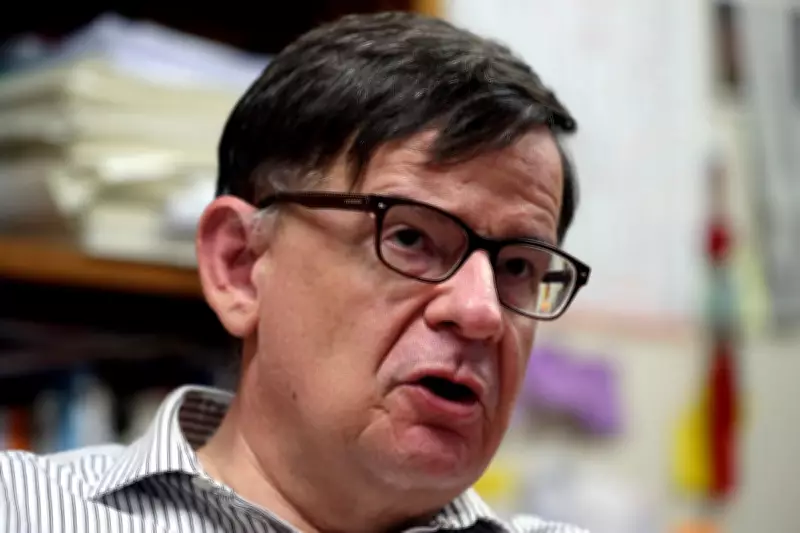
In a startling incident that has raised questions about academic freedom and political expression, Andrei Lankov, a prominent Russian scholar specialising in North Korean studies, was detained by Latvian authorities just minutes before he was due to deliver a lecture. The episode, which unfolded on Wednesday 25 February 2026, saw Mr Lankov placed on a blacklist and subsequently expelled from the country, according to multiple reports from Russian media outlets.
Detention and Expulsion Details
Mr Lankov, who holds dual Russian and Australian citizenship and teaches history at South Korea's Kookmin University, confirmed to news agencies that he was taken into custody by Latvian police shortly before his scheduled talk on North Korea. He recounted that officers escorted him to an immigration office and then transported him by car to the border with Estonia, where he was eventually expelled from Latvia.
At approximately 11pm Moscow time, Mr Lankov stated he was still being held, with lawyers actively working on his case and friends assisting with logistical arrangements. He detailed the events to NK News, explaining, "About thirty minutes before the event, police and immigration came and told me that the foreign ministry of Latvia included me on its list of undesirable people."

Potential Reasons Behind the Blacklisting
While Latvian officials have not provided an official clarification, Mr Lankov believes his detention and blacklisting are directly linked to his views on North Korea. He suggested that his writing style, which he describes as "excessively objective," may have been perceived as problematic by authorities. "I say positive things about North Korea sometimes, and when negative, not in a hysterical style," he remarked, implying that his balanced approach might not align with political narratives.
In a post on Telegram, Mr Lankov further elaborated, "Overall everything is fairly clear. The authorities do not like the fact that I refuse to turn real-life situations into politically convenient caricatures." This statement underscores his belief that his academic integrity has led to his designation as an undesirable person in Latvia.
Background and Career of Andrei Lankov
A native of Leningrad, now known as St Petersburg, Mr Lankov has a deep connection to North Korea, having lived there as an exchange student in the 1980s. His career has been dedicated to studying the country, with stints working in South Korea and Australia during the 1990s before taking up a teaching position in Seoul in 2004.
Mr Lankov is renowned for his realist perspective on North Korea, often characterising it as a Machiavellian regime that adeptly manages limited resources and manipulates major powers to ensure its survival. Notably, he has also expressed critical views on Russia's war in Ukraine and Moscow's utilisation of North Korean troops to sustain its military campaign.
Previous Legal Issues in Russia
This incident is not the first time Mr Lankov has faced legal challenges. In April 2025, a Moscow court reportedly fined him 10,000 rubles (approximately £92) for participating in the activities of an organisation deemed "undesirable" in Russia. At the time, Mr Lankov told RBK that he learned about the case from journalists, highlighting ongoing tensions between his academic work and political sensitivities.
Reactions and Implications
Officials at Kookmin University in South Korea have stated they are attempting to assess the situation, indicating concern over the treatment of their professor. Meanwhile, Mr Lankov's lawyer confirmed the blacklisting, though it was noted that this designation did not prevent his initial entry into Latvia, according to the Russian Anti-War Committee.
The detention of a respected scholar like Andrei Lankov raises significant issues regarding freedom of speech and academic discourse in international contexts. As debates continue over the boundaries of political expression, this case serves as a poignant example of how scholarly objectivity can sometimes clash with governmental policies, leading to contentious outcomes that reverberate across borders.