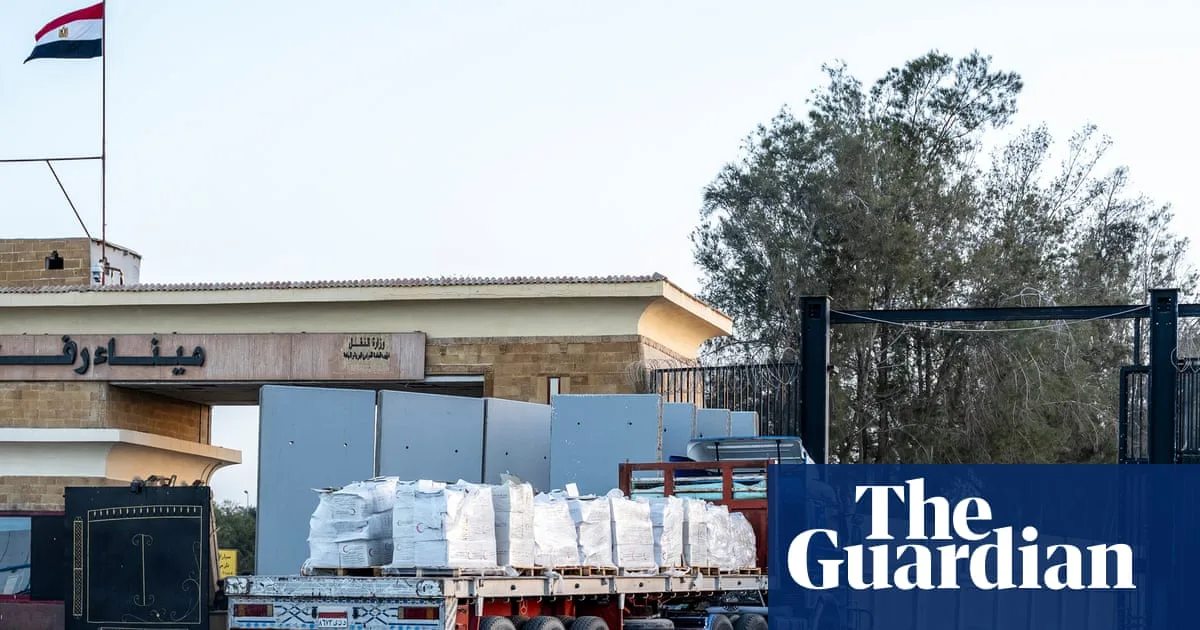
The Rafah border crossing, long described as Gaza's essential lifeline to the wider world, could soon reopen, offering a crucial glimmer of hope for the war-shattered Palestinian territory. Palestinians are now awaiting this development with profound anticipation, as the crossing represents their only direct gateway to a neighbouring country not controlled by Israel prior to the conflict.
Imminent Reopening Follows Hostage Recovery
Expectations for the reopening surged after Israel announced on Monday that the remains of the final hostage in Gaza, Ran Gvili, had been recovered. Hours earlier, Israeli authorities had indicated the Rafah crossing would open with specific limitations once this search operation was concluded. The opening is viewed as a key step that would usher in the second phase of the U.S.-brokered ceasefire, although its activation had originally been called for as part of the initial phase of the agreement.
Vital Functions and Current Uncertainties
It remains unclear precisely when the crossing will become operational and whether it will permit the two-way flow of both goods and people into and out of Gaza. Prime Minister Benjamin Netanyahu's office stated late Sunday that Israel had consented to a reopening "for pedestrian passage only, subject to a full Israeli inspection mechanism." In contrast, Hamas issued a statement on Monday demanding Israel open the Rafah crossing in both directions "without restrictions."
Ali Shaath, head of the new Palestinian committee managing Gaza's daily affairs, suggested last week that the crossing would open this week to facilitate movement to and from the enclave. A reopened Rafah would significantly ease the plight of Gazans needing to seek urgent medical treatment abroad, travel internationally, or visit family in Egypt, which hosts tens of thousands of Palestinians. It would also provide a vital boost to Gaza's devastated economy, enabling the export of Palestinian products like olive oil to markets in Egypt and across the Arab world.
"We hope this will close off Israel's pretexts and open the crossing," said Abdel-Rahman Radwan, a resident of Gaza City whose mother is a cancer patient requiring treatment outside the territory. Israel has also stipulated that Palestinians wishing to leave Gaza must obtain security approval from both Israeli and Egyptian authorities.
A Critical Lifeline for a Devastated Population
With large swathes of Gaza reduced to rubble, the United Nations has emphasised that the territory's population of over two million people desperately requires a massive influx of fuel, food, medicine, and tents. While some aid has trickled through the crossing, trucks have been queued outside for months awaiting entry.
Before the war, the Rafah crossing was a bustling hub for goods and people. Although Gaza has four other border crossings, they are all shared with Israel, making Rafah uniquely important as the sole link to another neighbouring country. After Hamas-led militants attacked southern Israel on October 7, 2023, sparking the war, Egypt tightened restrictions on traffic through Rafah. Israel then took control of the Gaza side in May 2024 as part of its military offensive, closing the crossing except for occasional medical evacuations.
Damaged Infrastructure and Governance Questions
The Gaza side of the Rafah crossing sustained heavy damage during the conflict. Once it reopens, Israel has agreed to adhere to the humanitarian terms established for the previous ceasefire that took effect in January 2025, including permitting a specified number of aid trucks into Gaza daily.
A significant unresolved question is who will operate the Gaza side of the crossing once the war ends, given that the current ceasefire deal stipulates Hamas should have no role in running the territory. The crossing will also be central to any future reconstruction efforts in Gaza. Last week, Jared Kushner, former U.S. President Donald Trump's son-in-law and Middle East adviser, suggested postwar construction would initially focus on building "workforce housing" in Rafah, the nearby southern city currently under Israeli military control.
However, Netanyahu struck a different tone on Monday, telling Israel's parliament, the Knesset: "We are at the start of the next (ceasefire) phase. What is the next phase? The next phase is disarming Hamas and demilitarizing the Gaza Strip. The next phase is not reconstruction."
Humanitarian Aid Inching Forward
Meanwhile, the delivery of humanitarian supplies continues at a painstaking pace. On Monday, the Egyptian Red Crescent facilitated the entry of a convoy carrying over 7,060 tons of food and medical aid through the Egyptian side of the Rafah crossing. This aid was en route to Israeli inspection at the Kerem Shalom crossing before it could potentially proceed into Gaza, according to Egypt's State Information Service.
Egypt has expressed its desire for the crossing to be opened immediately in both directions, allowing Palestinians in Egypt to enter Gaza. Cairo has consistently opposed the permanent resettlement of Palestinian refugees within its borders. The imminent reopening of the Rafah crossing, therefore, stands as a pivotal development, holding the potential to alleviate immense human suffering while remaining entangled in complex political and security negotiations.






