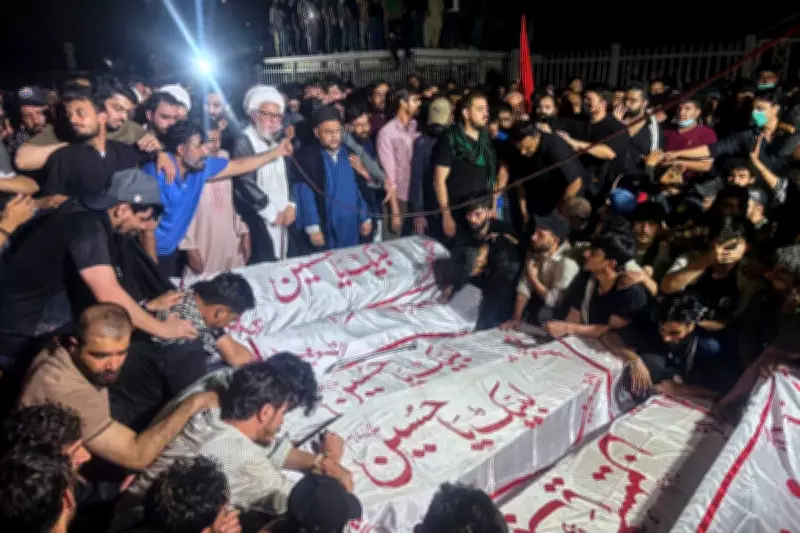
Pakistani authorities have deployed military forces and imposed a strict three-day curfew across northern regions following deadly protests that erupted in response to US-Israeli strikes on Iran. The violent demonstrations, which began on Sunday, resulted in multiple fatalities and widespread destruction of property, including attacks on United Nations facilities.
Northern Cities Under Lockdown
Before dawn on Monday, officials implemented a curfew in the northern cities of Gilgit and Skardu that will remain in effect until Wednesday. This drastic measure comes after several people were killed and tens more injured during violent protests triggered by the killing of Iran's Supreme Leader Ayatollah Ali Khamenei in coordinated US-Israeli military strikes.
Violence Against UN Facilities
Thousands of Shiite demonstrators targeted United Nations offices on Sunday, attacking the UN Military Observer Group (UNMOGIP) headquarters that monitors the ceasefire in the disputed Kashmir region. Protesters also stormed the UN Development Programme offices in Skardu city, causing significant damage to both facilities.

According to police reports from the Gilgit-Baltistan region, at least 12 people lost their lives and 80 others sustained injuries during the unrest. Demonstrators additionally burned down a police station and damaged a school building along with the offices of a local charity organization in Gilgit.
UN spokesman Stephane Dujarric confirmed on Monday that protesters became violent near the UNMOGIP Field Station, which was extensively vandalized during the attacks. "The safety and security of UN personnel and premises throughout the region remain our top priority, and we continue to closely monitor the situation closely," Dujarric stated.
Government Response and Security Measures
Shabir Mir, a government spokesman for Gilgit-Baltistan, announced on Monday that the situation was now under control but emphasized that the curfew would remain enforced until Wednesday as a precautionary measure. Police chief Akbar Nasir Khan urged all residents to stay indoors, citing "deteriorating law and order conditions" throughout the region.
Protests Spread to Major Cities
The unrest extended beyond northern territories to Pakistan's major urban centers. In the southern port city of Karachi, demonstrators stormed the US Consulate on Sunday, smashing windows and attempting to set the building ablaze. Police responded with batons, tear gas, and gunfire, resulting in 10 fatalities and more than 50 injuries.
Additional clashes occurred in the capital city of Islamabad, where one person was killed during an attempted Shiite march toward the US Embassy. The escalating violence prompted the US Embassy and its consulates in Karachi and Lahore to cancel all visa appointments and American Citizen Services on Monday, citing serious security concerns.
Pakistani authorities have significantly bolstered security at US diplomatic missions nationwide, including enhanced protection around the US consulate building in Peshawar, to prevent further outbreaks of violence.
Economic and Political Fallout
The Pakistan Stock Exchange experienced a dramatic plunge on Monday, with the benchmark KSE-100 Index falling nearly 10 percent amid rising geopolitical tensions following the attacks on Iran. Investors sold off shares across all major sectors, with financial analysts citing heightened uncertainty as the primary driver behind the sharp market decline.
Regional Tensions Escalate
Anger has been mounting throughout Pakistan, particularly among members of the Shiite minority community, following US and Israeli strikes on Iran that killed Khamenei and other senior Iranian officials. While Shiites constitute a minority nationwide, they form a majority population in several northern districts and in Khyber Pakhtunkhwa province bordering Afghanistan.
Sunday's violent protests occurred against a backdrop of ongoing cross-border fighting between Pakistan and Afghanistan, which began last Thursday after Afghanistan launched retaliatory attacks in response to Pakistani airstrikes the previous Sunday. Pakistan has since conducted repeated military operations along the volatile border region.

The combination of international tensions over Iran and regional conflicts with Afghanistan has created a perfect storm of instability in Pakistan, prompting the government to implement extraordinary security measures to restore order and prevent further loss of life.