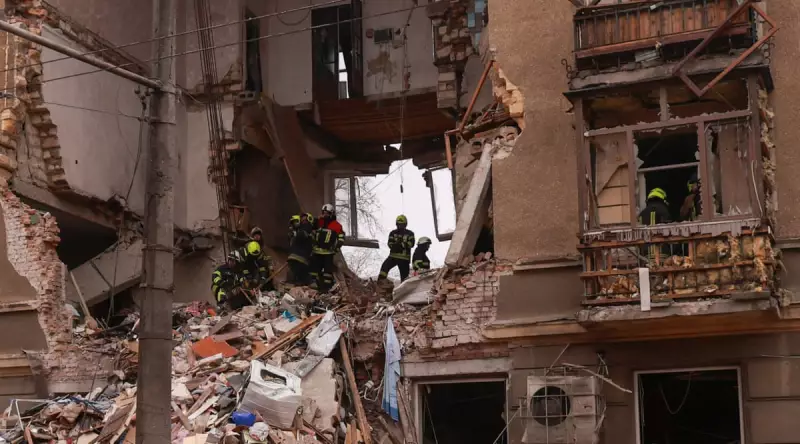
The chilling aftermath of a Russian drone assault on Odesa on 27 January reveals a city under sustained bombardment. Unable to approach Ukraine's primary port directly, Moscow has adopted a strategy of relentless long-range strikes using missiles and drones, transforming the historic Black Sea metropolis into a frontline of psychological and physical warfare.
A City Shaken by Relentless Strikes
Outside the Kadorr apartment complex, approximately 500 metres from Odesa's seafront, residents and emergency personnel gather in freezing conditions. A gaping hole marks where a Russian drone obliterated part of the 25th floor, with rubble and shattered glass hastily cleared below. Vehicles lie crushed beneath fallen masonry as property owners assess the devastation.
Anastasia, a 35-year-old resident displaced from Donetsk following Russia's eastern invasion, describes the terrifying moment of impact. "I was sleeping when the building shook violently. Initially, I believed it was merely a dream. Although I didn't hear the explosion itself, the deafening roar of another Russian Shahed drone followed. The situation had been relatively calm since my arrival, but recently the danger has become palpable. While I haven't decided whether to relocate, fear is my constant companion now."

Escalating Conflict in the Black Sea Theatre
Russian attacks against Odesa have intensified dramatically in recent months, reigniting Black Sea hostilities that had previously reached a stalemate. This escalation coincides with Ukrainian operations targeting Russian oil tankers in shadow fleets and strikes on the naval base at Novorossiysk. Vladimir Putin's longstanding claim to Ukraine's principal port, coupled with his December threat to sever the city's maritime access, underscores Odesa's strategic significance.
Capturing Odesa or imposing an effective naval blockade remains beyond Moscow's military capabilities, particularly after Ukrainian missile batteries destroyed key Russian warships like the Moskva early in the conflict. Consequently, Russia has resorted to pounding the urban centre from afar with coordinated missile and drone barrages.
Infrastructure Under Systematic Attack
The most devastating recent assault occurred on 13 December, when 160 drones and missiles targeted energy facilities, plunging extensive areas into darkness and cutting water supplies for days. This marked the beginning of near-daily attacks that have created persistent humanitarian challenges.
In his Odesa office, Ukrainian navy spokesperson Dmytro Pletenchuk displays a January calendar documenting the assault pattern. "Shahed. Shahed. Shahed... Only two days this month have been free from attacks," he states on 19 January, indicating 16 days of sustained rocket and missile strikes. "The Russians systematically target our energy infrastructure, believing the winter cold will force capitulation."
The Black Sea Chessboard
Pletenchuk characterises the current Black Sea situation as a strategic stalemate. "It resembles a chessboard where neither side can make decisive moves. While we've pushed Russian warships back to Novorossiysk, Russian aviation maintains control over substantial Black Sea airspace. This has created a vast grey zone spanning approximately 25,000 square kilometres."
This contested environment has fostered a long-range conflict where Ukraine pursues crucial Russian oil shipments while Moscow attempts to cripple Kyiv's economic lifeline: maritime agricultural exports. "The escalation began in autumn when Russia increased shelling frequency against Ukrainian ports," Pletenchuk explains.
Civilian Suffering and Psychological Warfare
Parallel to maritime targeting, Moscow has systematically attacked civilian energy infrastructure across Ukraine, including Odesa. Ukrainian officials assert this strategy aims to "disconnect" the nation from power grids, exacerbating civilian hardship during freezing winter months.

Odesa regional governor Oleh Kiper acknowledges the Black Sea's dual nature: "While it serves as a natural defensive barrier, unlike inland cities with layered air defences like Kyiv, the maritime approach creates vulnerabilities to long-range strikes from Crimea and missile launches." Describing the 13 December attack's aftermath, Kiper reveals: "At least 60% of the Odesa region lost electricity, with concurrent failures in water, heating, and supply systems. Depending on broader national circumstances, some districts now endure daily power outages lasting up to ten hours."
Preparing for Persistent Threats
Lt Col Denys Nosicov, heading southern territorial defence groups, outlines recent tactical developments: "The enemy has employed combined rocket and Shahed drone attacks over recent months, aiming to exert psychological pressure on Odesa's population and undermine morale. Daily drone assaults coincide with Russian psychological operations across social media platforms."
Ukrainian military leadership emphasises Odesa's continued strategic importance. Chief of staff Oleksandr Syrski recently noted Russian ambitions "to reach Odesa and completely sever our maritime access," while President Volodymyr Zelenskyy observed in January: "They deliberately target infrastructure to isolate Odesa and other cities, striking both people and the economy by diminishing export capabilities through maritime corridors."
Economic Lifeline Under Fire
With approximately 90% of Ukraine's agricultural exports traversing Odesa's ports, shipping routes have become active war zones. Military analyst Oleksandr Kovalenko summarises the paradox: "The Black Sea, which sustains our economy, simultaneously represents our vulnerability."
Nosicov confirms comprehensive defensive preparations: "We're establishing circular defences around Odesa with anti-tank obstacles, designated engagement areas, and minefields. We treat all Russian threats across land, sea, and air with equal seriousness, though I believe any Putin order to capture Odesa would precipitate Moscow's most significant regional defeat."
Educational Institutions in the Crosshairs
The human cost extends to educational facilities like the Lyceum for Construction and Architecture, where director Igor Chernenko supervises repairs after three Shahed drones struck in January. In his unheated, smoke-permeated office, Chernenko recalls: "The attack occurred around 2:40am on 13 January. Our night guard reported everything shaking. Upon arrival at 4am, the building remained ablaze."
Standing on a snow-covered second-floor roof where two drones penetrated, surrounded by shattered windows and shrapnel-damaged neighbouring structures, Chernenko reflects: "I cannot comprehend why Russians would target this place, unless they wish to prevent us from training workers who will rebuild Ukraine. Among our most devastating losses is the archive maintained since 1945. Previously, we experienced weekly attacks; now they occur nightly. Their actions reflect persistent Russian claims to what they consider a Black Sea pearl."
As freezing civilians endure the brunt of long-range assaults, Odesa's resilience faces its sternest test yet, with its strategic importance ensuring the bombardment continues unabated.