North Korean leader Kim Jong Un has announced that his nation will disclose comprehensive plans to enhance its nuclear weapons programme during the forthcoming ruling party congress. This declaration comes as the isolated state continues to demonstrate its military capabilities through a series of provocative weapons tests.
Recent Military Demonstrations and Strategic Intent
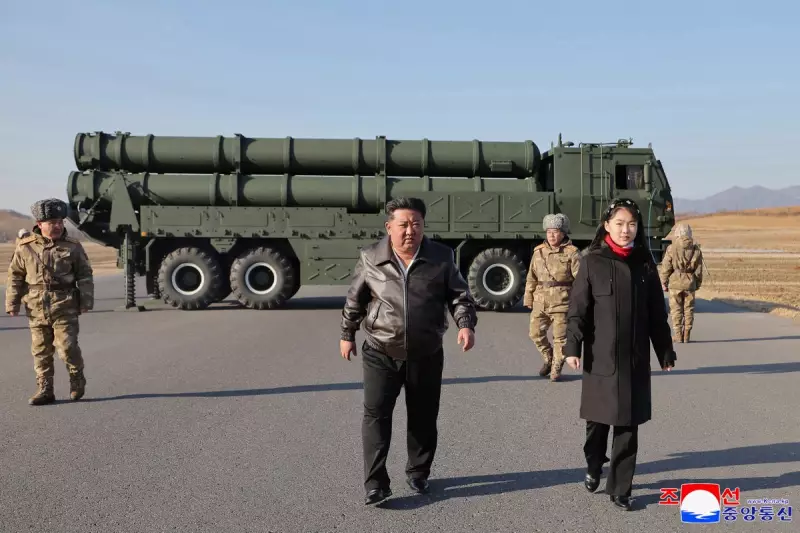
According to reports from state media, Kim Jong Un personally observed a live-fire drill of an upgraded large-caliber multiple rocket launcher system on Tuesday. The Korean Central News Agency (KCNA) stated that this exercise was designed to improve the effectiveness of North Korea's "strategic deterrent," a term widely understood to refer to its nuclear arsenal.
The agency emphasised that the mobility and strike accuracy of these launcher systems have been significantly enhanced. Military analysts note that North Korea's large-sized rocket launchers occupy a grey area between conventional artillery and ballistic missiles, as they can generate their own thrust and be guided during flight trajectories.

Upcoming Party Congress as Propaganda Platform
The Workers' Party congress, scheduled to commence in February, represents North Korea's first such gathering in five years. Kim Jong Un has positioned this event as a crucial platform to announce "next-stage plans for further bolstering up the country's nuclear war deterrent."
These congresses traditionally serve as major propaganda spectacles for the regime, establishing new political directives and economic priorities. The upcoming assembly is expected to follow this pattern while placing particular emphasis on military advancements.
Recent Testing Activities and Strategic Calculations
Since December, North Korea has conducted an intensive series of weapons tests, including what it describes as hypersonic missiles, long-range strategic cruise missiles, and new anti-aircraft systems. These demonstrations are widely interpreted as efforts to showcase military achievements ahead of the party congress.
Experts suggest that North Korea's testing programme serves multiple purposes:
- Validating technological advancements in weapons systems
- Demonstrating military readiness to domestic and international audiences
- Establishing bargaining positions for potential future negotiations
Technical Challenges and Strategic Ambitions
While KCNA has not detailed the specific nature of the forthcoming nuclear development plans, foreign analysts identify several technical hurdles North Korea must overcome. These include mastering multiple independently targetable reentry vehicle (MIRV) technology to defeat missile defence systems and developing warheads capable of surviving atmospheric reentry during intercontinental ballistic missile flights.
Kim Jong Un has consistently maintained that strengthening military capabilities represents an "invariable line" of Workers' Party policy. This principle appears to guide the regime's strategic planning despite international sanctions and diplomatic isolation.
Diplomatic Stalemate and Future Prospects
North Korea has maintained its refusal to engage in substantive negotiations with the United States and South Korea since the collapse of nuclear diplomacy between Kim Jong Un and former President Donald Trump in 2019. This diplomatic impasse persists despite occasional signals of potential openness to dialogue.
Regional analysts suggest that Kim Jong Un might consider returning to negotiations if offered substantial economic incentives and political concessions in exchange for limited denuclearisation measures. However, the regime's recent rhetoric and military activities indicate a continued prioritisation of weapons development over diplomatic engagement.
The presence of Kim's teenage daughter during the recent weapons test has attracted particular attention, with South Korea's intelligence service previously identifying her as a potential successor. Her continued public appearances alongside her father reinforce perceptions of dynastic continuity within North Korea's leadership structure.