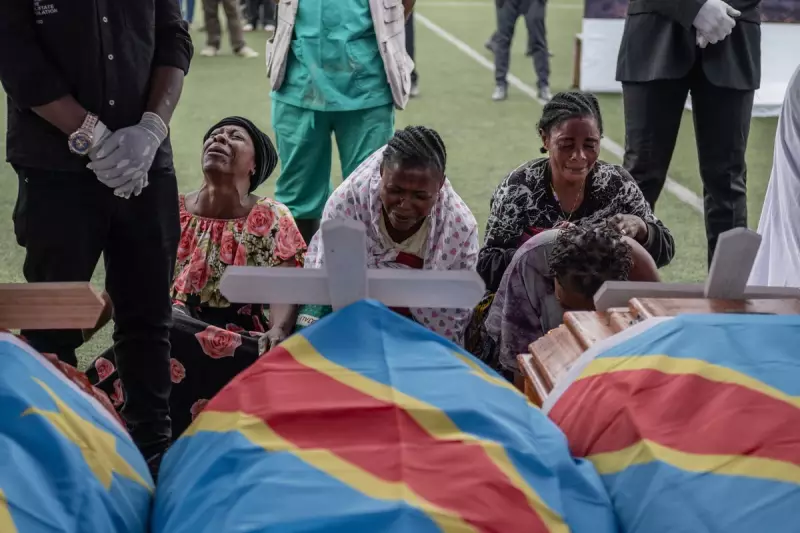
The Rwanda-backed M23 rebel group has conducted a highly public, symbolic funeral for 22 individuals it claims were killed in a drone strike earlier this month in the volatile eastern Democratic Republic of Congo.
A Staged Ceremony Amid Ongoing Conflict
The event took place on Thursday, 8 January 2026, at the Unity Stadium in Goma, the provincial capital of North Kivu. Officials from the M23's own administration were present, alongside religious representatives and hundreds of grieving family members. The coffins, containing bodies transferred from the Masisi territory the previous day, formed the centrepiece of a ceremony the Congolese government labelled as "the height of indecency and inhumanity".
The rebel group asserts the victims were all civilians, killed in a series of strikes using so-called kamikaze drones on 2 January. They allege the attack was carried out by the Armed Forces of the Democratic Republic of Congo (FARDC) and their allies. The Congolese military has not publicly commented on the specific incident.

Contested Narratives and Mounting Casualties
However, independent analysis casts doubt on the M23's account. Stewart Muhindo, a researcher from the Kinshasa-based Ebuteli centre, stated the figure of 22 civilian deaths was "greatly exaggerated". He suggested the actual number was likely under a dozen and that some coffins may have contained the bodies of combatants killed in clashes, a tactic intended to garner international sympathy.
Local medical reports confirm significant casualties. Théophile Kubuya Hangi, medical director of Masisi General Hospital, told the AP that the facility received 47 wounded. "Twenty-two people died from their injuries. Fourteen wounded are still hospitalised and receiving care," he said. Survivor Promesse Hagenimana described the moment of the explosion: "We threw ourselves to the ground. When I got up, my arm felt heavy. Next to me, a little boy was dead."
Emmanuel Ndizeye, administrator of Masisi territory, noted that not all victims could be evacuated, with some buried on site due to insecurity and poor road conditions.
Diplomatic Tensions and a Deepening Crisis
The staged funeral occurs against a backdrop of fragile negotiations between the M23 and the Congolese government, aimed at ending decades of instability. It also intensifies the war of words between Kinshasa and Kigali. Congolese government spokesperson Patrick Muyaya, in a post on X, directly blamed Rwanda, calling the ceremony a "fabricated narrative" that could not erase reality.
Erasto Musanga, appointed as North Kivu governor by the M23, retaliated by accusing Congolese President Félix Tshisekedi of being responsible for the violence and threatening legal action through the rebel group's own justice system.
The United Nations reports that the M23 has grown from a few hundred members in 2021 to approximately 6,500 fighters, with Rwanda consistently accused of backing the group by Congo, the U.S., and UN experts. The conflict in mineral-rich eastern Congo, involving over 100 armed groups, has displaced more than 7 million people, creating one of the world's most severe humanitarian emergencies. Despite a U.S.-brokered deal between the Congolese and Rwandan governments and ongoing talks, fighting continues to claim numerous civilian and military lives on multiple fronts.