Kushner's Ambitious Gaza Reconstruction Plan Faces Daunting Challenges
Jared Kushner, former President Donald Trump's son-in-law and Middle East adviser, has unveiled an ambitious vision for rebuilding Gaza that includes modern high-rise cities, tourist-friendly coastlines, and state-of-the-art port facilities. However, this optimistic blueprint faces substantial obstacles that cast doubt on its feasibility.
Visionary Presentation at Davos Forum
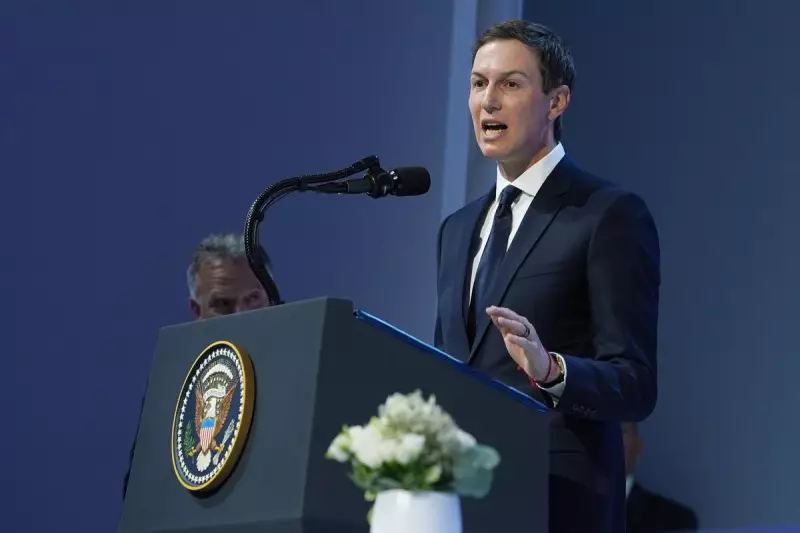
During a ten-minute presentation at the Davos economic forum in Switzerland, Kushner outlined his transformative vision for Gaza's future. He described potential developments featuring sleek urban landscapes with modern infrastructure that could theoretically be constructed within three years, drawing parallels with rapid construction projects elsewhere in the Middle East.
"In the Middle East, they build cities like this ... in three years," Kushner asserted during his Thursday address. "And so stuff like this is very doable, if we make it happen."

Reality on the Ground Presents Stark Contrast
The reality in Gaza presents a dramatically different picture from Kushner's vision. Following more than two years of conflict between Israel and Hamas, the territory lies in ruins with former apartment blocks reduced to hills of rubble. The United Nations Office for Project Services estimates Gaza contains over 60 million tons of debris - enough to fill nearly 3,000 container ships.
UN officials project that clearing this rubble alone would require more than seven years, with additional time needed for demining operations to address unexploded ordnance hidden throughout the wreckage. Meanwhile, sewage-contaminated water has created public health crises, and city streets have been transformed into dirt canyons.
Security Remains the Fundamental Challenge
Kushner acknowledged that his reconstruction plan depends entirely on establishing security in Gaza - a significant uncertainty given current conditions. Since the ceasefire took effect on October 10th, Israeli troops have killed at least 470 Palestinians in Gaza according to the territory's Health Ministry, including numerous civilians.
The disarmament of Hamas represents a particularly contentious issue. While Hamas officials have indicated willingness to consider "freezing" weapons as part of a process toward Palestinian statehood, they maintain their right to resist Israeli occupation. Additionally, competing armed groups in Gaza further complicate any disarmament efforts.
Political Obstacles and Israeli Opposition
Kushner's presentation suggested that the U.S.-backed Palestinian committee overseeing Gaza (NCAG) would eventually transfer control to a reformed Palestinian Authority. However, Israeli Prime Minister Benjamin Netanyahu has consistently opposed any postwar arrangement involving the Palestinian Authority in Gaza.
International conflict resolution expert Nomi Bar-Yaacov described the board's initial concept as "totally unrealistic," suggesting it reflects a real estate developer's perspective rather than a peacemaker's approach. She noted that Israel would likely oppose high-rise buildings that could provide surveillance opportunities near military installations.
Practical Implementation Questions Remain Unanswered
Kushner's presentation left several practical questions unaddressed, including how demining operations would proceed and where Gaza's approximately two million residents would live during reconstruction. Most families currently shelter in areas along Gaza's coastline that Kushner's plan designates for future tourism development.
The plan calls for eight residential areas interspersed with parks, agricultural land, and sports facilities, along with zones for "advanced manufacturing," data centers, and industrial complexes. Initial construction would focus on "workforce housing" in Rafah, a southern city devastated during recent conflicts.
Financial and Logistical Hurdles
Rebuilding Gaza represents an enormous financial undertaking, with joint estimates from the United Nations, European Union, and World Bank projecting costs of approximately $70 billion. Without security guarantees, attracting the necessary investment and stimulating job growth would prove extremely challenging.

Rights groups have noted that rubble clearance and demining activities have not yet begun in earnest in areas where most Palestinians live, as Israel has prevented the entry of heavy machinery needed for such operations.
As world leaders gathered to ratify the charter of the Board of Peace - the body overseeing ceasefire and reconstruction efforts - Kushner's vision highlighted both ambitious possibilities and the substantial obstacles that must be overcome for any meaningful reconstruction to occur.