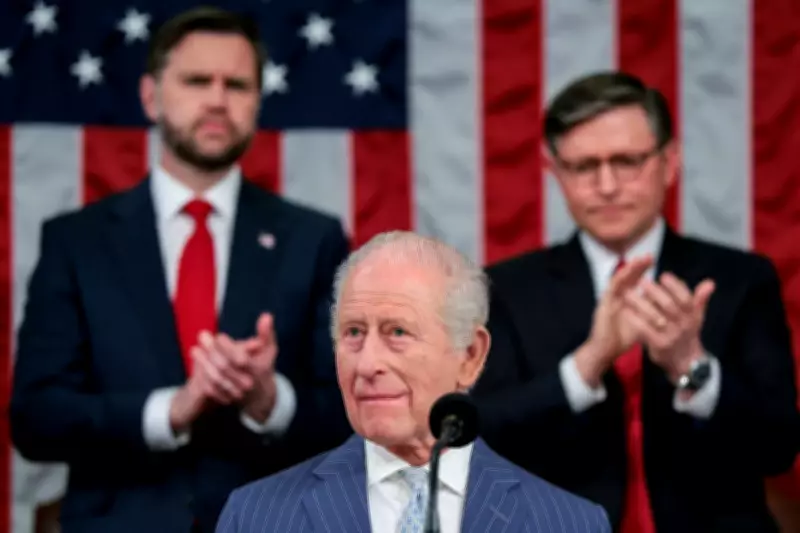
With eloquence and elan, King Charles's address to the US Congress was a masterclass in sending contrarian messages to President Donald Trump that few would dare deliver. Simon Walters highlights the key battlegrounds in the King's speech.
Huge Cheers as King Charles Hails Importance of Checks and Balances
It is one of the most difficult tasks in modern diplomacy: how do you meet Donald Trump in the US and come away with your dignity intact? The challenge has filled statesmen and women and other world leaders with fear ever since the humiliation of Ukraine's Volodymyr Zelensky in the White House last year. You are caught between a rock and a hard place: stand up to Trump in his own back yard and you risk his wrath; shower him with flattery and you look weak.
King Charles showed in his widely lauded address to the US Congress that, with a combination of eloquence and elan, it can be done. He managed to win 13 standing ovations while delivering a series of powerful messages to the US President that few others have dared to deliver in Washington. He did it by couching his message in such nuanced and sophisticated terms that even Trump and his volatile supporters could not take offence.

Scrutiny of the text of the King's address shows key sections were little short of an open rebuke to the US president on a wide range of topics from NATO to Ukraine, the abuse of power, and climate change. Here are the key points of the King's address decoded.
On NATO
What Trump has said: Trump has made repeated threats to withdraw from NATO, complaining it has failed to support him in the Iran War and does not pay enough towards its cost. He has insulted British troops, falsely claiming they avoided front line duty in Afghanistan.
What the King said: He reminded the President that, far from abandoning the US, the only time NATO's crucial Article 5 – which states an attack on one is an attack on all – has been invoked was in defence of America, after the 9/11 attacks. On that occasion, the UK and other NATO members fought alongside the US in Afghanistan, the King pointed out. "In the immediate aftermath of 9/11, when NATO invoked Article 5 for the first time, and the United Nations Security Council was united in the face of terror, we answered the call together – as our people have done so for more than a century, shoulder to shoulder, through two World Wars, the Cold War, Afghanistan and moments that have defined our shared security."
On Ukraine
What Trump has said: Following his shocking treatment of President Zelensky in the White House, Trump has repeatedly indicated he is not prepared to bankroll Ukraine's efforts to defeat the invasion by Russia and is seen as being more closely aligned to Russia's Vladimir Putin than Zelensky.
What the King said: The King invited President Zelensky to meet him in a show of sympathy after his White House ordeal. And in his address to Congress, he made a direct appeal to the US to side with Ukraine, not Russia, in the dispute. "Unyielding resolve is needed for the defence of Ukraine and her most courageous people – in order to secure a truly just and lasting peace… freedom is again under attack following Russia's invasion of Ukraine."
On Defence
What Trump has said: He has accused NATO members, Britain included, of spending far too little on defence.
What the King said: He stood up for Britain, saying the UK government had pledged to increase defence spending. "The UK recognises that the threats we face demand a transformation in British defence. That is why our country, in order to be fit for the future, has committed to the biggest sustained increase in defence spending since the Cold War... Our defence, intelligence and security ties are hardwired together through relationships measured not in years, but in decades. Today, thousands of US service personnel, defence officials and their families are stationed in the United Kingdom, as British personnel serve with equal pride across 30 American states."
On Climate Change
What Trump has said: He has suggested climate change is a hoax, and takes a "Drill, baby, drill" approach to exploiting oil reserves.

What the King said: He is a lifelong campaigner for a whole variety of ecological causes. "As we look toward the next 250 years, we must also reflect on our shared responsibility to safeguard nature, our most precious and irreplaceable asset. Millennia before our nations existed, before any border was drawn, the mountains of Scotland and Appalachia were one; a single, continuous range, forged in the ancient collision of continents. The natural wonders of the United States of America are indeed a unique asset… Yet even as we celebrate the beauty that surrounds us, our generation must decide how to address the collapse of critical natural systems, which threatens far more than the harmony and essential diversity of nature. We ignore at our peril the fact that these natural systems – in other words, nature's own economy – provide the foundation for our prosperity and our national security."
On Religion
What Trump has said: He and Vice President JD Vance have claimed the UK and other countries have done too little to curb the influence of Islam and Muslim immigrants on European culture. Trump threatened to return Iran, one of the most populous Muslim nations, "back to the stone ages" after declaring war on it.
What the King said: Notwithstanding the fact that he is head of the Church of England, the King stressed his support for "interfaith dialogue" and greater understanding between different religions and communities in the search for world peace. "For many here – and for myself – the Christian faith is a firm anchor and daily inspiration that guides us not only personally, but together as members of our community. Having devoted a large part of my life to interfaith relationships and greater understanding, it is that faith in the triumph of light over darkness which I have found confirmed countless times. Through it, I am inspired by the profound respect that develops as people of different faiths grow in their understanding of each other. It is why it is my hope – my prayer – that, in these turbulent times, working together and with our international partners, we can stem the beating of ploughshares into swords."
On Australia
What Trump has said: Australia has provoked Trump's anger by refusing to respond to his request for it to join the naval coalition to protect shipping in the Gulf endangered by the Iran war.
What the King said: As well as being Australia's head of state, he has had great affection for the nation ever since studying there in his youth. He defended Australia's record in the 'AUKUS' defence alliance made up of the UK, US and Australia. "We have agreed the most ambitious submarine programme in history – AUKUS – in partnership with Australia, a country of which I am also immensely proud to serve as sovereign."
On Tariffs
What Trump has said: He has not spared Britain from his frequent use of the threat of trade tariffs as a weapon to curb imports to the US and as leverage in wider diplomatic disputes.
What the King said: He went out of his way to underline why a good trading relationship with the UK was in the best interests of America as well as future generations of Britons. "More broadly, we celebrate the $430bn in annual trade that continues to grow; the $1.7tn in mutual investment that fuels that innovation; and the millions of jobs on both sides of the Atlantic supported across both economies. These are strong foundations on which to continue to build for generations yet unborn."
On Abuse of Power
What Trump has said: He has been accused of attempting to rule by diktat and bypassing customary checks on presidential powers.
What the King said: He served a reminder that US and UK laws had shared origins. "Our Declaration of Rights of 1689 was not only the foundation of our constitutional monarchy but also provided the source of so many of the principles reiterated – often verbatim – in the American Bill of Rights of 1791. And those roots go even further back in our history: the US Supreme Court Historical Society has calculated that Magna Carta is cited in at least 160 Supreme Court cases since 1789, not least as the foundation of the principle that executive power is subject to checks and balances."