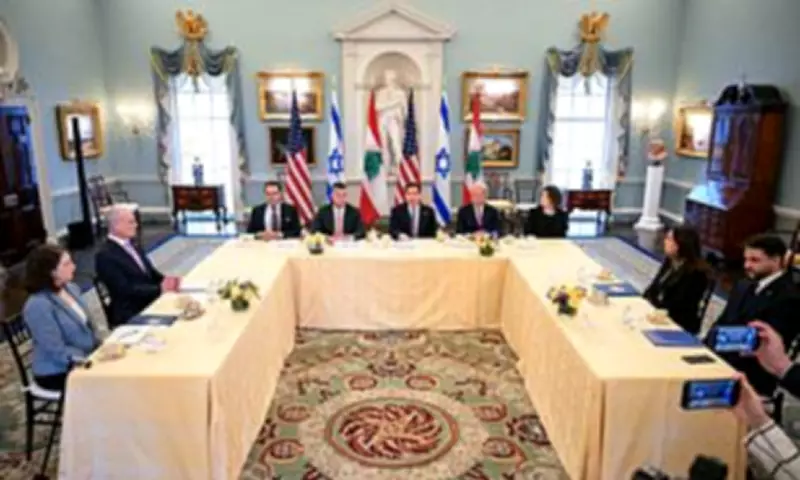
Historic Diplomatic Breakthrough as Israel and Lebanon Hold Direct Talks
In a landmark diplomatic development, Israel and Lebanon convened their first direct negotiations in more than thirty years on Tuesday. The historic summit, hosted by US Secretary of State Marco Rubio in Washington, was hailed by Israeli officials as a significant step toward regional stability.
A 'Victory for Sanity' Amidst Ongoing Tensions
Following the two-and-a-half-hour meeting, Israel's ambassador to the United States, Yechiel Leiter, described the discussions as a profound achievement. 'We discovered today that we're on the same side of the equation, and that's the most positive thing we could have come away with,' Leiter stated. He emphasised that the talks centred on establishing a 'clearly delineated border' between the two nations, while firmly asserting that the security of Israeli civilians remains non-negotiable. 'This was a victory for sanity, for responsibility and for peace,' Leiter proclaimed, underscoring the symbolic importance of the dialogue.
Lebanon's Stance and Humanitarian Concerns
Lebanon's ambassador, Nada Hamadeh Moawad, characterised the talks as 'productive', reflecting a cautious optimism from the Lebanese side. The discussions aimed not only at border issues but also at addressing the severe humanitarian crisis in Lebanon, exacerbated by recent conflicts. Lebanese President Joseph Aoun expressed hope that this dialogue signals 'the beginning of the end of the suffering of the Lebanese people in general, and those in the south in particular.' He stressed that lasting stability requires the Lebanese army to redeploy to the internationally recognised border, ensuring sole responsibility for security without external interference.

US Mediation and Broader Regional Dynamics
The United States played a pivotal role in facilitating these talks, with State Department spokesman Tommy Pigott confirming that all parties agreed to launch direct negotiations at a mutually agreed time and venue. 'The participants held productive discussions on steps toward launching direct negotiations between Israel and Lebanon,' Pigott noted. However, the US also reiterated its support for 'Israel's right to defend itself' against attacks from Hezbollah, highlighting the complex security landscape.
Secretary of State Marco Rubio acknowledged the challenges ahead, describing the talks as a 'process' but one worth pursuing. 'It's a historic gathering that we hope to build on,' he remarked, indicating a commitment to sustained diplomatic engagement.
Hezbollah's Defiance and Iranian Involvement
Despite the diplomatic progress, significant obstacles remain. The capacity of Lebanon's government to counter Hezbollah is limited, and the militant group has openly rejected any agreements made in Washington. Wafiq Safa, a senior member of Hezbollah's political council, told the BBC, 'We are not bound by what they agreed to,' underscoring the group's autonomous stance. Meanwhile, Iranian negotiators in separate discussions in Islamabad insisted on including Lebanon in any ceasefire agreements, a position opposed by both the US and Israel.
Historical Context and Future Prospects
These talks mark the first direct engagement between Israel and Lebanon since 1993, occurring against a backdrop of ongoing violence, including recent Israeli strikes in southern Lebanon. The discussions were organised a month prior, independent of the US-Iran talks, according to a US State Department official. As both nations navigate these delicate negotiations, the focus remains on achieving a sustainable ceasefire and addressing humanitarian needs, with the hope that this historic dialogue can pave the way for lasting peace in the region.