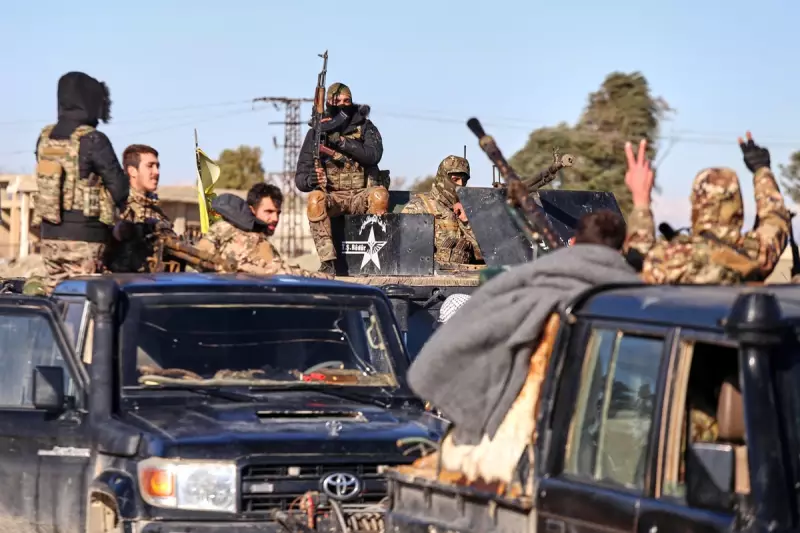
The relocation of thousands of Islamic State group prisoners from detention centres in northeast Syria to Iraq has commenced, following a formal request from Baghdad officials. This significant security operation has garnered support from both the US-led coalition and the Syrian government, marking a pivotal development in regional counter-terrorism efforts.
Massive Prisoner Transfer Underway
The US military confirmed on Wednesday that it had initiated the transfer of approximately 9,000 IS detainees currently held across more than a dozen facilities in northeast Syria. These detention centres are controlled by the Kurdish-led Syrian Democratic Forces (SDF), who have played a crucial role in combating the terrorist organisation.
The initial phase involved moving 150 IS members from Syria's northeastern province of Hassakeh to secure locations in Iraq. Military officials indicate that up to 7,000 detainees could eventually be transferred to Iraqi-controlled facilities, representing one of the largest prisoner relocations since the territorial defeat of ISIS.

Iraqi Initiative Driven by Security Concerns
An Iraqi security official confirmed that the decision to transfer the prisoners was an Iraqi initiative, motivated by pressing national security interests rather than leaving detainees in increasingly unstable Syrian facilities. This sentiment was echoed by a senior US military official, who revealed that Iraq had "offered proactively" to accept the prisoners.
Both officials spoke anonymously as they were not authorised to comment publicly on the sensitive operation. Their statements highlight Baghdad's growing apprehension about instability along the Iraqi border, where escaped detainees could pose a direct threat to Iraq's security.
Escalating Instability in Northeast Syria
This substantial relocation effort unfolds against a backdrop of mounting instability in northeast Syria. Syrian government forces recently assumed control of the sprawling al-Hol camp from the SDF as part of a ceasefire agreement. The camp houses thousands of mostly women and children associated with IS fighters.
The chaos has extended to prison facilities, with state media reporting that troops seized a detention centre in the northeastern town of Shaddadeh on Monday. During this operation, some IS detainees managed to escape before being recaptured, illustrating the precarious security situation.
Prison Sieges and Negotiations
Tensions escalated further when the SDF reported on Thursday that government forces shelled al-Aqtan prison near the northern city of Raqqa with heavy weapons. Simultaneously, they imposed a siege around the facility with tanks and deployed additional fighters.
Al-Aqtan prison, which holds numerous IS prisoners, had been surrounded by government forces earlier in the week. Negotiations regarding the facility's future remain ongoing, highlighting the complex power dynamics in the region.
Persistent ISIS Threat
The prisoner transfers underscore the persistent threat posed by the Islamic State group. Despite being militarily defeated in Iraq in 2017 and Syria two years later, the organisation continues to operate through sleeper cells that carry out deadly attacks in both countries.
The SDF has previously handed over foreign fighters, including French citizens, to Iraqi authorities for trial and sentencing. While the SDF still manages over a dozen detention facilities, these are slated for handover to government control under an ongoing peace process. This process also envisions the eventual integration of the SDF into government forces.
As the transfer operation progresses, regional security officials remain vigilant about the potential for escaped detainees to regroup and launch new attacks. The coordinated effort between Iraqi, Syrian, and coalition forces represents a critical attempt to address this enduring security challenge while navigating the complex political landscape of post-conflict Syria.