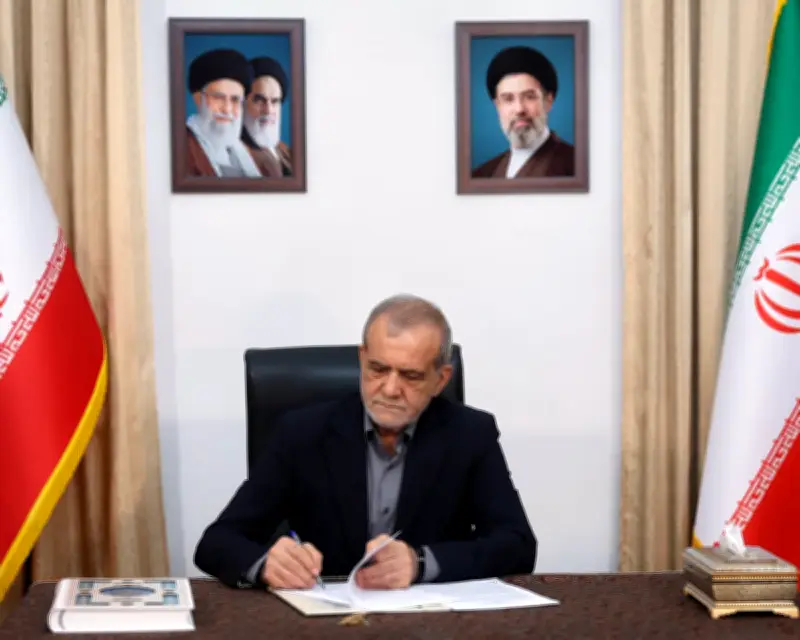
Iran's president, Masoud Pezeshkian, signed a memorandum of understanding with the United States aimed at ending the war, marking a pivotal moment for the nation's future. The precise ideological lessons drawn from the 110-day conflict may determine whether negotiations culminate in a verifiable nuclear agreement, potentially reshaping the Middle East.
The Interregnum and Leadership Dynamics
The invisibility of Iran's injured supreme leader, Mojtaba Khamenei, has created an interregnum. Khamenei published a letter opposing the deal in principle but deferred to Pezeshkian after receiving assurances. He emphasized protecting the country's rights and the axis of resistance, positioning himself to avoid blame if negotiations fail.
Donald Trump accused the Iranian leadership of being dishonorable, aligning with CIA Director John Ratcliffe's warning that a gap exists between public and private positions. Intelligence suggests Iran may stall on a nuclear agreement or secretly assemble a weapon, as the Strait of Hormuz becomes a wasting asset.
Strategic Lessons from the War
Few Iranians deny the Strait of Hormuz proved the US can no longer impose global order unilaterally. Hardline editor Payam Fazlinejad stated, "Geography sometimes takes revenge on technology; Iran possesses greater deterrent power than a nuclear weapon." He urged breaking the cycle of war and protests, emphasizing the public's desire for normality.
Trump, at the G7 summit, described Iran's leaders as "the most rational group we have ever dealt with," embracing their pragmatism. His team claims unprecedented access to senior Tehran figures since the 1979 revolution.
Internal Battles Over the Deal
The hardline Paydari Front, linked to former negotiator Saeed Jalili, denounced the deal as a catastrophe. Critics accuse state broadcaster Irib of suppressing diverse opinion, similar to Fox News. The internal struggle mirrors the 2015 nuclear deal, where chief negotiator Javad Zarif faced vitriol for dealing with the "Great Satan."
Trump's 2018 withdrawal from the deal undermined advocates of opening to the West. Currently, his inability to control Israel in Lebanon weakens negotiations in Tehran. Despite Khamenei's intervention, hardliners retreated, with Mohammad Bagher Ghalibaf emerging as a key beneficiary. Ghalibaf suggested a vote on the deal at the supreme national security council, with only one dissenter, likely Jalili.
Future Governance and Economic Focus
Early clues indicate the new leadership will be more authoritarian, pro-China, and willing to heed IRGC advice. Preparations for Ali Khamenei's funeral suggest no shift toward secularism. On the nuclear front, a deal is possible, but verification roles and UN inspection regimes remain untested.
Ghalibaf emphasized shifting focus to inflation and currency markets, stating, "The criterion of success is shifting from repelling external threats to improving the economy." He advocates a balanced approach between East and West, especially with China, as few countries progress without Chinese investments.
However, US sanctions since 2018 have made Chinese investment in Iran nearly impossible. Iranians who hoped for Trump's "help is on its way" feel abandoned. One citizen said, "No one is happy with the deal. We did not want a Xi, or an Iranian Putin."