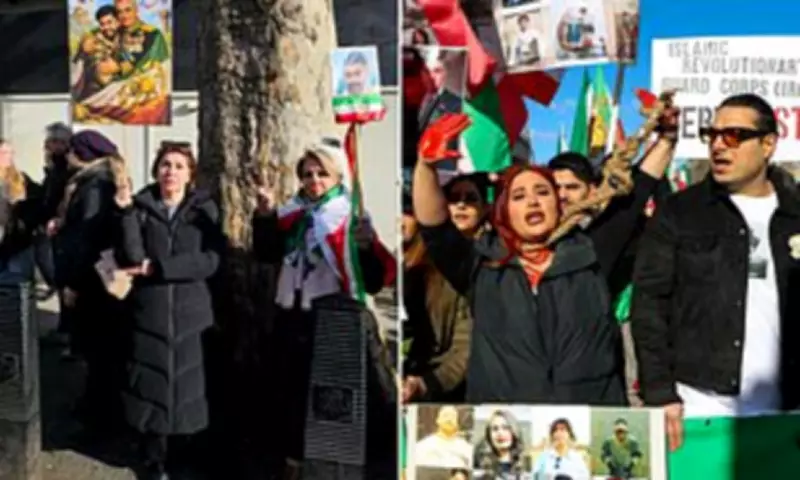
Grieving relatives of a young man killed during Iran's violent crackdown on protesters joined thousands marching through central London on Saturday, demanding the overthrow of the Islamic regime. The demonstration coincided with a call from Reza Pahlavi, son of Iran's last shah, urging the United States to help "bury" the Tehran government.
Family Tragedy Fuels Protest
Mehdi Hosseini was just 28 years old when he was killed while trying to transport a wounded friend to hospital during the protests. His family revealed the heartbreaking details as they joined the London march, carrying signs bearing his image alongside that of Pahlavi.
"He was fighting for freedom and democracy against the terrorist regime," said his aunt Farah, who withheld her full name out of fear for relatives still living in Iran. She described how they had been caught up in the deadly repression enacted by Iranian forces against demonstrators who have taken to the streets in unprecedented numbers since January.

London Demonstration Draws Thousands
The London protest saw demonstrators gather at Whitehall before marching to the Iranian embassy. Many carried Union Jacks, Israeli flags, and the Shahist flag of Iran featuring a lion holding a sword. The crowd sang "God Save The King" and chanted "Long Live Reza Pahlavi," expressing support for the exiled heir to Iran's former monarchy.
Farah declared her support for the return of the Shah, stating: "We have been a monarchy for 2,000 years. Reza Pahlavi is the legal ruler of Iran. It's not only us we are fighting for. We are fighting to make the whole world safe."
Human Rights Catastrophe
Another family member, Parvaneh, highlighted the devastating human cost of the crackdown. "There have been lots of young people killed by the IRGC. They're only 14, 15, or 16, it's been horrible," she said, referring to Iran's Islamic Revolutionary Guard Corps.
According to the US-based Human Rights Activists News Agency, at least 7,008 people, mostly protesters, have been killed in the crackdown, though rights groups warn the actual toll is likely far higher. More than 53,000 people have been arrested in connection with the protests.
Pahlavi's Call to Action
Reza Pahlavi, who has not returned to Iran since before the 1979 Islamic revolution that ousted his father, spoke to reporters at the Munich Security Conference, declaring it was "time to end the Islamic republic." Outside the conference, approximately 200,000 of his supporters thronged the streets, calling on world leaders to increase pressure against Tehran.
"The Iranian regime is a dead regime," said Said, a 62-year-old protester originally from Iran. "It must be game over."
Pahlavi has urged Iranians both at home and abroad to continue demonstrations against the authorities, calling on them to chant slogans from their homes and rooftops to coincide with protests taking place outside the country.
International Response
The protests come as Washington continues diplomatic engagement with Tehran, with Switzerland confirming that mediator Oman would host a fresh round of talks in Geneva next week. Representatives of Iran and the United States, who have had no diplomatic relations since shortly after the 1979 revolution, held discussions on Iran's nuclear programme last week in Oman.
Former US President Donald Trump had said on Friday that a change of government in Iran would be the "best thing that could happen," as he sent a second aircraft carrier to the Middle East to increase military pressure on Tehran. Trump had earlier threatened military intervention to support the wave of street protests that peaked in January.
Regime Crackdown Continues
Despite the ongoing repression, videos verified by AFP show people in Iran continuing to chant anti-government slogans even as the clerical leadership celebrated the anniversary of the Islamic revolution. Iranian authorities have claimed the protests were hijacked by "terrorists" fueled by their sworn enemies Israel and the United States.

Many protest chants have called for the monarchy's return, and Pahlavi, now 65, has stated he is ready to lead a democratic transition. However, the Iranian opposition remains divided, with Pahlavi facing criticism for his support for Israel, including a highly publicised visit in 2023 that fractured attempts to unify opposition camps.
Trump declined to specify who he would want to succeed Supreme Leader Ayatollah Ali Khamenei, but added that "there are people" who could lead Iran. As the protests continue both inside Iran and among the diaspora abroad, the calls for regime change grow louder, with grieving families like Hosseini's demanding justice and freedom for their homeland.