Iran Temporarily Closes Strait of Hormuz for Military Exercises
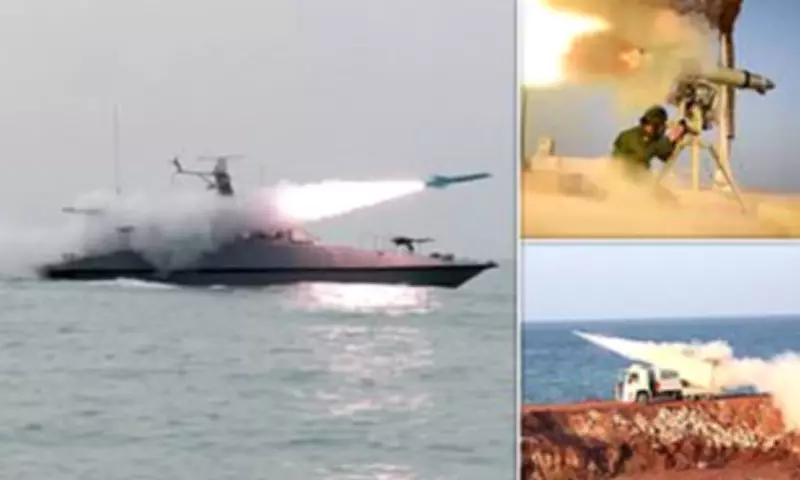
Iran has enacted a temporary closure of sections of the strategically vital Strait of Hormuz to conduct a live-fire military drill. This action coincides with a significant build-up of US military forces in the Arabian Sea, serving as a stark warning to the international community should former US President Donald Trump order an attack on Iranian interests.
A Rare and Significant Closure
The shutdown, described by analysts as rare and potentially unprecedented in recent decades, involves live-fire exercises reported by Iranian state media. The Strait of Hormuz is a critical maritime chokepoint, facilitating the passage of approximately 20 percent of the world's oil supply. Tehran's move is widely interpreted as a signal of the severe economic fallout that could ensue if the United States follows through on threats of military action as bilateral tensions escalate.
While Iran has previously harassed shipping in the strait during periods of conflict, such as the 1980s Iran-Iraq war, it has not executed a full closure since that era. This holds true even during last year's intense 12-day conflict when Israeli and US forces targeted Iranian nuclear and military sites. The precise duration and operational impact of Tuesday's closure remain unclear, with Iranian outlets citing a closure of several hours for 'safety and maritime concerns'.

Historical Context and Modern Importance
The Strait of Hormuz is a narrow, bending waterway, roughly 21 miles wide at its most constricted point. It connects the Persian Gulf to the Gulf of Oman, providing access to global shipping lanes. Although Iran and Oman hold territorial waters within the strait, it is internationally recognized as a passage for all vessels.
- Historically, it was a key route for trade in ceramics, ivory, silk, and textiles from China.
- Today, it is the primary conduit for supertankers carrying oil and gas from major producers including Saudi Arabia, Kuwait, Iraq, Qatar, Bahrain, the UAE, and Iran itself.
- The vast majority of this energy exports flows to Asian markets, with China being Iran's primary remaining oil customer.
While alternative pipelines exist in Saudi Arabia and the UAE, the US Energy Information Administration notes that 'most volumes that transit the strait have no alternative means of exiting the region.' Past threats to this route have triggered immediate spikes in global energy prices.
Escalating Tensions and Military Posturing
The current drill, dubbed 'Smart Control of the Strait of Hormuz,' follows a period of heightened friction. In early February, amid massive anti-government protests in Iran and US threats, Iran conducted a similar live-fire exercise, warning ships but not closing the passage. Tensions escalated further on February 4th when a US Navy fighter jet shot down an Iranian drone approaching the aircraft carrier USS Abraham Lincoln in the Arabian Sea. Iran also reportedly harassed a US-flagged merchant vessel in the strait.
The US military's Central Command (CENTCOM), which oversees naval forces in the region including the Bahrain-based 5th Fleet, has previously stated Iran has a 'right to operate professionally in international airspace and waters.' However, it has issued stern warnings against any interference or threatening behaviour toward American warships or commercial vessels, vowing not to tolerate actions like pointing weapons or getting dangerously close.
Broader Strategic Standoff
These manoeuvres occur against a backdrop of intensifying US-Iran hostilities. President Trump initially threatened military strikes following Iran's crackdown on protests, later shifting to using the threat of attack as leverage in nuclear negotiations. A new round of indirect nuclear talks was held in Geneva on Tuesday.
The US has significantly bolstered its military presence in the region. The USS Abraham Lincoln carrier strike group has been stationed in the Arabian Sea for weeks, positioned to launch strikes if ordered. Trump recently announced the deployment of the world's largest aircraft carrier, the USS Gerald R. Ford, from the Caribbean to join this build-up.

In response, Iran has warned of potential preemptive strikes against US interests across the Middle East and Israel. On Tuesday, Supreme Leader Ayatollah Ali Khamenei issued a stark warning, stating, 'the strongest army in the world might sometimes receive such a slap that it cannot get back on its feet.' He emphasized that while a warship is dangerous, 'more dangerous is the weapon that can sink the warship into the depths of the sea.' Iran maintains a substantial arsenal of short- and medium-range missiles capable of targeting neighbouring Gulf states.
The temporary closure of the Strait of Hormuz underscores the fragile and volatile state of affairs in the region, with any miscalculation carrying profound risks for global energy security and geopolitical stability.