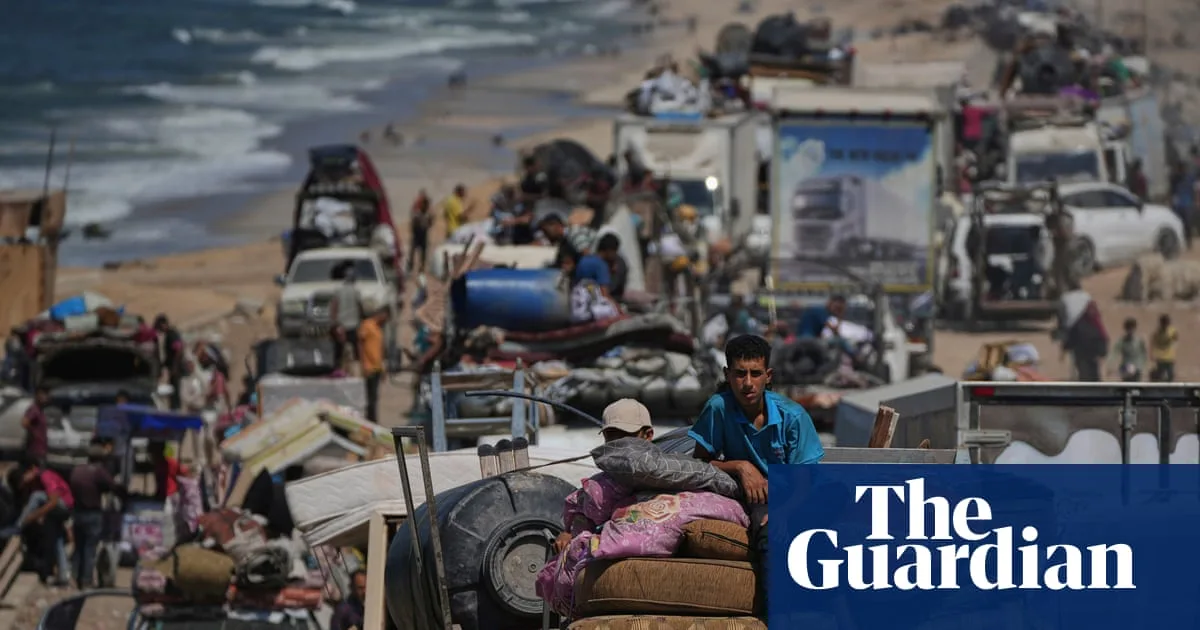
More than a quarter of a million people have been displaced from Gaza City in the last month, according to UN figures, as a new Israeli offensive forces tens of thousands to flee makeshift homes and shelters daily. Israeli artillery, tanks, and warplanes struck Gaza City again on Thursday, with a UN official describing 'new waves of mass displacement' after about 60,000 fled in 72 hours earlier this week.
An unbroken column of traffic laden with household items and families packed Gaza's coastal road on Thursday, heading south towards areas designated by Israel. Transport prices have soared, forcing some to walk. 'We are heading to go sleep on the streets towards the beach, like this, barefoot … We don't know where to go,' said Yasser Saleh, standing on a trailer pulled by a car.
Israeli military officials said Gaza City was a 'Hamas stronghold' and estimated up to 450,000 civilians had left, based on drone surveillance and other sources. Israeli forces now control the city's eastern suburbs and have moved into Sheikh Radwan and Tel al-Hawa areas, positioning to advance on central and western districts where most remaining residents shelter.
Swathes of Gaza City, once a busy hub, have been reduced to ruins. Until weeks ago, over a million people lived there, many already displaced multiple times. On Wednesday, Israeli Finance Minister Bezalel Smotrich described Gaza as a 'real-estate bonanza', saying 'the demolition, the first stage in [Gaza City’s] renewal, we have already done. Now we just need to build.'
The Israeli military opened a second route out of Gaza City for two days to encourage the exodus. Shadi Jawad, 47, who fled via the route, said: 'The situation is indescribable – crowds everywhere, the sound of explosions, women and men crying and screaming as they walked while carrying their belongings.' The military has dropped leaflets urging people to flee to a 'humanitarian zone' in the south, but aid agencies say conditions there are dire, with insufficient food, medicine, and shelter.
Rosalia Bollen of Unicef said the designated area is 'a largely overcrowded stretch of dunes … inappropriate, unprepared and unsafe to host displaced families.' Much of northern Gaza is gripped by famine, according to experts. Hamas's armed wing warned of fierce fighting, while the Israeli military reported four soldiers killed by a roadside bomb in Rafah. Prime Minister Benjamin Netanyahu rejected advice from top generals not to launch the new offensive.