The ongoing diplomatic feud between former US President Donald Trump and French leader Emmanuel Macron has intensified dramatically following a series of provocative statements made at the World Economic Forum in Davos. In a striking development, the French presidency has publicly labelled Trump's latest accusations as "fake news," deploying a pointed social media response that underscores the deteriorating relationship between these two NATO allies.
France's Forceful Rebuttal on Social Media
Responding directly to claims made during Trump's Davos address, the official French presidency account on platform X issued a firm correction regarding assertions about pharmaceutical pricing. "It is being claimed that President @Emmanuel Macron increased the price of medicines," the statement read. "He does not set their prices. They are regulated by the social security system and have, in fact, remained stable. Anyone who has set foot in a French pharmacy knows this."
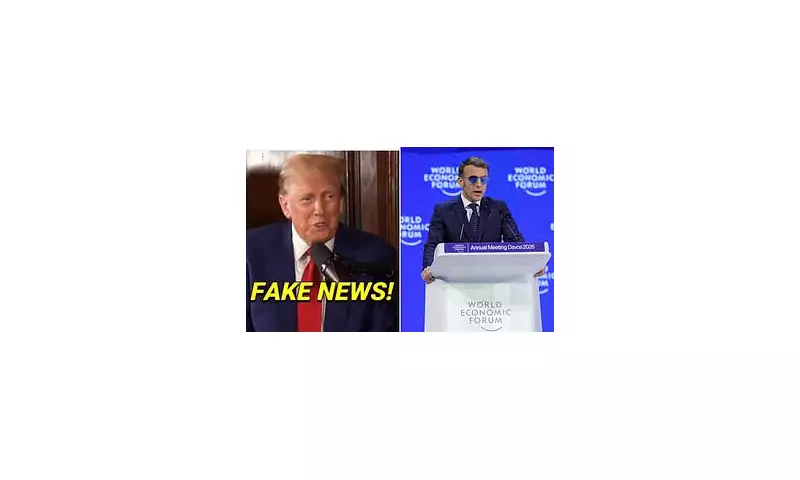
Accompanying this textual rebuttal was a particularly biting visual element: a GIF showing Trump himself mouthing the words "fake news" before a microphone, with the same phrase displayed prominently in text. This marked a significant escalation in tone from the French government, which has increasingly utilised its @frenchresponse account to challenge what it perceives as misinformation from the Trump administration.

Trump's Controversial Davos Performance
During his speech at the prestigious international gathering, Trump made several assertions that have drawn widespread criticism and disbelief. Most notably, he claimed to have pressured President Macron into raising domestic drug prices in France through the threat of substantial tariffs on French imports to the United States. According to Trump's account, he delivered an ultimatum to the French leader: "Here's the story, Emmanuel, the answer is, you're going to do it, you're going to do it fast. And if you don't, I'm putting a 25 per cent tariff on everything that you sell into the United States, and a 100 per cent tariff on your wines and champagnes."
Trump further claimed that Macron acquiesced immediately, responding: "No, no, Donald, I will do it, I will do it." The former US President boasted about the efficiency of his approach, stating it took him "on average three minutes a country, saying the same thing, 'You will do it'."
Personal Mockery and Trade Threats
Beyond the substantive policy claims, Trump's speech included elements of personal mockery directed at the French President. He imitated Macron's French accent and commented derisively on the sunglasses Macron wore during his own Davos address the previous day. "I watched him yesterday with those beautiful sunglasses," Trump remarked. "What the hell happened?" French officials had explained that Macron was concealing an eye injury caused by a burst blood vessel.
The trade threats extended beyond the drug price claims, with Trump suggesting he might impose 200 per cent tariffs on French wines and champagnes in an apparent effort to pressure Macron into joining his "Board of Peace" initiative focused on resolving global conflicts. When asked about Macron's initial reluctance to participate, Trump responded dismissively: "Well, nobody wants him because he's going to be out of office very soon."
Macron's Substantive Response and Broader Context
In his own address to the World Economic Forum, President Macron delivered a more measured but equally firm response to the underlying tensions. While not mentioning Trump by name, he warned that "we're shifting to a world without rules" where "international law is trampled underfoot, and the only law that matters is that of the strongest." The French leader emphasised his preference for "respect to bullies" and "rule of law to brutality" – clear references to the tariff threats emanating from Washington.

Macron took a notably harder line than many European Union counterparts regarding Trump's previously stated ambition to acquire Greenland from Denmark. He urged the EU to consider deploying its most potent trade tools against Washington, specifically mentioning the Anti-Coercion Instrument (ACI) – sometimes called the "trade bazooka" – which could theoretically impose approximately £81 billion in tariffs on US goods. "The crazy thing is that we could find ourselves in a situation where we use the anti-coercion mechanism for the very first time against the United States," Macron observed.
A Surprising Reversal on Greenland
In a dramatic development following his contentious speech, Trump announced a significant policy reversal regarding Greenland. After what he described as a "very productive" meeting with NATO Secretary General Mark Rutte, the former President declared he would not impose the tariffs scheduled for February 1st on European countries that opposed his Greenland acquisition plan. Instead, he announced a "framework of a future deal" concerning Greenland and "the entire Arctic Region."
This represented a substantial climbdown from Trump's previous insistence that he wanted to obtain the island "including right, title and ownership." Danish Prime Minister Mette Frederiksen welcomed the shift, noting that Arctic security concerns all NATO members and that discussions between the US President and NATO leadership were "good and natural."
NATO Tensions and Historical Corrections
The diplomatic friction extended beyond Franco-American relations to encompass broader NATO alliances. During his Davos remarks, Trump expressed doubt about whether European allies would support the United States in a conflict, stating: "I know them all very well. I'm not sure that they'd be there. I know we'd be there for them. I don't know that they would be there for us."
This assertion prompted a pointed correction from NATO Secretary General Rutte, who reminded Trump of the substantial sacrifices made by European nations during the Afghanistan conflict. "There's one thing I heard you say yesterday and today," Rutte responded. "You were not absolutely sure Europeans would come to the rescue of the US if you will be attacked. Let me tell you, they will and they did in Afghanistan."
The NATO chief provided specific context, noting that "for every two Americans who paid the ultimate price, there was one soldier from another NATO country who did not come back to his family – from the Netherlands, from Denmark and particularly from other countries." This reality check highlighted the sometimes overlooked contributions of European allies to shared security objectives.
Text Message Diplomacy Revealed
Adding another layer to the complex relationship between the two leaders, Trump revealed a private text message exchange with Macron during the diplomatic tensions. The French President's message attempted to find common ground while expressing confusion about certain US positions. "My friend, we are totally in line on Syria. We can do great things on Iran," Macron wrote. "I do not understand what you are doing on Greenland. Let us try to build great things."
This glimpse into their private communications revealed both the personal dimension of their relationship and the substantive policy disagreements that have characterised their interactions. The public airing of such private correspondence further complicated an already strained diplomatic dynamic between two of the Western world's most prominent leaders.
The escalating war of words between Trump and Macron reflects broader tensions in transatlantic relations, with trade policy, defence commitments, and personal diplomacy all contributing to a period of unusual public discord between traditional allies. As both leaders navigate domestic political challenges alongside international diplomacy, their contentious exchanges continue to shape perceptions of Western unity and the future of multilateral cooperation.