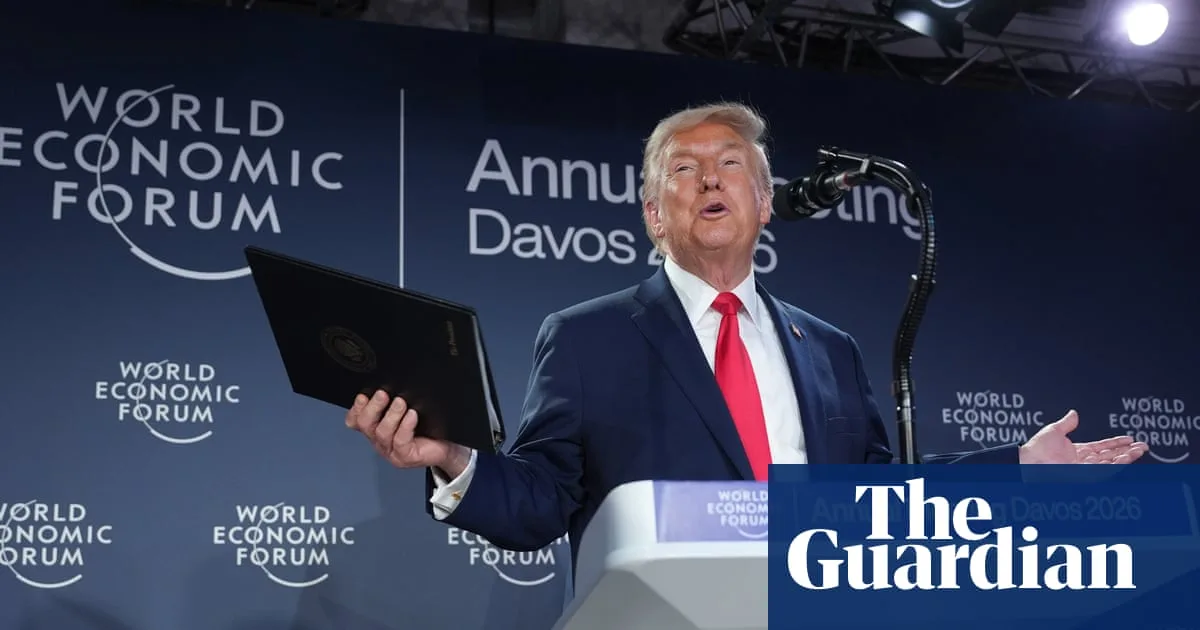
Fact-Checking Trump's Davos Speech: Claims on Greenland, Wars, Migration, and NATO
Fact-Checking Trump's Davos Speech Claims

During a lengthy address at the World Economic Forum in Davos yesterday, former US President Donald Trump delivered a speech that oscillated between focused policy points and what many observers described as incoherent rambling. The combative presentation covered a vast array of topics, with Trump making several bold and often outlandish claims that have since come under intense scrutiny.

Greenland and Historical Sovereignty

One of the more striking assertions involved Greenland. Trump stated, 'After the war we gave Greenland back. How stupid were we to do that? But we did it.' This claim requires careful historical examination.

Technically, the United States could not have 'handed back' Greenland to Denmark after the Second World War because it never held ownership or sovereignty over the island. Greenland has remained under Danish sovereignty since the early 18th century.

Wide Pickt banner — collaborative shopping lists app for Telegram, phone mockup with grocery list

Trump is partially correct in alluding to the period following Nazi Germany's occupation of mainland Denmark in 1940. In 1941, the US assumed responsibility for Greenland's defence through an agreement with the Danish ambassador to the US. At that time, America was officially neutral in the conflict and had rejected a British proposal to occupy the island.

Although the US established numerous military bases there, effectively making Greenland a de facto US protectorate for defence purposes, the land unequivocally remained Danish territory throughout.

VERDICT: FALSE

Claims of Diplomatic Achievements and Ceasefires

Trump boasted about his role in international diplomacy, asserting, 'I settled eight other wars.' The former president, who has often expressed disappointment at not receiving a Nobel Peace Prize, appears to be exaggerating his accomplishments, though the full historical assessment may evolve.

He was indeed involved in facilitating three ceasefires:

  • Between India and Pakistan
  • Between Armenia and Azerbaijan
  • Between Israel and Iran

Trump also played a key role in achieving a ceasefire between Israel and Hamas, though peace in that region remains fragile and far from 'settled.' Similarly, he contributed to resolving a long-standing dispute between Egypt and Ethiopia over a dam on the Nile, and a confrontation between Kosovo and Serbia.

However, other conflicts he claims to have ended – such as those between the Democratic Republic of Congo and Rwanda, and between Thailand and Cambodia – have since seen renewed violence. Some disputes, like one between Albania and Azerbaijan, never actually began in the first place.

VERDICT: PARTIALLY TRUE

US Migration Patterns and Economic Data

On domestic issues, Trump claimed, 'In 2025, for the first time in 50 years, the United States had reverse migration.' This statement has a basis in recent data, though the timeframe is slightly inaccurate.

The claim stems from a report published this month by the Washington-based think-tank, the Brookings Institution. It found that the number of people emigrating to the US compared to those leaving the country was close to zero or even negative last year.

Fact-checkers at the Poynter Institute note that the last time the US experienced this phenomenon, known as 'negative net migration,' was actually longer ago than Trump stated – during the Great Depression between 1931 and 1940.

VERDICT: TRUE

Wind Energy and China's Renewable Capacity

Trump repeated a familiar assertion about renewable energy, saying, 'China makes almost all of the windmills and yet I haven't been able to find any wind farms in China.' He insisted this month that China manufactures turbines to 'sell them to suckers like Europe, and suckers like the United States' but does not use them domestically.

In reality, while China still relies heavily on coal for energy, it possesses approximately 44 per cent of the world's wind farm capacity. This is the highest share of any country and nearly three times that of the United States.

VERDICT: FALSE

Pickt after-article banner — collaborative shopping lists app with family illustration

Cost of Living and Economic Indicators

Addressing the key battleground of American politics – the cost of living – Trump asserted, 'Grocery prices, energy prices, air fares, mortgage rates, rent and car payments are all coming down, and they're coming down fast.' The accuracy of this statement is mixed.

Mortgage rates have indeed decreased from around 7 per cent when Trump took office in January 2025 to a little over 6 per cent currently. Air fares and car prices have also fallen.

However, food and energy prices have risen overall. While items like eggs, milk, and bread may be cheaper, the costs of meat, fruit, and vegetables have increased. Consequently, grocery prices have roughly increased at the same rate as they did during the final year of the Biden administration, which was marked by significant inflation.

Energy is also significantly more expensive – nearly 7 per cent higher than a year ago – despite a recent decrease in petrol prices.

VERDICT: PARTLY TRUE

NATO and International Alliances

On foreign policy, Trump claimed, 'We've never gotten anything from NATO.' This statement overlooks critical historical events.

Ironically, the only time the NATO alliance has invoked Article 5 – which states that an attack on one member is an attack on all – was after the terror attacks on the United States on September 11, 2001.

NATO troops, including contingents from countries like Denmark, fought and died alongside US forces in Afghanistan. Following President Barack Obama's support for a 'surge' in the conflict, the number of non-US NATO troops in Afghanistan doubled to more than 132,000 by 2011.

VERDICT: FALSE

Trump's Davos speech presented a complex tapestry of assertions, blending factual inaccuracies with partially correct statements and occasional truths. As the political landscape evolves, such claims will likely remain a focal point for fact-checkers and public debate.




