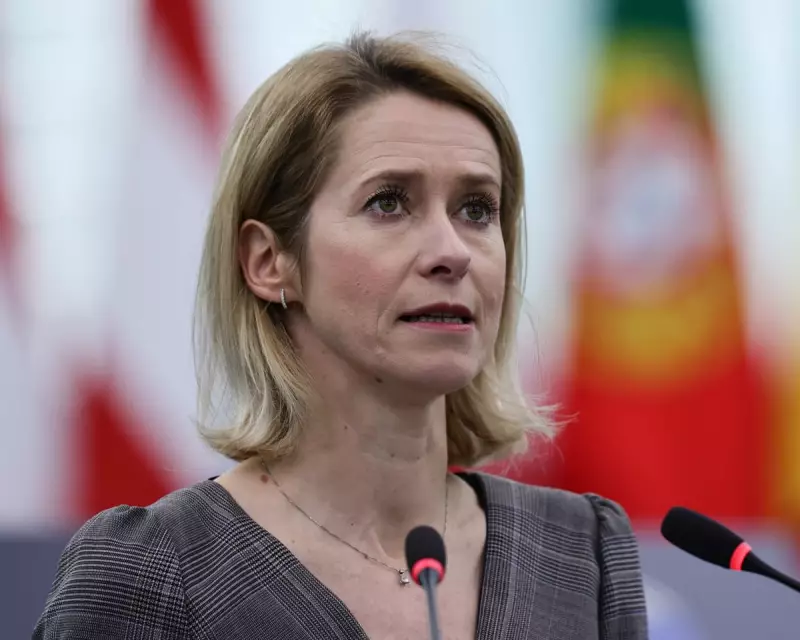
EU foreign policy chief Kaja Kallas has delivered a stark and sobering assessment of Europe's position in a rapidly changing global landscape, warning that the bloc must urgently adapt or face severe consequences.
A Bleak Picture of Global Instability
Speaking at the European Defence Agency's annual conference this morning, Kallas painted a grim picture of deepening crises and shifting geopolitical realities. "We need to prepare ourselves for the future," she stated. "Indeed, the crisis we face has deepened dramatically during the past year."
Her address highlighted the continuing devastating impact of Russia's aggression in Ukraine, alongside growing global uncertainty. Crucially, she emphasised the dramatically changing nature of EU-US relations, which have underpinned the transatlantic security system for over eight decades.

Europe No Longer Washington's Priority
In a particularly striking observation, Kallas warned that "Europe needs to adapt to new realities" as it is "no longer Washington's primary centre of gravity." She described this shift as structural rather than temporary, indicating a fundamental realignment in international relations.
"The shift has been ongoing for a while," Kallas explained. "It is structural, not temporary. It means that Europe must step up. No great power in history has ever outsourced its survival and survived."
The Risk of a Return to Might Makes Right
The Estonian politician raised serious alarm about the potential for a dangerous regression in global politics. "The risk of full-blown return to coercive power, politics, spheres of influence and a world where might makes right is very real," she cautioned.
To counter these threats, Kallas argued that Europe – and the European Union specifically – must respond decisively by significantly increasing defence spending and clearly defining what role it intends to play in tomorrow's world.
A Personal Warning Bell Analogy
Drawing on her personal experiences growing up in Estonia, Kallas employed a powerful analogy to illustrate the urgency of the situation. "When I was a schoolgirl in Estonia, before anyone had mobile phones in their pocket, many schools used the bell system to tell you the time," she recalled.
"The first bell was the signal to go to class. The second bell was a warning, and the third bell meant that you were late and there would be consequences. We are now dangerously close to the third bell."
This vivid comparison underscores her belief that Europe is running out of time to address these mounting challenges effectively.
Broader Conference Context
Kallas delivered her warning alongside the EU's defence commissioner Andrius Kubilius at the European Defence Agency conference. The event continues to address critical security issues facing the continent.
Her remarks form part of a broader conversation about European sovereignty, defence capabilities, and strategic autonomy in an increasingly volatile international environment where traditional alliances are being tested.