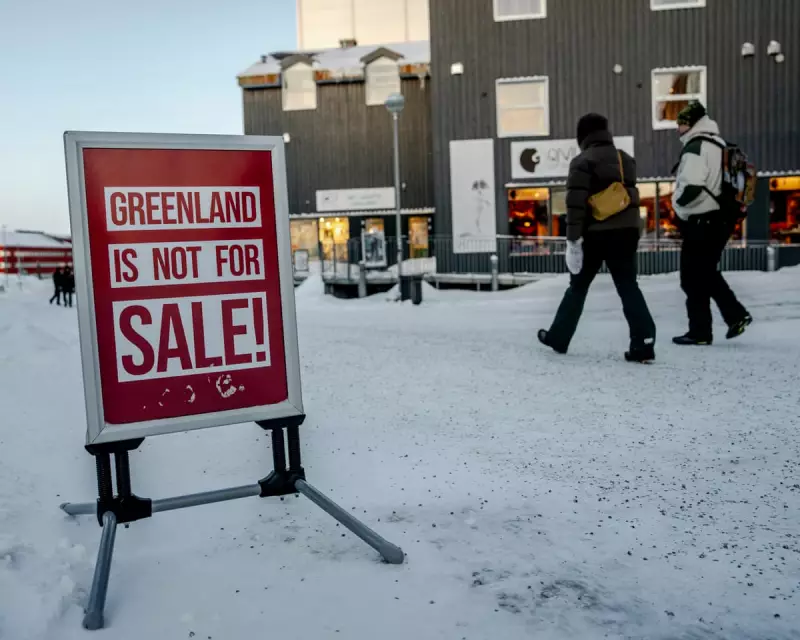
Residents in Nuuk, Greenland, are increasingly looking to European allies for support amid rising geopolitical tensions. This reliance underscores a broader crisis as Europe confronts a moment of truth over Greenland, with leaders moving away from appeasement strategies towards Donald Trump.
The Unfolding Crisis: Trump's Greenland Gambit Threatens Western Alliances
Emmanuel Macron's private message to Donald Trump, questioning actions on Greenland, has been publicly shared by Trump, highlighting a deepening rift. This move appears designed to embarrass the French president, yet it resonates with millions of perplexed European citizens. As Russia's conflict in Ukraine continues to inflict physical damage, Trump's contentious stance on Greenland risks fracturing the Western defence alliance, NATO.
Trump's Logic and Escalating Claims
By Trump's unconventional reasoning, which he has linked to being overlooked for the Nobel Peace Prize, Europe lacks the authority to block US acquisition of Greenland from Denmark. In a lengthy address at Davos, Trump reinforced his territorial assertions, ruling out military force but demanding immediate negotiations. He maintained that only the United States possesses the capability to secure Greenland effectively.

If the US even considers coercive measures against a NATO ally, purportedly to protect the Arctic from Russian and Chinese influence, the mutual defence principles of NATO could lose their significance. Belgian Prime Minister Bart De Wever captured the surreal nature of this crisis by noting that one NATO nation is threatening another with potential military invasion.
Trade Threats and Diplomatic Strains
Trump has intensified pressure with a series of trade threats, including punitive tariffs on eight European countries that deployed troops to the Arctic to bolster security around Greenland. These nations now face tariffs starting at 10% from February 1st, potentially rising to 25% by June 1st, unless Trump's demands are met.
Diplomats had hoped that a confrontation might be avoided at Davos if Trump was genuinely committed to a compromise benefiting NATO and the US. However, his tactics of intimidation and blackmail could prove counterproductive, as Europe shows signs of abandoning appeasement. An emergency summit of 27 EU leaders this Thursday is poised as a potential turning point, marking a shift from past strategies of persuasion and flattery.
Europe's Response: From Tariffs to the 'Big Bazooka'
What options does Europe have in this high-stakes standoff? Retaliatory tariffs on €93 billion worth of US imports, such as soya and bourbon, are prepared in Brussels, ready for activation if new US tariffs are imposed on February 1st. Additionally, Members of the European Parliament have agreed to suspend ratification of the recent EU-US trade deal, a move considered radical until now.
The Anti-Coercion Instrument: A Powerful Tool
Emmanuel Macron advocates for deploying the EU's most potent trade weapon, the anti-coercion instrument (ACI), often referred to as the 'big bazooka'. Implemented in 2023 primarily as a defence against China, this instrument has yet to be used. It could enable the EU to take severe measures, such as blocking companies from aggressor nations from operating within the single market.
Despite some governments still urging dialogue, the EU's unity on the Trump threat remains under scrutiny. According to Brussels correspondent Jennifer Rankin, while the bloc presents a united front in rhetoric, practical cohesion will be tested in the coming days. The recent crisis meeting of EU ambassadors revealed no majority support for activating the ACI, suggesting that the €93 billion package of countermeasures might be the initial response, with punitive tariffs potentially taking effect by February 7th.
Divisions Within Europe
Notable differences in approach are emerging among key European leaders. Macron is adopting a more assertive stance, whereas German Chancellor Friedrich Merz and Italian Prime Minister Giorgia Meloni emphasise the importance of continued dialogue. These divisions could influence the EU's ability to present a unified and forceful response.

Broader Strategies: Boycotts and Economic Leverage
At this critical juncture, described by Gordon Brown as Europe's 'moment of truth', there is a significant risk that leaders may shy away from employing their toughest economic tools. Alberto Alemanno, a professor of EU law at HEC Paris, argues that a calibrated trade response would be a mistake. He advocates for using the 'big bazooka' alongside a coordinated boycott of the upcoming football World Cup in the United States.
Alemanno acknowledges that such actions would entail real costs for Europe but warns that the cost of inaction—permanent subordination to an increasingly adversarial power—is far greater. The ultimate goal, he stresses, is not to punish America but to make Europe resilient against American blackmail.
Expert Perspectives on EU Action
Georg Riekeles from the European Policy Centre thinktank concurs, suggesting that the EU should utilise the bazooka to target a range of US services, including digital platforms operating in Europe. He asserts that while the US holds leverage over Europe, the reverse is also true, and for Europe, the stakes are existential. Riekeles believes that with coercion as blatant as it currently is, the legal case for rapid mobilisation of the anti-coercion instrument is clear, providing Brussels with a powerful set of retaliatory tools.
He also recommends reactivating tariffs on US goods and declaring the recent Turnberry trade deal null and void, as its foundational premises have been undermined. German MEP Damian Boeselager supports both deploying the bazooka and freezing the EU-US trade deal, noting that merely making the bazooka a credible option alters the balance of power—a language Trump understands. Boeselager emphasises that Europe, as an economic superpower, is not defenceless.
The Cost of Appeasement Versus Action
Nathalie Tocci, a professor at the Johns Hopkins School of Advanced International Studies, has long argued that the cost of appeasing Trump outweighs the cost of independent action, even in defending Ukraine. While European Commission President Ursula von der Leyen has urged governments to leverage their power and abandon traditional caution in a 'lawless world', Tocci remains sceptical about whether EU leaders will take decisive steps.
She observes that Europe has compromised for too long, and whereas the effectiveness of appeasement was once debatable, it now appears futile. Tocci predicts that EU leaders will keep economic options open, possibly moving to retaliatory tariffs only if Trump proceeds with his tariffs on February 1st. Even then, she doubts the bazooka will be triggered immediately.
As Europe navigates this complex crisis, the decisions made at the upcoming summit could redefine transatlantic relations and Europe's strategic autonomy on the global stage.