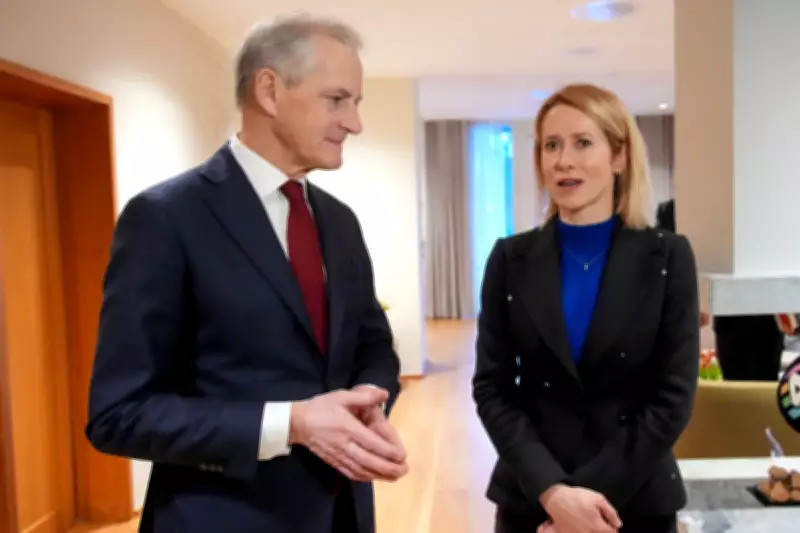
The European Union's foreign policy chief, Kaja Kallas, has delivered a stark warning against proposals for a Europe-wide army, describing the concept as potentially "extremely dangerous" during a security conference in Norway. Her comments come as the bloc grapples with how to bolster its own security capabilities following signals from the United States that its strategic priorities are shifting.
A Firm Rejection of European Military Ambitions
Speaking on Monday, Kallas explicitly rejected calls for a separate European army, arguing that such a move would create practical and strategic complications. "Those who say that we need a European army, maybe those people haven't really thought this through practically," she stated. "If you are already part of NATO then you can't create a separate army."
Command Chain Concerns and NATO Overlap
Kallas emphasised that the most critical asset during any military crisis is a clear and unambiguous chain of command. She warned that establishing a European army alongside NATO structures would lead to dangerous confusion. "And if you have, like the European army and then you have the NATO (one), then, you know, the ball just falls between the chairs. And this is extremely, extremely dangerous," she explained.

This debate has resurfaced amid heightened tensions within NATO, particularly following controversial threats by former US President Donald Trump regarding Greenland, a semi-autonomous territory of NATO ally Denmark. The situation has prompted renewed discussions about European strategic autonomy.
Allied Support for NATO's Existing Framework
Norwegian Prime Minister Jonas Gahr Støre, whose country is not an EU member but a key NATO ally, echoed Kallas's sentiments. He defended NATO's existing decision-making processes, describing them as complex but well-trained. Støre firmly rejected the idea of a European army, stating, "it is not a road we should travel."
NATO's Command Structure and US Leadership
NATO's military operations are overseen by a Supreme Allied Commander, a position always held by a senior United States officer. The role is currently filled by Air Force Lieutenant General Alexus Grynkewich. This structure underscores the integral role of American leadership within the alliance.
Realistic Assessments of European Defence Capabilities
Adding to the conversation, NATO Secretary-General Mark Rutte recently delivered a sobering assessment of Europe's current defence capabilities. Speaking to EU lawmakers in Brussels last week, Rutte asserted that Europe remains incapable of defending itself without substantial US military support.
"If anyone thinks here ... that the European Union or Europe as a whole can defend itself without the U.S., keep on dreaming. You can't," Rutte stated bluntly. He suggested that for Europe to achieve genuine strategic autonomy, it would need to more than double its current military spending targets. Rutte concluded that Europe and the United States fundamentally "need each other" for collective security.
The consistent message from multiple senior figures highlights a pragmatic, though cautious, approach to European security. While the desire for greater autonomy is understandable given geopolitical shifts, the prevailing view among key decision-makers is that strengthening the existing NATO framework, rather than creating parallel structures, remains the safest and most effective path forward.