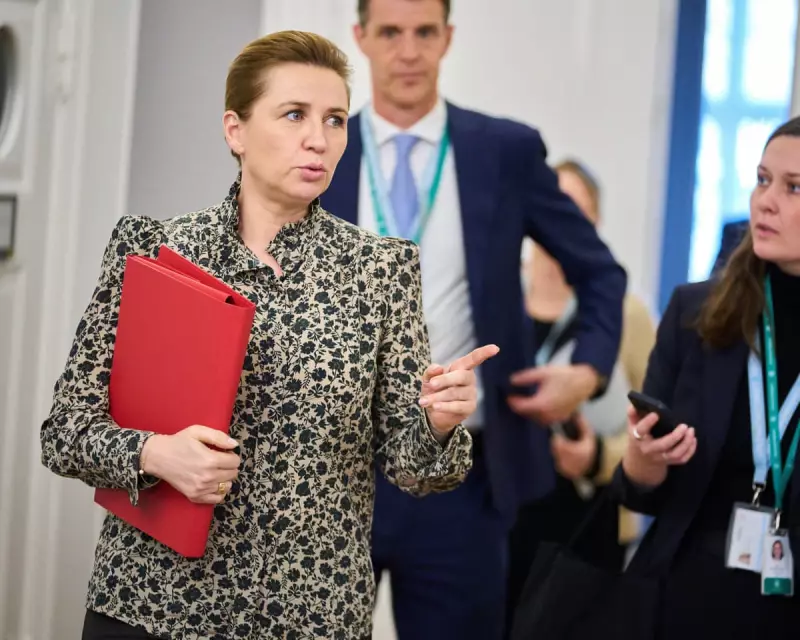
Danish Prime Minister Mette Frederiksen has called for "constructive" negotiations regarding Greenland that fully respect its territorial integrity. This statement comes as European leaders cautiously welcome Donald Trump's decision to withdraw tariff threats against nations opposing his controversial plans to acquire the vast Arctic island.
Sovereignty Remains Non-Negotiable
"We can negotiate all political aspects – security, investment, the economy – but we cannot negotiate our sovereignty," Frederiksen declared on Thursday. Her comments followed the US president's suggestion that a "framework of a future deal" had been established to resolve the escalating dispute.
Frederiksen confirmed she had received assurances that discussions between Trump and NATO Secretary General Mark Rutte in Davos, Switzerland, did not involve compromising Danish or Greenlandic sovereignty. Greenland operates as a largely self-governing territory within the Danish kingdom.

Arctic Security Dialogue
"Denmark wishes to continue a constructive dialogue with its allies on ways to strengthen security in the Arctic, including the US Golden Dome missile-defence system, provided this is done with respect for our territorial integrity," the prime minister elaborated.
Rutte addressed an audience in Davos, describing a "very good discussion" with Trump regarding how NATO allies could collaborate to ensure Arctic security. This cooperation would extend beyond Greenland to include all seven alliance nations with Arctic territory.
"One workstream emerging from yesterday's talks is to ensure that China and Russia do not gain access to the Greenland economy or establish military presence there," Rutte explained, highlighting the strategic importance of the region.
De-escalation After Weeks of Tension
Trump dramatically reversed his position on Wednesday, abandoning threats to use tariffs as leverage for seizing Greenland and explicitly ruling out military force. This marked a significant retreat from weeks of aggressive rhetoric that had strained NATO alliances and threatened a new transatlantic trade conflict.
Over the weekend, the US president had threatened to impose 10% tariffs on imports from Denmark, France, Germany, Sweden, the United Kingdom, the Netherlands, and Finland unless they withdrew objections to his Greenland ambitions. This prompted European Union leaders to consider substantial retaliatory measures.
European Reactions and Relief
EU leaders convened for an emergency meeting in Brussels on Thursday to discuss managing relations with the unpredictable US president, amid concerns that transatlantic ties had suffered lasting damage.
European officials expressed cautious optimism about the announced deal framework. Italian Prime Minister Giorgia Meloni claimed a diplomatic victory, stating Italy had "always maintained it is essential to continue fostering dialogue" between allies.
Dutch Prime Minister Dick Schoof noted it was "positive we are now on the path to de-escalation," while emphasising the need for continued NATO cooperation on Arctic security involving the US, Canada, and Europe.
German Chancellor Friedrich Merz welcomed Trump's rhetorical shift, urging Europeans not to hastily abandon the transatlantic partnership. "Despite all the frustration and anger of recent months, let us not be too quick to write off the transatlantic partnership," Merz stated in his Davos address.
France's Finance Minister Roland Lescure described the announcement as "a first positive sign that things are moving in the right direction. The magic word for the last 48 hours has been de-escalation. Right now, we're de-escalating."
Strategic Importance and Mineral Resources
Trump has repeatedly justified the need for US control of Greenland citing "national security" concerns, despite the existing US military base at Thule and a bilateral agreement permitting significant American expansion on the island.
While specific details of the proposed agreement remain unclear, Trump characterised it as "a deal that everybody's very happy with. It's the ultimate long-term deal. It puts everybody in a really good position, especially as it pertains to security and to minerals." Greenland possesses substantial deposits of rare earth minerals crucial for modern technology.

European Unity and Firm Response
Sweden's Foreign Affairs Minister Maria Stenergard suggested that unified resistance from Denmark's allies had influenced Trump's change of position. European leaders had previously condemned what French President Emmanuel Macron termed Trump's "new colonialism."
The European Union had prepared substantial retaliatory measures, including tariffs on €93 billion (£80 billion) of US imports and deployment of its "anti-coercion instrument" – a powerful mechanism limiting US access to European markets across investment and digital services.
Teresa Ribera, a European Commission executive vice-president, emphasised the importance of European vocal opposition. "Silence is too ambiguous, too dangerous," she warned in an interview. "If Europe remains silent in the face of Trump, it fuels fear."
A European diplomat concurred that EU firmness contributed to Trump's reversal, alongside domestic US political pressure and market reactions. However, Germany's Vice-Chancellor Lars Klingbeil advised caution, stating Europe "should wait and see what substantive agreements are reached."
Trump's renewed interest in Greenland, initially floated in 2019, intensified dramatically in recent weeks with the president declaring the US would take control "one way or the other" and insisting "Now it is time, and it will be done!!!" The current diplomatic developments suggest a more measured approach may prevail.