US DEA Quietly Resumes Anti-Drug Coordination with Bolivia After 20-Year Hiatus
The United States has discreetly resumed intelligence coordination on counternarcotics efforts with Bolivia under its conservative president, according to a high-ranking Bolivian official. This revival of a sensitive relationship comes nearly twenty years after left-wing former President Evo Morales expelled U.S. anti-drug agents from the world's third-largest producer of cocaine.
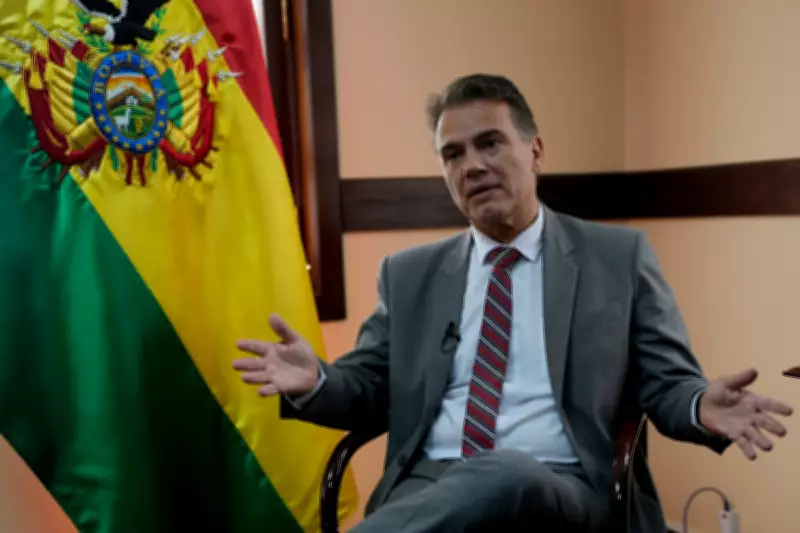
While officials finalize the details of a formal agreement that will see the Drug Enforcement Administration return to the Andean nation, the U.S. has already begun sharing information on transnational criminal networks with Bolivian law enforcement. Additionally, American agencies are assisting in vetting and training Bolivian officers, as confirmed by Bolivia's Vice Minister of Social Defense and Controlled Substances, Ernesto Justiniano, in an interview with The Associated Press.
Initial Cooperation and Diplomatic Thaw
"We are already receiving support in various ways, in the training and integrity analysis of personnel," Justiniano stated. "There is a lot of intelligence, resources, they can provide us, and we need it." The DEA did not respond to requests for comment on these remarks, which mark Justiniano's first public confirmation to foreign media about the ongoing U.S. counternarcotics assistance in Bolivia.

This quiet resumption of coordination coincides with Bolivian President Rodrigo Paz, a centrist former senator who assumed office last November, restoring full diplomatic relations with Washington. For nearly two decades, Morales' Movement Toward Socialism party had shunned Western alliances in favor of partnerships with China, Russia, Cuba, and Iran.
U.S. Secretary of State Marco Rubio has praised Paz's election as a "transformative opportunity for both nations" as the Trump administration overhauls decades of U.S. policy to assert Washington's dominance in the Western Hemisphere.
Finalizing Details and Strategic Importance
The exact parameters of the DEA's renewed presence in Bolivia are still being negotiated. Justiniano noted that "there were still a couple more meetings to be held, an agreement to be finalized by the foreign ministry." However, experts view the agency's return as a significant foreign policy achievement for the U.S. in Latin America, especially amid regional tensions over President Donald Trump's militarized approach against drug cartels.
"We have little idea what's been going on these past 20 years, so having the DEA back there can open a lot of other doors for the U.S.," said retired U.S. diplomat Daniel Foote, who served in Bolivia during the cocaine heyday. "This is as much about helping Bolivia as it is keeping the U.S. safe."
Addressing Historical Sensitivities and Current Challenges
Justiniano was cautious when questioned whether this renewed U.S. assistance would resemble the heavy-handed policies of the late 1990s. During that period, DEA-backed Bolivian forces engaged in deadly clashes with farmers while destroying coca crops that had sustained Indigenous communities for centuries.
He acknowledged the lingering sensitivities, particularly in the coca-growing regions near Cochabamba, where resentment persists over Washington's militarized tactics. The national backlash in 2006 propelled Morales, a former coca growers' union leader, to power and sustained his popularity for three consecutive terms.
"In Bolivia, when it comes to language, you have to be very careful," Justiniano emphasized. "Are we going to have bases full of gringos here? No, that's not going to happen." However, he added that Bolivia "would welcome" the DEA playing a direct role in interdiction operations on the ground, stating, "We do need to conduct joint operations."
Farmers in the tropical Chapare region are preparing for stricter policies that could hinder legal coca production. Coca growers' leader Aquilardo Caricari recently declared, "We will not allow the establishment of any military base in the Cochabamba tropics," referencing the arrests and killings of farmers in the 1990s.

Bolivia's Transformation and Ongoing Issues
As Bolivia's first Indigenous president, Morales made coca leaves central to his agenda of resisting foreign interference and promoting Andean heritage. He decriminalized the leaf, extolled its medicinal benefits, and allocated coca plots to farming families while empowering unions to curb excess production.
Nevertheless, officials report that the legal market for traditional coca use has not deterred the illicit trade, where prices are substantially higher. Justiniano claimed that over 90% of coca grown in the Chapare is now diverted into cocaine production, but obtaining reliable data has been nearly impossible since Morales expelled U.S. anti-narcotics agents in 2008.
At the time of its expulsion, the DEA maintained about 100 agents across four offices in Bolivia, representing its second-largest foreign presence outside Colombia. Since then, Foote remarked, "Bolivia has been a blind spot." The once-quiet city of Santa Cruz in eastern Bolivia has evolved into a bustling hub for traffickers from diverse regions, including Albania and China.
Historical Echoes and Future Prospects
In a historical parallel, President Paz aims to reclaim Bolivia's role as a U.S. ally in combating drug trafficking, nearly four decades after his father, former President Jaime Paz Zamora, pursued similar efforts. During Paz Zamora's tenure, which began in 1989, Colombia's Medellin and Cali cartels had long used Bolivia as an air bridge, purchasing semi-processed coca paste for global cocaine distribution.
Paz Zamora invited U.S. military training for Bolivian security forces, extradited cocaine kingpins to the U.S., and dismissed government officials accused of accepting drug money. Robert Gelbard, the U.S. ambassador to Bolivia at the time, recalled that while these efforts reduced cocaine production, he hopes the DEA under the younger Paz will avoid "the sort of aggressive approach we followed in the 1990s."
Even if Bolivia desired a more forceful DEA return, Washington's cooperation might be limited. The agency closed over a dozen offices worldwide during the Biden administration. However, former Bolivian ambassador to Washington Jaime Aparicio anticipates a different approach under Trump, noting, "Drugs are his main enemy in this region."