

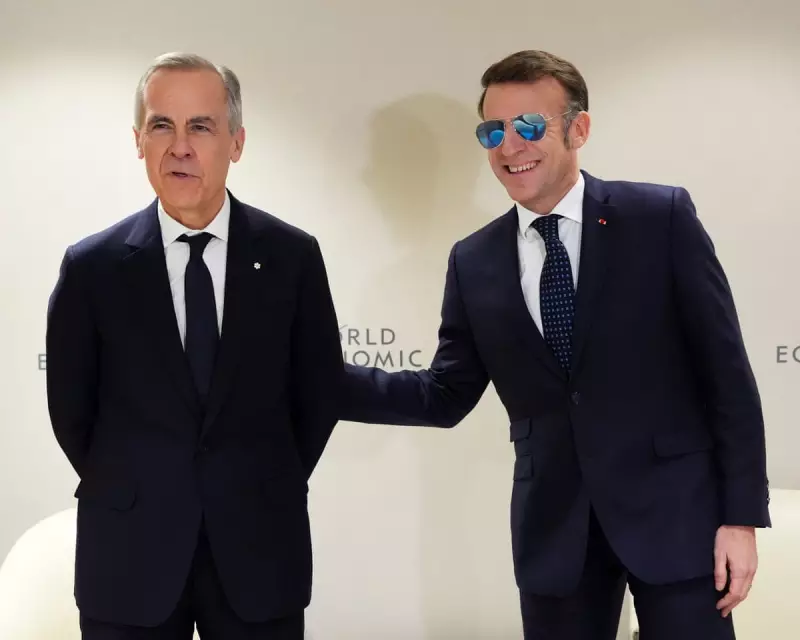
Davos Forum Becomes Stage for Western Leaders to Confront Post-US Reality
The annual World Economic Forum in Davos, Switzerland, has transformed into a crucible for geopolitical realignment, as prominent figures from across the Western world gather to articulate a stark new truth. With former Bank of England Governor Mark Carney and French President Emmanuel Macron at the forefront, a chorus of voices is emerging that challenges the long-held assumption of American global leadership.
The 'Brutal Reality' of a Lawless World Order
In a series of pointed addresses, leaders have moved beyond diplomatic niceties to describe what Carney termed "the end of a pleasant fiction and the beginning of a brutal reality." This sentiment, echoing the dissident philosophy of Czech writer Vaclav Havel, centres on the belief that the rules-based international order has been fundamentally undermined. The catalyst for this collective awakening is widely identified as the policies and rhetoric of former US President Donald Trump.
Trump's recent appearance at Davos, characterised by rambling speeches and renewed threats—such as the half-withdrawn proposition to invade Greenland—has acted as a final provocation. His glorification of economic tariffs as tools of intimidation against allies has shattered remaining illusions about the reliability of the transatlantic partnership.

A Unified Diagnosis from Europe's Core
The European response has been notably unified in its diagnosis. European Commission President Ursula von der Leyen told the European Parliament that the continent now inhabits "a world defined by raw power" and must develop its own levers of influence. Emmanuel Macron was even more direct, warning of a slide into a "rule-free" global system where imperial ambitions threaten multilateral institutions.
Finnish President Alexander Stubb provided a strategic analysis, arguing that liberal Europe faces a dual squeeze from a United States that no longer prioritises it and simultaneously views it as an ideological adversary. "The people around Trump in the Maga movement see themselves as leading a big shift," Stubb noted, framing it as a movement against the pillars of liberalism and global interdependence.
The British Dilemma and Carney's Message to Starmer
The most delicate position belongs to the United Kingdom, traditionally wedded to its "special relationship" with Washington. Mark Carney, in his widely praised speech, delivered a tacit but unmistakable message to UK Labour leader Keir Starmer. He argued that middle powers negotiating bilaterally with a hegemon do so from a position of inherent weakness, suggesting that the only viable path is to combine forces to create a impactful "third way."
This counsel highlights a growing internal debate within the Labour leadership. While Starmer has been historically pragmatic and reluctant to publicly break with the US, there is increasing recognition of the need to build a network of middle-power alliances. Energy Secretary Ed Miliband's public praise for Carney's address signals this shifting sentiment, with discussions potentially turning towards revitalising a closer UK-European defence pact.
Salvaging What Remains While Forging a New Path
The emerging consensus among these leaders is not one of outright hostility towards the United States, but rather a clear-eyed pragmatism. The strategy involves salvaging cooperative elements where possible—such as on issues like NATO presence in Greenland or security guarantees for Ukraine—while simultaneously building independent capacity.
As Carney concluded, the imperative for middle powers is to consistently "name reality." Silence in the face of economic intimidation from any quarter, he warned, is akin to keeping the propagandistic sign in the shop window. For Keir Starmer and the UK, embracing this new reality may represent the most significant foreign policy recalibration in eight decades, a wrenching change that the evolving dynamics of the Trump era may have rendered unavoidable.






