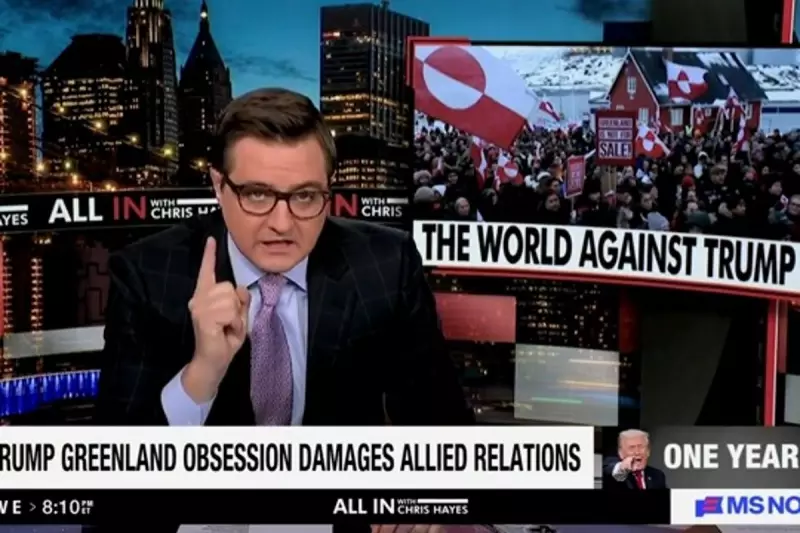
In a striking Tuesday night broadcast, prominent MS NOW host Chris Hayes posed a troubling question about America's shifting global position, wondering aloud whether the United States has now become "the bad guy" on the world stage. Hayes suggested that recent actions and rhetoric from the Trump administration bear unsettling resemblance to historical Axis powers, creating what he described as a dangerous destabilisation of the international order.
Growing Alarm Over Greenland Ambitions
The catalyst for Hayes' grave assessment stems from President Donald Trump's renewed and intensified campaign to annex Greenland, the semi-autonomous Danish territory that has become an unexpected flashpoint in transatlantic relations. In recent weeks, Trump has doubled down on his threats regarding Greenland, declaring there is "no going back" on American ambitions to take control of the strategically significant island.
"These allies are becoming aware that the most powerful person in the world is a danger and threat to it, and making the world order unstable," Hayes asserted during his prime-time programme. "And that means we're all in a lot of trouble."

Military Posturing and Economic Threats
The situation has escalated significantly with Trump initially refusing to rule out using American military force to seize Greenland, prompting Denmark and Greenland's government to announce expanded military exercises in the territory alongside NATO allies. The Danish Ministry of Defence confirmed an increased armed forces presence in and around Greenland, describing the move as a necessary response to growing tensions.
As several European nations dispatched military personnel to Greenland in recent days, Trump responded by threatening to impose a ten percent tariff on Denmark and other European countries beginning in February should they continue opposing his Greenland takeover plans. This economic pressure adds another layer to what Hayes characterises as increasingly aggressive behaviour from the American administration.
Personal Grievances and Global Consequences
Compounding concerns, Trump has suggested that personal frustrations may be influencing his geopolitical decisions. In messages to the Norwegian prime minister, the president connected his anger over not receiving the Nobel Peace Prize to his "maximalist desire" to acquire Greenland, stating he no longer feels "an obligation to think purely of Peace" but can now prioritise what he believes benefits America.
Ahead of Trump's visit to Davos, where he moderated his position by asserting he "won't use force" while still maintaining America is "the only country" capable of securing Greenland, Hayes dedicated his programme's opening segment to sounding alarm bells about what he perceives as the administration's push to dismantle longstanding alliances.
Historical Parallels and Global Order
Hayes drew direct comparisons between current American foreign policy and that of the Axis nations defeated in World War II, specifically mentioning Japan, Italy and Germany. While acknowledging that post-war American hegemony has been "abused egregiously" in conflicts like Vietnam and Iraq, Hayes argued it has largely served as a "world war avoidance machine with the U.S. at the centre."
"What we are dealing with today is what happens when the winners of World War II, one of them, realised the order they built is crumbling and that the global hegemon is sounding and maybe acting now like an Axis power," Hayes lamented during his broadcast.
Broader Implications for International Stability
The MS NOW host emphasised that the consequences of American actions extend far beyond domestic politics, noting that Denmark has warned any attack on Greenland would effectively end NATO. Hayes suggested that European allies are developing the same "daunting awareness" that American critics of Trump have held since his presidency began, referencing controversial early actions including pardons for January 6th insurrectionists.
"Americans electing Donald Trump is not just our problem," Hayes concluded. "We have made it the world's problem because we have made ourselves the centre of the global order. And the post-World War II global order has been predicated basically on U.S. hegemony."

As tensions continue mounting over Greenland and transatlantic relations face unprecedented strain, Hayes' commentary reflects growing international concern about America's evolving role and the potential consequences for global stability in what he characterises as an increasingly volatile geopolitical landscape.