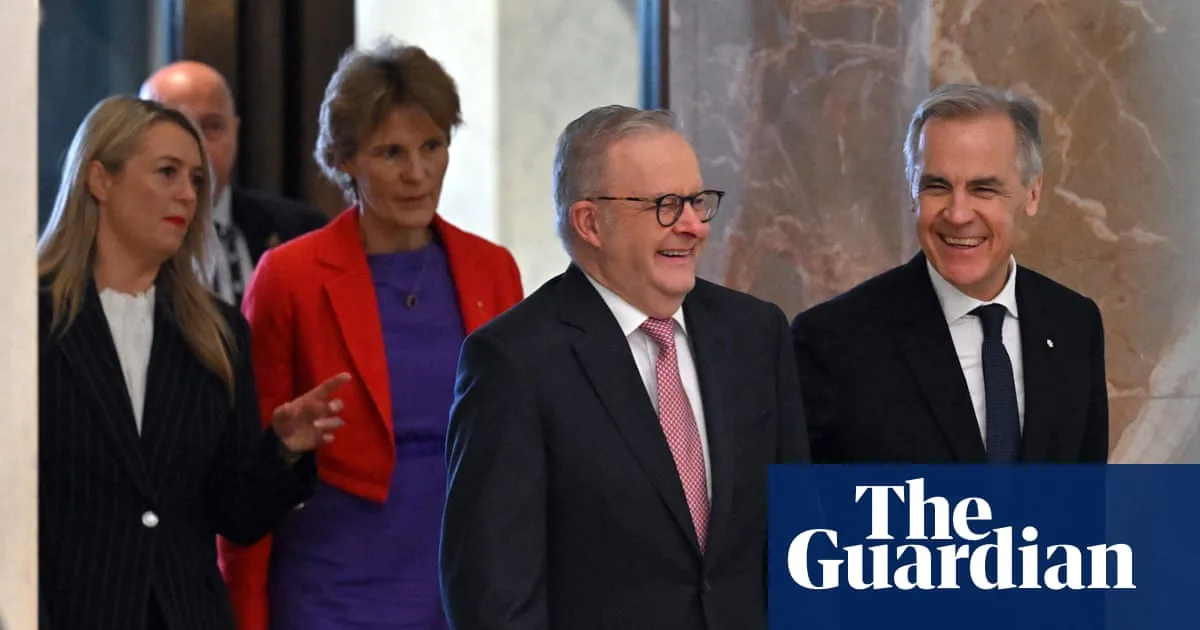
Canadian Prime Minister Mark Carney has proposed that Canada and Australia act as “strategic cousins” to negotiate more effectively with superpowers, including the United States under Donald Trump. Speaking to the Australian federal parliament in Canberra, Carney called for enhanced cooperation on critical minerals, defence, and trade, and announced Australia’s accession to the G7 critical minerals alliance.
Carney emphasised that combined, Canada and Australia produce 34% of global lithium stocks, 32% of uranium supply, and 41% of iron ore. He argued that in a world where the “global architecture is breaking down,” middle powers should collaborate rather than compete. He reaffirmed the importance of the Five Eyes intelligence network, describing it as functioning “very well.”
On defence, Carney said both countries should build up capabilities in next-generation drones, surveillance aircraft, and cyber and AI tools. He also stressed the need for middle powers to develop sovereign AI capabilities to avoid being caught between “hyperscalers and hegemons.”
Regarding Ukraine, Carney stated that members of the international coalition planning for peace must provide “robust security guarantees” once the war ends. He also softened his earlier support for US and Israeli strikes on Iran, suggesting they appeared inconsistent with international law due to lack of UN Security Council authorisation or imminent threat. Both Carney and Australian Prime Minister Anthony Albanese called for de-escalation, though Australia maintained its support for the strikes.
Carney’s visit has been praised for advancing middle-power diplomacy, urging countries like Japan, India, and South Korea to band together to protect institutions and advance mutual interests.