
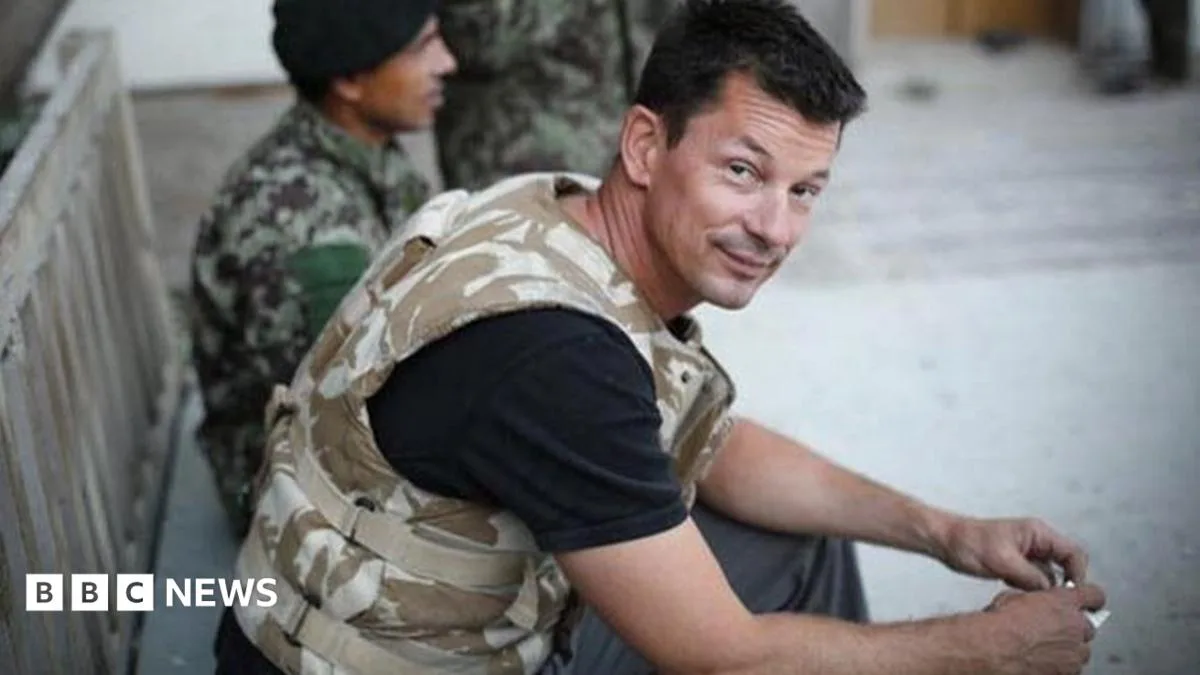
Today marks 10 years since British photojournalist John Cantlie was kidnapped by Islamic State militants in Syria. He is thought to be the only foreign hostage held by them who was neither released nor murdered on camera. Mr Cantlie outlived other UK hostages and appeared in the group's propaganda videos, though his fate is unknown.
He is presumed dead but his body has never been found, and his family recently held a funeral for him. In a quaint Norman church in a quiet Hampshire village, some of John Cantlie's favourite rock songs were played in front of his family and friends who had gathered to remember the man who disappeared.
Mr Cantlie was a motorbike enthusiast, adventurer and storyteller - but above all, a passionate photojournalist. In 2012, after working in some of the wilder regions of the world, including Afghanistan and the Himalayas, he went to Syria to document the developing civil war there. In July of that year he was kidnapped along with a Dutch photographer, and got shot while trying to escape before another militant group intervened and secured their release. Mr Cantlie returned to Britain but then, against the advice of some, went back to Syria to continue his work.
"John knew the dangers of repeatedly going into Syria to document the atrocities President Assad was carrying out on the Syrian people," his sister Jessica told me. "I respected his decision to go back and understood why he felt he had to go." On 22 November 2012, soon after crossing the porous border from Turkey into Syria, he was abducted by gunmen at a checkpoint along with the American journalist James Foley. They had fallen into the hands of so-called Islamic State (IS).
Over subsequent years he was held in appalling conditions, fed starvation rations, brutalised and tortured along with US and European hostages. The Europeans were released one by one, reportedly for huge ransoms, while all the other Britons and Americans were murdered on camera. Two of their worst tormentors were British jihadists from west London: El Shafee El Sheikh and Alexander Kotay. They have both been convicted in a US court and sentenced to life in prison.
"I will always be particularly proud," says his sister, "by hearing of John's leadership, steadfast support and kindness towards all the other, mostly younger men he was held hostage with. [He was 42 when kidnapped]. They were kept in circumstances so terrible we cannot begin to imagine. He was a good and decent man." Controversially, Mr Cantlie survived for years by becoming a captive spokesman, writing and voicing the propaganda reports that IS wanted to hear. He appeared in 14 of their videos, initially dressed in an orange jumpsuit. He told other hostages he was doing it against his will, even telling one who was going home he wanted the then coalition government to bomb their prison to end his torment. He was last seen in December 2016 in Mosul, and since his body has never been found it is thought most likely he perished in the massive US-led coalition bombing of that city, where IS were entrenched. "John is deeply missed and mourned," said his sister Jessica. "But his indomitable spirit is still with us in some rather wonderful way."




