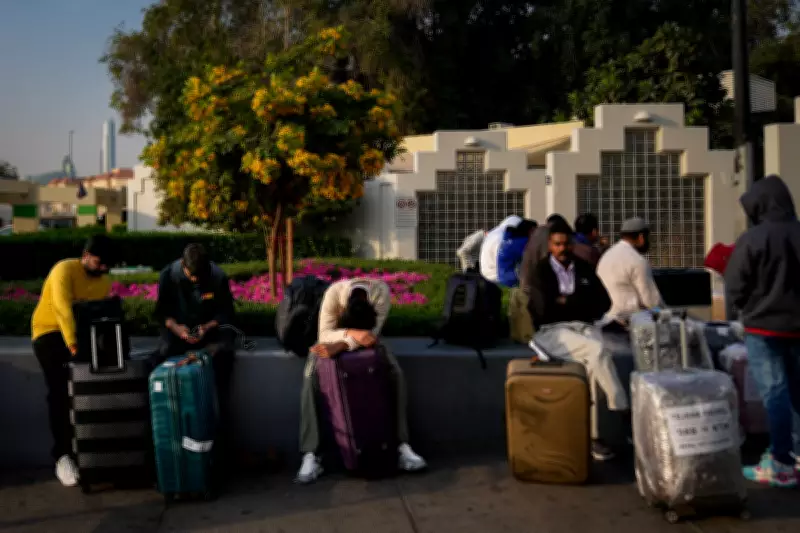
The sunny smiles have been completely wiped off the faces of British expats currently residing in Dubai. As Iranian missiles continue to rain down across the region, the ambitious young professionals and non-domiciled individuals who once flocked to the Gulf for its financial benefits are now finding themselves urgently swapping tax shelters for bomb shelters. This dramatic shift underscores a harsh new reality in what was previously considered a safe haven.
A Sudden End to the Dubai Dream
Across the United Arab Emirates, roads stand eerily empty and offices have fallen silent. All flights have been grounded, and working from home has become the mandatory order of the day. The last time such widespread disruption occurred was during the global pandemic. Since that period, tens of thousands of British citizens have permanently left the United Kingdom to establish new homes in the Gulf region.
Many of these individuals are notably wealthy, having been attracted primarily by Dubai's complete lack of personal income tax. A significant number are non-doms, who grew increasingly despairing of the Labour government's perceived targeting of the rich with ever-higher taxes. High-profile figures, including billionaire industrialist Lakshmi Mittal and former footballer Rio Ferdinand, made headlines when they abandoned the UK for a new life in this emirate.

Seeking Sun, Opportunity, and a Tax Break
There are also those who were drawn by the promise of a more relaxed lifestyle in a location where the sun shines almost all year round. They moved to seek new professional opportunities that they felt Britain no longer offered, particularly in sectors like professional services, real estate, and finance. Their social media feeds were once filled with pouting, bikini-clad shots in luxury kitchens, by pristine swimming pools, and on high-speed jet skis.
This environment saw a proliferation of former reality TV stars and social media influencers. For friends and family back in the UK, these expats delivered a relentless barrage of content praising life in Dubai and Abu Dhabi. They extolled the brilliant weather, the excellent restaurants comparable to London's, the fantastic shopping, and the availability of famous private school branches at lower costs. The message was constant: everybody is happy, everything is cool, and it is incredibly safe.
The security was touted as phenomenal, with crime rates negligible compared to London. You could wear a Rolex in public without feeling remotely threatened. And, of course, there was the added, significant bonus of not being clobbered by the taxman.
From Tax Shelter to Bomb Shelter
Today, however, the narrative has violently shifted. Instead of seeking a tax shelter, these expats are urgently seeking physical bomb shelters. They are hunkering down, hoping the region calms and the Iranian attacks cease. Estimates vary, but consensus suggests around 240,000 Brits made the decision to uproot and head to the UAE.
They were welcomed with open arms. A key driver of Dubai's transformation from a modest fishing village into a global business and tourist hub has been this very influx of foreigners. Approximately 90 percent of its 3.4 million population originally hail from elsewhere. According to the local Sotheby's branch, Britain is second only to India in terms of buyers of UAE real estate.
It is not just individuals who relocated, but entire businesses too. The Dubai Chamber of Commerce reports there are currently 5,000 British firms operating in the UAE, a figure that was expected to rise to 15,000 by 2035. Now, that idyllic vision has been brutally shattered.
A Rude Awakening to Regional Instability
The terrifying sights of burning hotels and towers, debris falling inside the soon-to-be-replaced Dubai International Airport, and the chilling sound of air-raid sirens have provoked massive consternation. Of course, the UAE's location in the heart of an unstable region was well known, as was its staunch support for Western interests.

Equally, the nation boasted state-of-the-art security. Cameras were everywhere, law and order was rigorously maintained, and bag and body searches were commonplace. In the skies, the UAE had invested heavily in advanced air defence systems. The place felt utterly secure. Not today it doesn't. Peace may eventually prevail, but a swift return to normality seems unlikely, if it ever returns at all.
While this specific episode may pass, it has served as a rude and frightening awakening. Authorities may install more sophisticated detection equipment and spend fortunes on military capabilities, but it will not change the fundamental fact that the UAE is situated right in the thick of a volatile region.
There may yet be peace with Iran, but the question remains: what about the next threat, from whoever, whenever? The turbulent nature of Middle Eastern politics makes the future impossible to predict. Iran has demonstrated that the UAE, once thought to be impenetrable, is profoundly vulnerable. In a sense, it is now as exposed as any other major global city.
The Fragility of the Expat Paradise
Londoners are well accustomed to the prospect of terrorist outrages, as are New Yorkers, Parisians, Berliners, and Muscovites. Residents of any major city in the world understand this grim reality. The UAE had long tried to insist it was different, despite its proximity to historically hostile neighbours and a regional reputation for violence and retribution.
A reassuring capital commitment towards safeguarding its inhabitants, doubtless coupled with a slick public relations campaign, may help prevent a full-scale reverse exodus. But the UAE may also be about to learn a harsh lesson that the UK has absorbed in recent years.
Thanks to vastly improved technology and global transport networks, the wealthy can base themselves virtually anywhere in the world. They owe no particular loyalty to any single nation. They can relocate relatively easily, and there are plenty of other destinations anxious for their custom and capital. They have done it before, and they can certainly do it again.
Suddenly, dear old London, with all its grime, problems, and the tax policies of Chancellor Rachel Reeves, does not seem quite so unattractive after all. The British public grew used to the endless stream of smug selfies and grinning expat posts. Those smiles have now been decisively wiped away, replaced by a fearful search for safety in an unexpected storm.