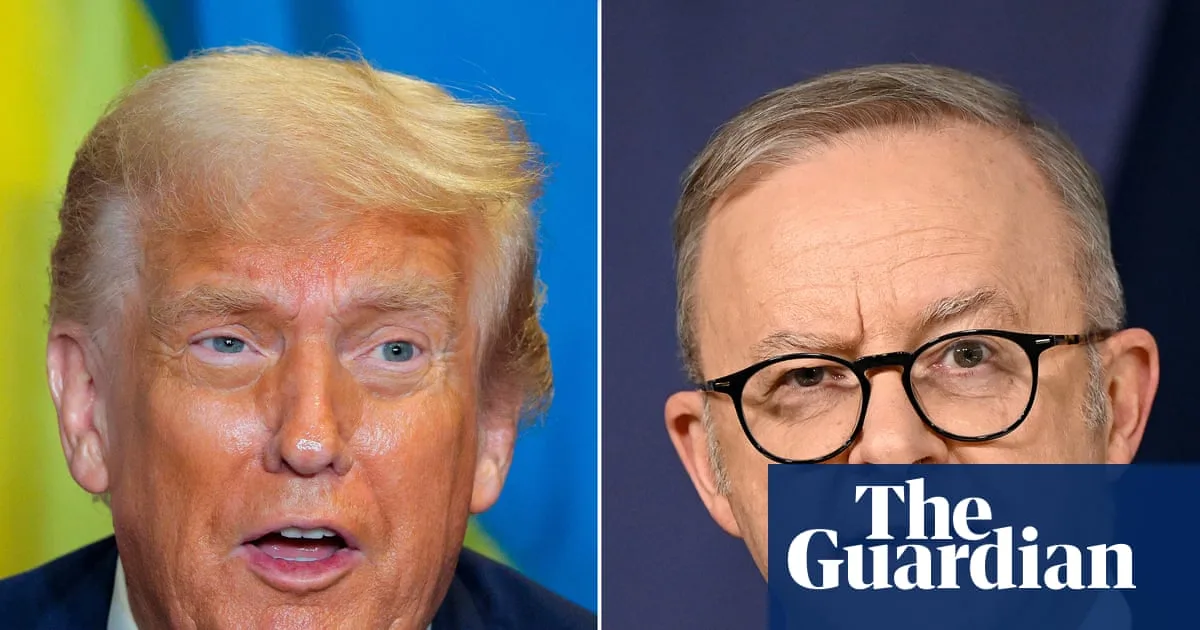
Australian Prime Minister Anthony Albanese has skillfully avoided providing a clear position on whether Australia will participate in former US President Donald Trump's newly announced international body, the Board of Peace. This diplomatic evasion comes as the global community shows deep divisions over the controversial initiative, with some nations embracing the proposal while key democratic allies express significant reservations.
International Split Over Trump's New Initiative
The Board of Peace represents Trump's latest foray into international diplomacy, having been formally unveiled during the recent World Economic Forum gathering in Davos. The stated primary purpose of this new body is to oversee reconstruction efforts in Gaza, though its mandate potentially extends to addressing broader global conflicts and peacekeeping operations. The White House has already appointed several high-profile figures to serve on the inaugural executive board, creating an intriguing mix of political backgrounds and expertise.
Notable appointments include Secretary of State Marco Rubio, special envoy Steve Witkoff, Trump's son-in-law Jared Kushner, and former British prime minister Tony Blair. This diverse leadership team suggests the initiative aims to bridge various political perspectives, though the actual operational framework remains somewhat ambiguous according to several diplomatic observers.
Albanese's Calculated Non-Commitment
When pressed by ABC's Insiders program about Australia's potential participation, Prime Minister Albanese demonstrated masterful political deflection. Countries including Hungary, Belarus, and Saudi Arabia have already agreed to join the initiative, while traditional democratic partners like France, Sweden, Norway, Canada, and the United Kingdom have raised substantial concerns about the board's legitimacy and objectives.
"You can look at my speech I gave to the United Nations, where I spoke about the pillars of our policies, including support for multilateralism," Albanese responded, carefully avoiding direct engagement with the question. He emphasized that his government had been preoccupied with domestic matters, particularly the response to the Bondi Beach terror attack and urgent legislation passed during emergency parliamentary sessions earlier in the week.
"We've been focused this week obviously on domestic concerns. We'll give it further consideration," the Prime Minister stated, establishing a pattern of deliberate ambiguity that would continue throughout the interview.
Questioning Legitimacy and Objectives
When specifically questioned about whether his government views the Board of Peace as a legitimate international body, Albanese again sidestepped providing a definitive assessment. "It's unclear what the objectives of this are," he remarked, highlighting the uncertainty surrounding Trump's initiative. "Which is why we will give it further consideration. My government is one that always has an orderly, considered approach to all of our policy, including our international engagement."
This cautious approach contrasts with more decisive positions taken by some of Australia's closest allies. When asked whether Australia would follow democratic partners like Canada and the United Kingdom in potentially rejecting the proposal, Albanese maintained his ambiguous stance while confirming ongoing diplomatic consultations.
"We're engaged with our like-minded countries as well about all of these issues," he revealed, noting that Canadian Prime Minister Mark Carney will visit Australia and address Parliament in March. "My friend Mark Carney will visit Australia and give an address to the Parliament in March. We are very much engaged with our partners overseas."
Broader Diplomatic Context and Shifting Dynamics
Albanese placed Australia's potential participation decision within the context of evolving global power dynamics and diplomatic tensions. He pointed to increasing turmoil in Europe, particularly regarding renewed American claims over Greenland under the Trump administration, as evidence of shifting international relations.
"We do have a shift in the way international politics is being played, with a greater engagement from middle powers," Albanese observed. "That's something I spoke about when I addressed the UN. We need greater cooperation as we see the world changing in its dynamic."
The Prime Minister endorsed recent remarks by Canadian leader Mark Carney at the World Economic Forum, where Carney warned that "if we're not at the table, we're on the menu." This metaphorical framing suggests Australia faces strategic calculations about engagement versus isolation in emerging international frameworks.
Controversial Comments About Australian Military Service
Separately, Albanese addressed recent controversial comments made by Donald Trump regarding Australia's military contribution in Afghanistan. During a Fox News interview, Trump had questioned whether NATO allies would defend the United States if threatened, specifically mentioning Australian troops in Afghanistan.
"They'll say they sent some troops to Afghanistan ... and they did, they stayed a little back, a little off the frontlines," Trump remarked, adding that international relationships "has to be a two-way street."
Albanese described these comments as "not acceptable" but notably stopped short of demanding a formal apology from the former president. "Those 47 Australian families who will be hurting by these comments—they deserve our absolute respect, admiration," the Prime Minister stated emotionally. "The bravery that was shown by 40,000 Australians who served in Afghanistan. They were certainly on the frontlines, in order to, along with our other allies, defend democracy and freedom. And to defend our national interest."
Bipartisan Defence of Australian Troops
Liberal MP Andrew Hastie joined the Prime Minister in condemning Trump's remarks, offering a fierce defence of Australian military service in Afghanistan. "President Trump has claimed that allied soldiers didn't serve in the front lines in Afghanistan," Hastie stated. "This is a massive slur, not just against Allied troops, but against our Aussie diggers who fought, bled and died alongside Americans."
The opposition MP emphasized the importance of mutual respect in international alliances, noting that "one of the most important things in building coalitions and alliances is mutual respect, and a really important virtue in a leader is restraint. And President Trump by dumping on allied troops has shown neither."
Despite this bipartisan condemnation of Trump's comments about Australian military service, Albanese maintained his position of not demanding an apology, stating simply: "I won't provide a running commentary on Mr Trump's remarks." This consistent refusal to escalate diplomatic tensions reflects the government's careful balancing act in managing relations with the United States during a politically sensitive period.
The Australian government's approach to both the Board of Peace initiative and Trump's controversial comments demonstrates a calculated diplomatic strategy of measured responses, ongoing consultation with international partners, and avoidance of premature commitments in an increasingly complex global landscape.






