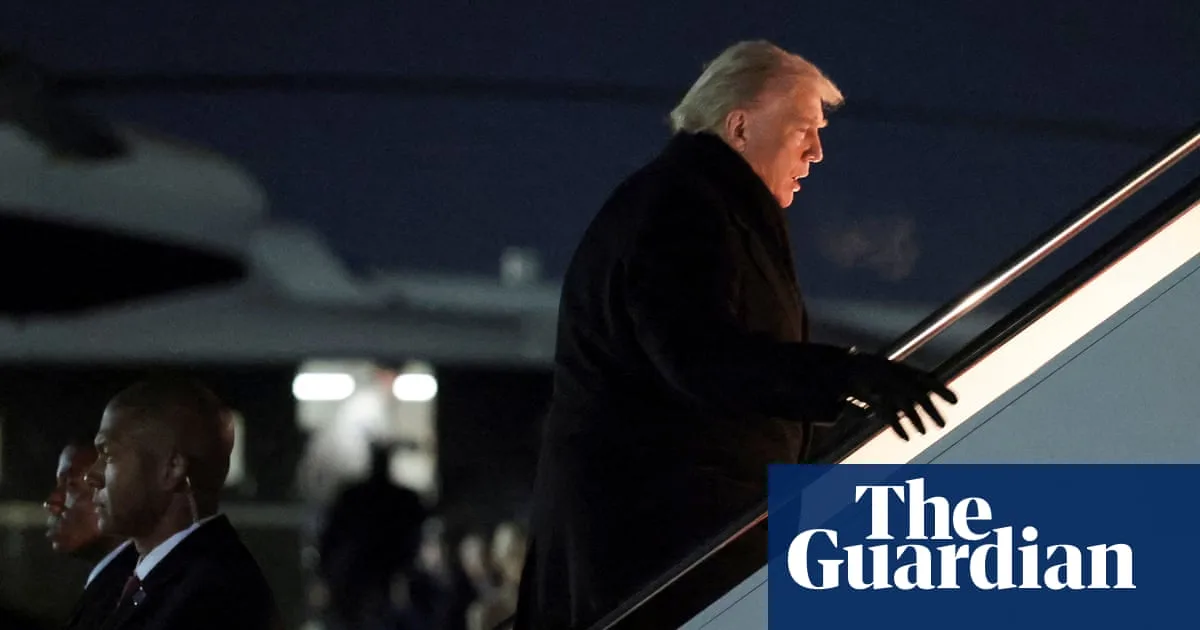
Air Force One was compelled to execute a dramatic U-turn on Tuesday evening while transporting President Donald Trump, following the detection of a "minor electrical issue" that necessitated an immediate return to Joint Base Andrews in Maryland.
Trump's Davos Journey Interrupted by Aircraft Glitch
The president was en route to the World Economic Forum in Davos, Switzerland, when the malfunction became apparent approximately thirty minutes into the flight. This unexpected development forced the pilots to circle back and land at the base, disrupting the carefully planned itinerary.
Subsequently, President Trump boarded an alternative aircraft, a Boeing 757 typically reserved for domestic travel, which successfully completed the transatlantic journey to Europe without further incident.
A Long-Standing Call for Modernisation
President Trump has consistently voiced complaints regarding the ageing fleet of presidential aircraft. The two specially modified Boeing 747 jets currently serving as Air Force One have been operational for nearly four decades, prompting repeated calls for an urgent upgrade.
This viewpoint was shared by his predecessor, Barack Obama, who authorised a contract with Boeing in 2016 to construct two new VC-25B planes as replacements. However, these next-generation aircraft are not anticipated for delivery until 2029, a timeline that has reportedly caused significant frustration for President Trump, who is likely to have concluded his term in office before their arrival.
A Historical Catalogue of Presidential Aircraft Incidents
While the aircraft tasked with transporting the commander-in-chief are equipped with state-of-the-art technology for security and communication, Tuesday's episode is far from an isolated occurrence in the storied history of Air Force One.
Reagan's Pressure Scare in 1984
On September 5, 1984, an earlier iteration of Air Force One, a Boeing 707 that entered service in 1958, experienced a relay failure within an air vent. This malfunction caused a loss of cabin pressure while flying at 21,000 feet with President Ronald Reagan on board.
After passengers reported symptoms including ringing in their ears, the pilot promptly descended to an altitude of 9,000 feet to rectify the situation, ultimately landing safely back in Washington, D.C.
Bush's Repeated Troubles
President George W. Bush encountered issues on multiple occasions. On July 14, 2004, a Boeing 747 transporting the president to Oak Ridge, Tennessee, lost a wing flap, necessitating the dispatch of a replacement aircraft from Joint Base Andrews to complete his journey home.
Later, on November 19, 2006, during a landing in Ho Chi Minh City, Vietnam, for the Asia-Pacific Economic Cooperation summit, six of Air Force One's tires blew out. This incident forced President Bush to utilise a backup Boeing 757 to travel to his next destination in Indonesia, while many White House staff members were relegated to a chartered United Airlines flight.
Obama's Flap Issue and Public Alarm
More recently, President Barack Obama was forced to switch planes in Philadelphia on November 2, 2014, after arriving from Connecticut due to a minor flap issue with the aircraft. This occurred during a busy cross-country campaign schedule ahead of the midterm elections.
In a separate, non-technical incident during Obama's tenure, Air Force One caused public alarm on April 27, 2009. The presidential plane was observed flying over the Statue of Liberty and Upper New York Bay, escorted by a U.S. Air Force F-16 fighter jet. This unannounced flyby, approved for a photo opportunity by the Department of Defense, led some residents of New York and New Jersey to fear an ongoing terrorist incident. The event resulted in a formal apology from President Obama, who was not aboard, and an internal review.
Minor Gaffes and Human Moments
The history of Air Force One also includes less serious, albeit memorable, human moments. These have ranged from President Joe Biden stumbling on the aircraft's steps to an incident in December where President Trump was interrupted while speaking to reporters by someone opening a bathroom door.
"Hello? Somebody's in there. Come on out," the president remarked with a chuckle to the individual inside, who opted to remain discreetly out of sight.
This latest electrical fault, while resolved without injury, underscores the ongoing operational challenges faced by the iconic presidential fleet and reinforces the debate surrounding its necessary modernisation.




