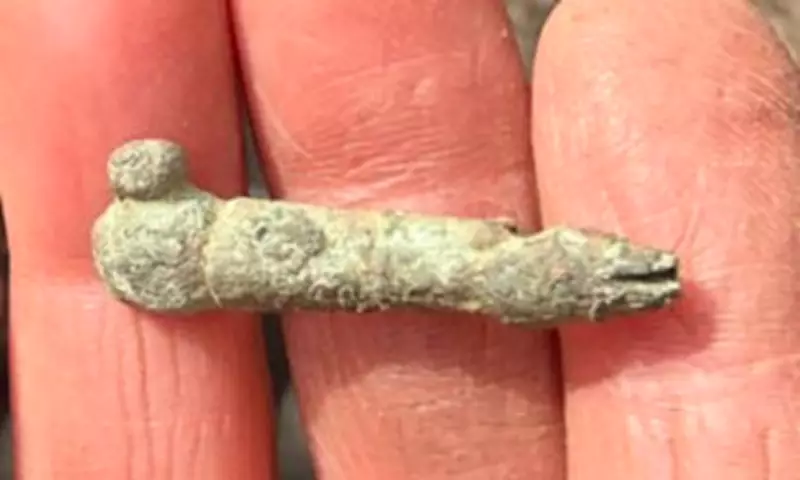
Archaeologists have discovered a 'beautiful' one-inch penis pendant beneath the Carlisle Cricket Club, located on the bank of the River Eden, which was once home to a Roman bathhouse. Experts say the tiny bronze phallus was likely worn as a good luck charm to ward off evil.
Excavation History
Excavations at Carlisle Cricket Club have been ongoing since 2017, with volunteer archaeologists unearthing dozens of relics, including pottery shards, pillar fragments, and large stone heads, as well as artefacts dating back to the Bronze Age. However, this is the first time researchers have discovered one of these popular Roman good luck charms.
Site director Frank Giecco told the BBC: 'It's our first little phallus, it's tiny, it's about 3cm (1.2in), but beautifully made in bronze.'

Roman Symbolism
While it might seem rude to modern eyes, the Romans viewed the phallus as a symbol of good luck, often linked to fertility and protection from evil spirits. Small charms like this one would have been worn on belts or as jewellery, while larger symbols were carved into walls or statues. Legionaries commonly donned penis charms before battle for safety.
Mr Giecco noted that the Romans were 'extremely superstitious' and that the pendant was intended as a 'good luck charm'. He expressed surprise that such objects were common throughout the Roman world, yet it took so long to find one at this site: 'It's unusual we haven't found a phallus-shaped object on the site before, it's so rich in other types of objects.'
Strategic Significance of Carlisle
The abundance of Roman artefacts at the cricket club stems from Carlisle's importance to the Empire's foothold in Britain. Known as Luguvalium to the Romans, the city was a key settlement near Hadrian's Wall, serving as a military and trading centre. Its strategic location at the crossroads of two major roads made it a major commercial hub, housing a legionary garrison and a 1,000-soldier division.
Mr Giecco said the phallus charm 'gives a fantastic insight into the minds of people who lived in Carlisle 1,800 years ago.'
Additional Discovery
Days after the initial find, volunteers uncovered another small charm of similar shape and design, believed to be another phallus pendant.
Other Roman Penis Finds in Britain
This is not the first Roman penis discovery in Britain. In 2021, archaeologists found a Roman millstone near Cambridge decorated with a large carving of a penis. The find came from a Roman villa near Godmanchester, uncovered during road maintenance. Ancient Romans often linked crops, milling, and the fertility symbol of the phallus. Similar phallic millstones have been found in Pompeii, one bearing the inscription 'Hic Habitat Felicitas' ('You Will Find Happiness Here'), intended to imbue the millstone and flour with protective properties.

Roman Rule in Britain
- 55 BC: Julius Caesar crossed the channel with around 10,000 soldiers, landing at Pegwell Bay on the Isle of Thanet, but was forced to withdraw.
- 54 BC: Caesar crossed again with 27,000 infantry and cavalry, landing at Deal. After hard battles, they defeated the Britons, but Caesar returned to Gaul later that year.
- 54 BC – 43 BC: No Romans present in Britain, but trade links increased their influence.
- 43 AD: A Roman force of 40,000 led by Aulus Plautius landed in Kent and took the south east. Emperor Claudius appointed Plautius Governor of Britain.
- 47 AD: Londinium (London) was founded, and Britain was declared part of the Roman empire. Networks of roads were built.
- 50 AD: Romans arrived in the southwest, building a wooden fort near the river Exe, which later became Exeter.
- 75–77 AD: Romans defeated the last resistant tribes, making all Britain Roman.
- 122 AD: Emperor Hadrian ordered a wall built between England and Scotland to keep Scottish tribes out.
- 312 AD: Emperor Constantine made Christianity legal throughout the Roman empire.
- 228 AD: Romans began to be recalled to Rome due to barbarian attacks.
- 410 AD: All Romans were recalled, and Emperor Honorius told Britons they no longer had a connection to Rome.