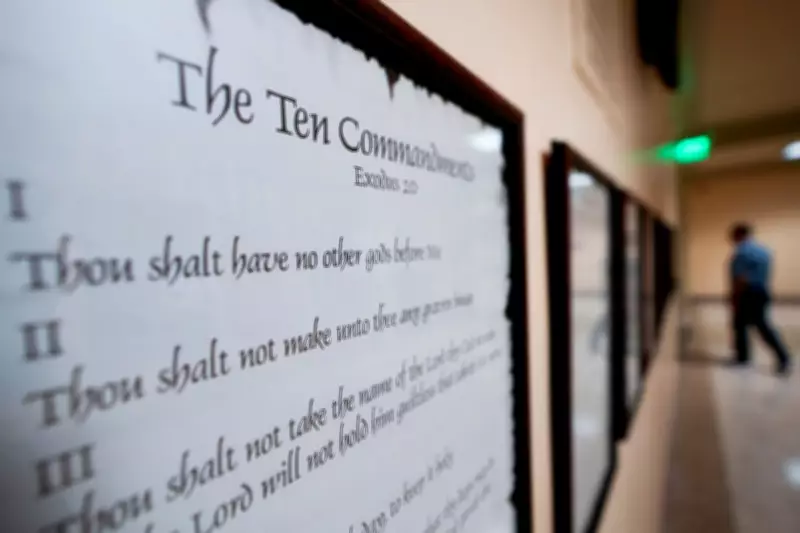
A federal appeals court has cleared the way for a contentious Louisiana statute that mandates the display of the Ten Commandments in public school classrooms, reigniting a fierce national debate over the separation of church and state. The 5th Circuit Court of Appeals, sitting en banc, voted 12-6 to overturn a prior injunction that had blocked the law's implementation, with the majority opinion released on Friday arguing it is too early to rule on the legislation's constitutionality.
Judicial Panel Cites Lack of Clarity in Ruling
In its decision, the court emphasized that without specific details on how prominently the religious text would be displayed, whether teachers would reference it during lessons, or if other historical documents like the Mayflower Compact or Declaration of Independence would also be exhibited, it lacks sufficient information to assess potential First Amendment concerns. The judicial panel stated that more facts are necessary to "permit judicial judgment rather than speculation," effectively postponing a definitive constitutional review.
Dissenting Judges Voice Strong Opposition
However, the six judges who voted against the decision penned a series of dissents, with some contending that the case is ripe for judicial review and others warning that the law exposes children to government-endorsed religion in a compulsory setting, creating a clear constitutional burden. Circuit Judge James L. Dennis notably wrote that the law "is precisely the kind of establishment the Framers anticipated and sought to prevent," highlighting deep divisions within the court.

Broader National Context and Political Implications
This ruling follows arguments heard by the full court in January 2026, after a three-judge panel had previously deemed Louisiana's law unconstitutional. Similar legislation in Arkansas has also faced federal court challenges, while Texas's law took effect on September 1, marking the largest national effort to hang the Ten Commandments in public schools. Despite injunctions in some districts, many classrooms across Texas have already displayed the posters, funded by school districts or through donations.
These laws are part of a broader push by Republicans, including former President Donald Trump, to incorporate religion into public education. Proponents argue that the Ten Commandments are historical documents foundational to U.S. law, while critics assert they violate the principle of church-state separation. The measures have been challenged by families representing diverse religions such as Christianity, Judaism, and Hinduism, as well as nonreligious families and clergy.
Historical Precedents and Legal Battles
In 1980, the U.S. Supreme Court ruled that a similar Kentucky law violated the Establishment Clause of the Constitution, which prohibits laws respecting an establishment of religion, finding it served a plainly religious purpose without a secular one. Then, in 2005, the Supreme Court held that Ten Commandments displays in Kentucky courthouses were unconstitutional, while simultaneously upholding a marker on the grounds of the Texas state Capitol in Austin, illustrating the nuanced legal landscape surrounding such issues.
As this legal battle unfolds, it underscores ongoing tensions between religious expression and constitutional protections in American public life, with potential implications for future policymaking and judicial interpretations across the nation.