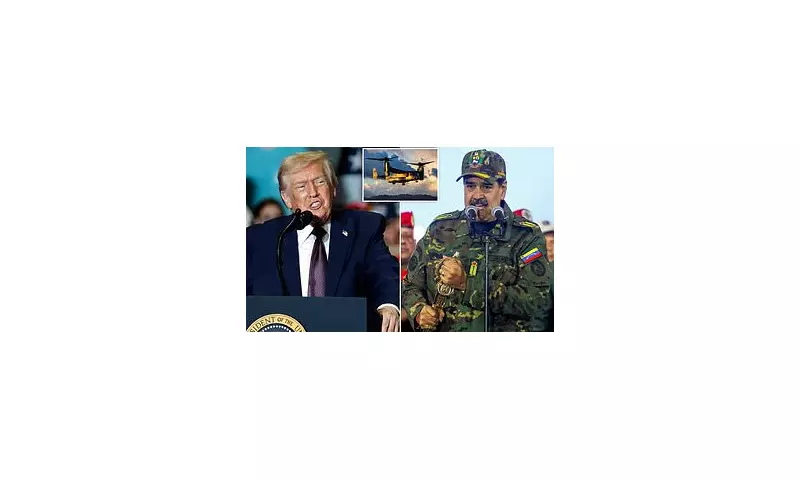
The United States has significantly escalated its military posture in the Caribbean this week, deploying a substantial force of troops and advanced aircraft as diplomatic tensions with the government of Venezuelan leader Nicolás Maduro continue to mount.
A 'Massive Armada' Arrives in the Region
According to reports, a fleet including no fewer than ten CV-22 Osprey tilt-rotor aircraft and C-17 cargo planes, alongside troops and equipment, arrived in the region on Monday. The deployment, originating from bases that house special operations units, suggests the potential involvement of elite forces, though the Pentagon has not confirmed specific troop types.
Former President Donald Trump, in a press conference on Monday, described the US buildup as "a massive armada, the biggest we've ever had" in the area. He directly addressed Maduro, stating it would be "smart" for the Venezuelan leader to step down. Trump added, "Soon we will be starting the same program on land," hinting at further escalations.

This naval and air deployment supplements an existing presence of at least 11 ships and 15,000 troops already operating near Venezuela's vicinity.
Sanctions, Seizures, and a Drone Campaign
The military movement coincides with an aggressive pressure campaign from the Trump administration targeting Maduro's regime. A key strategy has been the seizure of oil tankers used to circumvent US economic sanctions. US Ambassador Mike Waltz told the UN Security Council this week that these tankers "operate as the primary economic lifeline for Maduro and his illegitimate regime."
In response, Venezuela's National Assembly swiftly passed a law criminalising such seizures. The US has linked Maduro's government to the Cartel de los Soles, a group of drug-trafficking military officials designated a foreign terrorist organisation last month.
Furthermore, the administration has conducted a drone strike campaign against Venezuelan vessels. Officials report that these strikes have resulted in 95 fatalities so far.
A Long-Running Political Confrontation
The current crisis is the latest chapter in years of confrontation. Maduro, who has led Venezuela since 2013, faces a $50 million US bounty for his capture on narco-terrorism and other charges. His 2018 and 2024 election victories have been widely disputed by the US and other nations.
The US, under both the Biden and Trump administrations, has recognised opposition figures—first Juan Guaidó and, since November 2024, Edmundo González—as Venezuela's legitimate leaders. Both Guaidó and González now live in exile after Maduro's government issued arrest warrants for them.
While US Southern Command stated the recent deployments are part of "standard practice to routinely rotate equipment and personnel," the scale and timing point to a deliberate show of force. The Pentagon declined to comment further on the operational details.