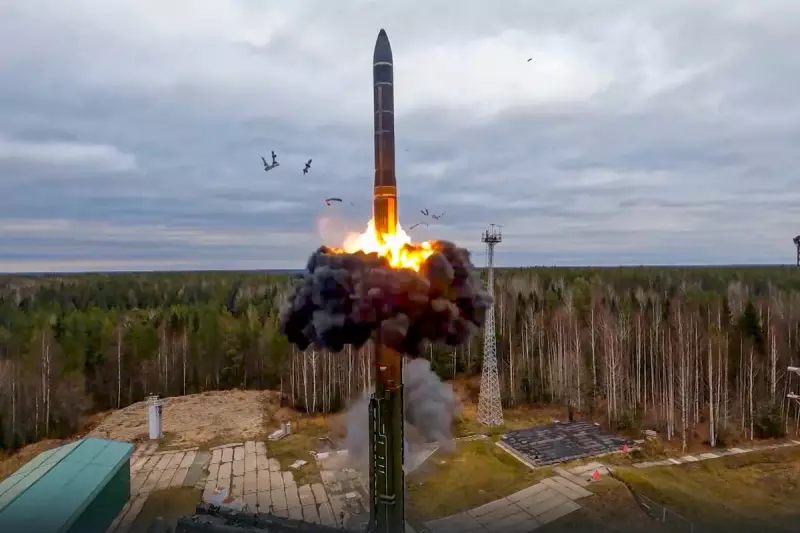
The international community faces a grave new threat to global security as the United States and Russia have both issued warnings that they could resume nuclear weapons testing, a practice largely abandoned for decades. These statements risk shattering a crucial international norm and have sent alarm bells ringing among non-proliferation experts.
A Dangerous Tit-for-Tat Threat
In a late October post on his Truth Social platform, U.S. President Donald Trump declared, "Because of other countries’ testing programs, I have instructed the Department of War to start testing our Nuclear Weapons on an equal basis. That process will begin immediately." The White House has not clarified which nations he was referencing or the precise nature of the proposed tests.
Moscow's response was swift. Russian President Vladimir Putin informed his Security Council that if the U.S. or any other signatory to the Comprehensive Nuclear-Test-Ban Treaty (CTBT) conducted tests, Russia would be "under obligation to take reciprocal measures." This exchange marks a severe escalation in rhetoric between the world's two largest nuclear powers.

The Fragile Norm Against Testing
The current crisis centres on the Comprehensive Nuclear-Test-Ban Treaty, adopted by the U.N. General Assembly in 1996. Although it has not formally entered into force due to a lack of ratification by 44 specific states, it is widely credited with establishing a powerful global norm against explosive nuclear testing.
To date, 187 states have signed the treaty and 178 have ratified it. However, key holdouts remain. China, Egypt, Iran, Israel, and the U.S. have signed but not ratified. India, North Korea, and Pakistan have done neither. Russia ratified the treaty but revoked its ratification in 2023, citing the "unacceptable" imbalance with the U.S. position.
Since the treaty's adoption, only ten nuclear tests have been conducted, all by India, Pakistan, and North Korea. This stands in stark contrast to the approximately 2,000 tests carried out before 1996, predominantly by the U.S. and the Soviet Union. The U.S. last conducted a test in 1992.
Who Stands to Gain from a New Test Era?
Experts warn that a resumption of testing by established nuclear powers would have dire consequences. Daryl Kimball, executive director of the Arms Control Association, stated that U.S. tests would "open the door for states with less nuclear testing experience to conduct full-scale tests that could help them perfect smaller, lighter warhead designs," ultimately decreasing global security.
Joseph Rodgers, a fellow at the Center for Strategic and International Studies, noted that countries like China or India could profit more from renewed testing than the U.S. or Russia, as they have far less testing experience and could significantly advance their weapons programmes.
The Role of Verification and Detection
Amid the uncertainty, the Comprehensive Nuclear-Test-Ban Treaty Organization (CTBTO) in Vienna plays a critical role. It operates a global network of 307 monitoring stations using seismic, hydroacoustic, infrasound, and radionuclide technologies to detect tests. The organisation successfully detected all six of North Korea's tests between 2006 and 2017.
CTBTO Executive Secretary Robert Floyd told The Associated Press his organisation's main role is providing "confidence to states" that they would know if a nuclear explosion occurred "anywhere, anytime." The system was designed to detect explosions of 1 kiloton but performs better, sensing yields as low as 500 tons of TNT. For context, the Hiroshima bomb was about 15 kilotons.
However, verification gaps exist. Kimball pointed out that hydronuclear tests with extremely small yields conducted underground could be "undetectable" by the current monitoring system.

Clarifying the U.S. position, U.S. Energy Secretary Chris Wright indicated the new tests would not include nuclear explosions. This suggests they may be subcritical experiments, which produce no self-sustaining chain reaction and are not banned by the CTBT. The treaty explicitly bans any nuclear explosion that produces a yield, adhering to a zero-yield standard.
The situation remains volatile, with the future of a decades-old restraint on nuclear weapons hanging in the balance. The international community now watches to see if these threats materialise into actions that could unravel a cornerstone of global arms control.