
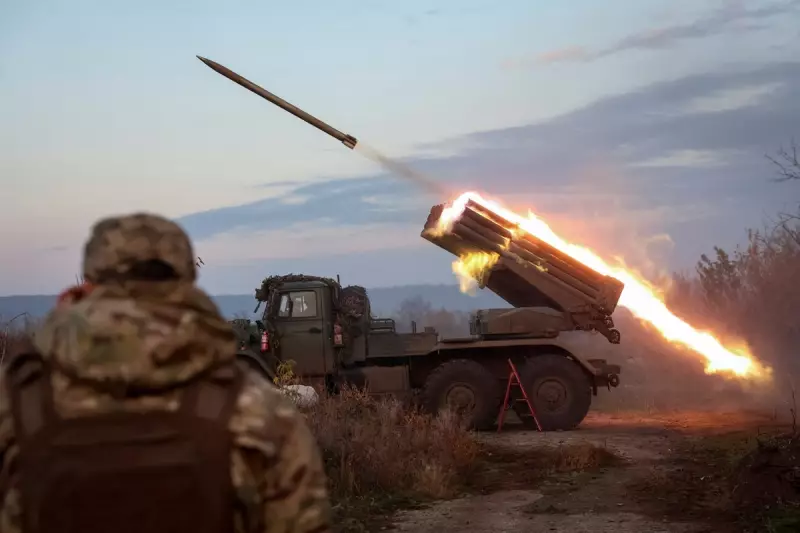
While Western allies deliberate over arms shipments, Ukraine has forged a formidable, homegrown weapons industry from the ashes of its post-Soviet collapse, creating a new paradigm for modern warfare.
The Flamingo: A Symbol of Ukrainian Ingenuity and Autonomy
At the heart of this renaissance is the FP-5 'Flamingo' cruise missile, an entirely Ukrainian-made weapon that grants Kyiv unprecedented strategic freedom. With a staggering range of 3,000 kilometres, a top speed of 900kmph, and a payload exceeding one tonne, the Flamingo can strike deep into Russian territory.
Its development epitomises the 'bodge-and-make-do' ethos: powered by a rocket and a Soviet-era turbofan jet engine, some of which were reportedly dug out of landfill sites. Early prototypes were even painted pink for easier retrieval after test flights.
The missile's most significant advantage is political. Unlike restricted Western systems like the Storm Shadow or ATACMS, Ukraine can deploy the Flamingo against any target it chooses, free from the constraints imposed by its allies.
Cheap, Fast, and Lethal: The Drone Revolution
Beyond long-range missiles, Ukraine's secret factories are mass-producing drones that are both sophisticated and remarkably inexpensive. Companies like Fire Point produce Shahed-style drones, the FP1 and FP2, using innovative methods.
These unmanned aircraft are assembled in hours. Wings are made in a couple of hours, while the fuselage, crafted from a mix of plastic and carbon, takes just 30 minutes. They are glued together with carbon printers, utilise lawnmower engines, and rely on open-source navigation systems.
Cost is a critical factor. An FP1 or FP2 drone costs about $50,000, a fraction of the estimated price of modern Russian Shaheds. This price advantage is vital in a war of attrition where Russia's jamming systems shoot down a high percentage of incoming drones.
From Nuclear Power to Start-Up Nation: A Historical Reckoning
Ukraine's current predicament stems from a painful history. After gaining independence in 1991, it possessed the world's third-largest nuclear stockpile and an arms industry that produced 30% of the Soviet Union's weapons, including terrifying ICBMs like the SS-18 'Satan'.
In 1994, it was persuaded to give up its nuclear arsenal in exchange for security guarantees from the US, UK, and Russia. A decade later, its defence sector, which once employed three million people, had collapsed. This left the nation vulnerable to Russia's first invasion in 2014 and desperately unprepared for the full-scale war in 2022.
Now, the industry is experiencing a rapid rebirth. Though currently valued at around $1 billion, it is growing at an incredible pace. This growth is fuelled by battlefield necessity and a drastic reduction in bureaucracy, allowing companies to prioritise frontline effectiveness over meeting NATO standards on paperwork.
As Iryna Terekh, Chief Technology Officer of Fire Point, stated: "We all have to grow up and build our own security with our own hands. This means ending reliance on America. What we learn from working in Ukraine is that you have to diversify and you have to rely on yourself."
This sentiment underscores a broader lesson for Europe: Ukraine, through sheer innovation and determination, is not only building the most powerful army in Western Europe but is also establishing itself as a future dominant force in the continent's defence landscape.