Britain's new top military commander has declared that the nation's security cannot be shouldered by the armed forces alone, issuing a stark warning about an increasingly perilous global landscape.
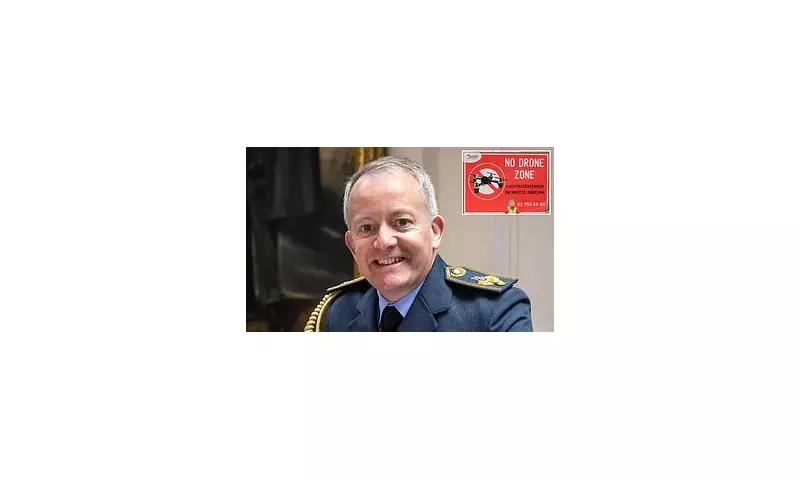
Air Chief Marshal Sir Richard Knighton, the Chief of the Defence Staff, confirmed that the UK has dispatched military personnel and equipment to Belgium following a series of disruptive drone incursions widely believed to have been orchestrated by Russia.
Security Alert Over European Skies
The urgent deployment was initiated after Belgium's primary airport, Zavantem, was forced into a temporary closure on Thursday evening when unidentified drones were detected in its vicinity. Similar aerial devices were also observed near a military base and other sensitive locations.
This incident is part of a worrying pattern of drone sightings over critical infrastructure, with recent reports from airports in Germany, Denmark, Norway, and Sweden. Sir Richard stated that his Belgian counterpart directly requested assistance to manage these security breaches.
While not definitively confirmed, Sir Richard acknowledged it was 'plausible' the Kremlin had ordered the drone incursions. The aerial intrusions caused significant travel chaos, with approximately 3,000 Brussels Airlines passengers facing cancellations and diversions, leading to what the carrier described as 'considerable costs'.
A Call for a United National Defence
In a separate commentary published in the Sunday Telegraph, Sir Richard, who assumed his role in September, elaborated on the broader threats facing the UK and its allies. He pointed to Russia's full-scale invasion of Ukraine as clear evidence that the relative safety once enjoyed by European nations is now under threat.
"This conflict reminds us that peace is never guaranteed," he wrote. "It must be defended, and sometimes at great cost."
He praised the armed forces for their work from deterring aggression on NATO's eastern flank to protecting critical undersea cables. However, he emphasised that a robust defence is a collective national responsibility.
"Defence is not the responsibility of the military alone. It is a national endeavour," Sir Richard argued. "It requires investment, innovation, and the support of a society that understands the stakes."
Echoes of Concern from Political Leadership
This sentiment was powerfully echoed by Conservative Party figure Kemi Badenoch. She expressed deep concern that Britain is "losing a sense of who we are and what we're fighting for," attributing this to a "slow erosion of pride" in national institutions and education.
Ms Badenoch cited a particularly alarming statistic, revealing that just ten per cent of 18 to 28-year-olds would be willing to fight for the country.
"A nation is only a nation when people are prepared to defend it. And it is both tragic and concerning that many people in Britain today no longer feel that call," she stated.
In response to the escalating threats, the government has committed to increasing defence spending to 2.5 per cent of GDP from April 2027, with an ambition to raise it further to 3 per cent in the next parliament.