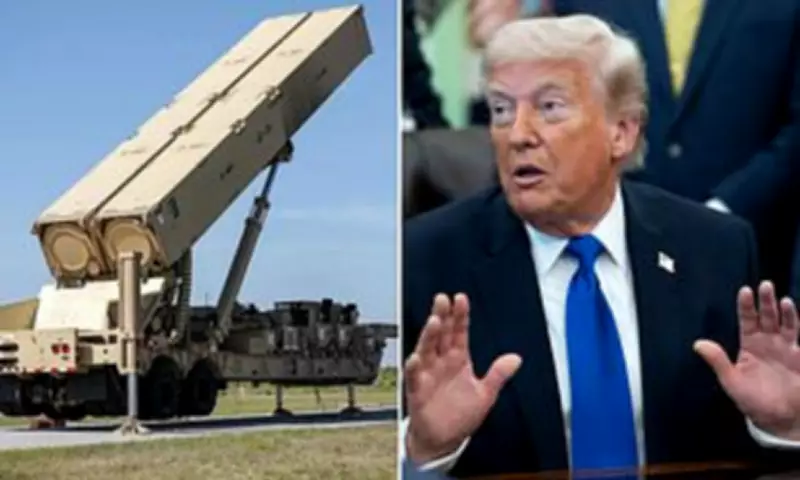
President Donald Trump is reportedly considering the first-ever deployment of America's £30 million Dark Eagle hypersonic missiles as he evaluates new military strikes against Iran. The long-range weapon, which travels at five times the speed of sound and can strike targets up to 2,000 miles away, would enable the US to target Iranian missile launchers that have been relocated beyond the reach of current American systems.
Centcom Request and Strategic Implications
The request from US Central Command (Centcom) argues that Tehran has moved its ballistic-missile launchers out of range of the Precision Strike Missile, which has a range of over 300 miles. However, the Dark Eagle program is running significantly behind schedule and has not yet been declared fully operational, even as Russia and China have already deployed their own hypersonic weapons. No final decision has been made on the request, according to Bloomberg, which cited a source with direct knowledge of the matter.
Centcom's move signals that Washington is preparing for further strikes against the Islamic Republic. While most details about the Dark Eagle remain classified, the nuclear-capable boost-glide missile is understood to reach altitudes in the upper atmosphere and can maneuver to evade air defenses.

Ceasefire and Rearming
A ceasefire between the US and Iran has been in place since April 9, but Trump faces pressure to either break the stalemate in negotiations or deliver a decisive blow to end the costly two-month war. Both sides have used the ceasefire to rearm and plan, according to Bloomberg's Becca Wasser, who warned that future rounds of fighting may be more deadly.
Deploying the missile to the Middle East would send a message to strategic adversaries Russia and China that the US can finally match a capability they have long mastered. Moscow's Kh-47M2 Kinzhal entered combat in 2019, while Beijing's DF-17 was deployed in 2020, leaving the US in a race to catch up.
Dark Eagle Development and Costs
The Dark Eagle, also known as the Long-Range Hypersonic Weapon (LRHW), is designed to glide to its target at over five times the speed of sound. Each battery costs approximately $2.7 billion (£2 billion), according to the Government Accountability Office. Its development has faced years of delays due to technical hurdles in achieving speeds up to Mach 5, along with supply-chain issues and testing failures.
Pentagon Plans and Iranian Threats
The Pentagon is drawing up plans to resume major combat operations against Iran to break its control over the Strait of Hormuz and force it back to diplomatic talks. Iran has threatened to respond with long and painful strikes on US positions if Washington renews attacks, reiterating its claim to the vital waterway. Supreme Leader Ayatollah Mojtaba Khamenei stated that Tehran would eliminate the enemies' abuses of the waterway, indicating an intent to maintain control.
UN Secretary-General Antonio Guterres warned that prolonged disruption of the strait could cause global growth to fall, inflation to rise, and push tens of millions more into poverty and extreme hunger. The sea channel has been closed for two months, choking off 20% of the world's oil and gas supplies and sending global energy prices surging.
Conflict Dynamics and Congressional Deadline
While the US and Israel have spent weeks pummeling Iran's military capability, Tehran has preserved a considerable number of its missiles and mobile launchers, some hidden in northern mountainous terrain. Washington hopes renewed strikes will pressure Iran to dismantle its nuclear program, a major sticking point in negotiations.
According to Axios, the Pentagon is also considering taking over part of the strait to reopen it for commercial shipping, an operation that may involve ground troops. On Friday, Brent crude rose 83 cents to $111.23 per barrel, while US benchmark crude added 12 cents to $105.19.

Trump faces a formal US deadline under the 1973 War Powers Resolution to end the war or seek congressional authorization. However, a senior administration official stated that hostilities had terminated due to the April ceasefire, potentially allowing the deadline to pass without altering the conflict's course. Democrats have repeatedly tried to pass resolutions to force Trump to withdraw US forces, but Republicans have voted them down almost unanimously.
Senator Susan Collins of Maine became the second Republican to back a war powers resolution, joining Senator Rand Paul of Kentucky. Under the resolution, the president can wage military action for only 60 days without congressional authorization, a deadline that began on February 28 when Trump formally notified Congress of the conflict.
Trump reiterated that Iran's economy is a disaster, but analysts suggest that if he expects Iran to blink first in an economic standoff, he may be waiting a while. The conflict has aggravated Iran's dire economic problems, but the country appears able to survive a standoff in the Gulf for now, despite a US blockade cutting off energy exports.