Britain's Fading Symbol of Remembrance
The iconic red poppy, which has served as Britain's enduring symbol of remembrance for over a century, appears to be facing a significant decline in public visibility and availability across the country. According to observations made by the Daily Mail in towns and cities nationwide, fewer people are wearing poppies in the run-up to Armistice Day on November 11 and Remembrance Sunday.
Nationwide Shortages and Changing Patterns
Volunteers across multiple regions report selling fewer poppies than in previous years, with some areas experiencing genuine shortages. The Daily Mail's survey found only a small percentage of shoppers displaying poppies in locations including areas heavily bombed during World War Two.
In Liverpool Street Station, a concerning snapshot revealed only four people wearing poppies among a crowd of nearly 100 commuters. Similar patterns emerged in Bideford, North Devon, where just five shoppers were spotted with poppies on the pedestrianised high street.
Ray Eyres, owner of Mill Street Butchers in Bideford, expressed his concern: "I've not sold many at all this year to be honest with you. It's got so bad I've started putting my own money in just so the collecting tin isn't quite so empty."
Multiple Factors Behind the Decline
The reasons for this apparent slump in popularity are complex and varied. Volunteers and observers point to several contributing factors including younger generations shunning the tradition, difficulties finding volunteers to sell poppies, and even complaints about the new plastic-free paper poppies first introduced in 2023.
Former Royal Marine Captain Derek Sargent, 78, who organises collections in North Devon, highlighted the volunteer crisis: "We used to have a lot more collectors, but it's a sign of the times. People who used to do it have died off and not been replaced."
The problem extends to distribution networks. Emma Cruickshank, manager of Hairshare salon in King's Lynn, explained how the traditional supply chain had broken down: "We used to have a person come in who would ask us if we wanted a box... but that all stopped years ago."
Regional Variations and Local Efforts
The situation varies significantly across different regions. In London's East End borough of Newham, which lost more than 3,000 residents during World War Two, poppy sellers were notably absent at Stratford station and the nearby shopping centre.
Meanwhile, in Whitechapel, Tower Hamlets, visitors could donate to a food bank and receive a free English-language Quran, but found no opportunity to purchase poppies. The contrast highlights shifting priorities in diverse urban communities.
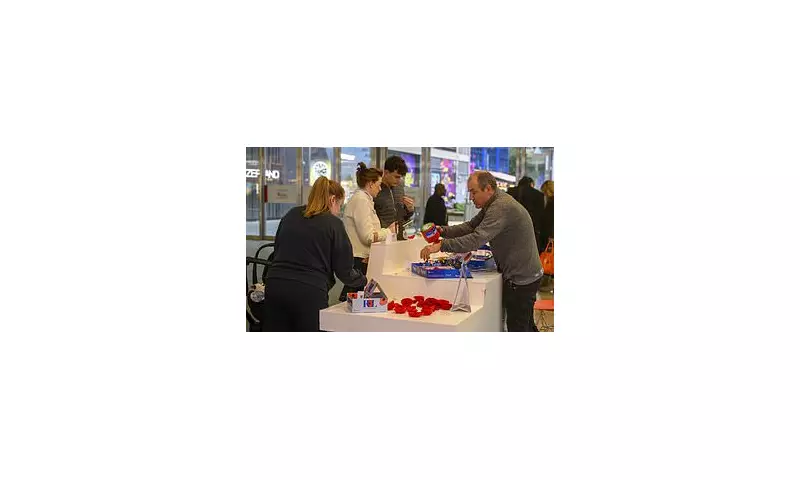
However, some areas maintain strong support. At Westfield shopping centre in Stratford, poppy seller Liam Adam reported brisk business: "We've taken, I reckon, a few hundreds pounds this morning or maybe 60 poppies. One person gave £40, that's a huge donation."
Financial Impact and Royal British Legion Response
The annual Poppy Appeal remains the Royal British Legion's biggest fundraising event, bringing in £51.4 million last year with 40,000 volunteers distributing 40 million poppies. However, this total still falls short of pre-Covid levels, notably the record £55 million set in 2018.
The fundraising pattern has shown volatility in recent years, with sales slumping to £27.9 million during 2020 lockdowns before recovering to £41.9 million in 2023.
A Royal British Legion spokesperson offered a more optimistic perspective: "The Royal British Legion has distributed 30 million poppies for this year's Poppy Appeal, as we do every year. We have more collectors supporting the Appeal than last year, with over 54,000 people generously donating their time across the nation."
Last week's London Poppy Day actually set a new record, raising £1.478 million in a single day, representing a 14% increase on the previous year.
Historical Significance and Modern Challenges
The poppy's association with remembrance dates back to World War One, when the flowers became a common sight on the Western Front, flourishing in fields churned up by fighting and shelling. Canadian doctor John McCrae famously drew inspiration from them for his poem 'In Flanders Fields', written while serving in Ypres in 1915.
After the war ended in 1918, a campaign grew to make the poppy a symbol of remembrance. Artificial poppies were first sold in 1921 to support the Earl Haig Fund for ex-servicemen and families of the fallen. The British Legion (which became the Royal British Legion in 1971) established a factory staffed by disabled ex-servicemen making poppies in 1922.
As Britain approaches another Remembrance Sunday, the mixed picture emerging nationwide suggests that while the tradition remains important to many, its visibility and accessibility face significant challenges in the modern era.