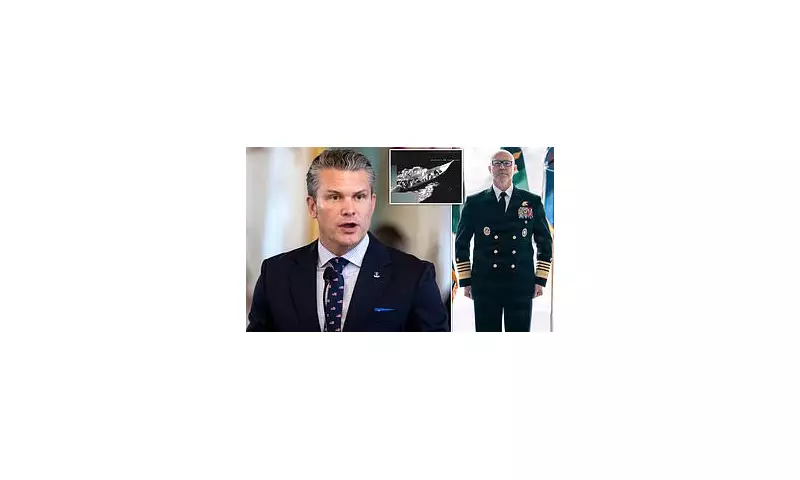
US Defence Secretary Pete Hegseth is embroiled in a major controversy, accused by military officials of throwing an 'American hero' under the bus following a deadly second strike on a suspected Venezuelan drug smuggling vessel. The White House has identified Admiral Frank Mitchell Bradley as the officer who ordered the contentious follow-up attack on September 2, which has ignited fury within the Pentagon and prompted accusations of potential war crimes.
Details of the Controversial Caribbean Strikes
The incident unfolded in the Caribbean on September 2. An initial missile strike hit the alleged drug-smuggling boat, setting it ablaze and reportedly killing all but two of the suspected cartel members on board. Commanders monitoring a live drone feed observed the two survivors clinging to debris in the water. According to insiders, Admiral Bradley, then head of Joint Special Operations Command, subsequently ordered a second strike that eliminated the duo.
Military sources claim Bradley was acting on direct orders from above to ensure no survivors. Hegseth allegedly demanded that everyone on board be killed. The second strike has drawn intense scrutiny because international humanitarian law prohibits attacks on incapacitated combatants. The Pentagon's own Law of War Manual states that shipwrecked persons cannot be knowingly attacked and must receive medical care unless they act with hostility.

Pentagon Revolt and Political Fallout
The public identification of Admiral Bradley by White House spokeswoman Karoline Leavitt sparked immediate revolt within the Pentagon. One military insider labelled the move 'protect Pete bulls**t', while another accused Leavitt of 'throwing us, the service members, under the bus' with her carefully crafted statement. The situation has reportedly led some officials to consider leaving their posts.
In a post on X, Hegseth mounted a strong defence of Bradley, calling him 'an American hero, a true professional' and offering his '100% support'. However, his comments simultaneously fuelled fears he was attempting to shift responsibility for the legally dubious second strike onto the Admiral. Both Republican and Democratic lawmakers have pledged investigations, with bipartisan concern that the action may have breached international law.
Legal Experts and Wider Geopolitical Tensions
Legal scholars have been scathing in their assessment. Laura Dickinson, a law professor at George Washington University, stated that most experts do not believe the boat strikes qualify as armed conflict, meaning lethal force would only be permissible as a last resort. 'It would be murder outside of armed conflict,' she said, adding that even in war, killing survivors 'would likely be a war crime'. A group of former military lawyers, the JAGs Working Group, called the order 'patently illegal'.
The controversy occurs against a backdrop of heightened US military activity in the region, with at least 11 warships and 15,000 troops deployed. President Trump has warned Venezuelan dictator Nicolas Maduro to flee and confirmed talks about his potential resignation. The administration has authorised covert CIA operations in Venezuela, weighing options to combat Maduro's alleged role in drug trafficking, which he denies.
In total, 11 people were killed in the September 2 strikes. The US military has conducted at least 19 similar strikes in the Caribbean and off Latin America since September, resulting in at least 76 deaths. The Pentagon has yet to publicly present evidence that the targeted boats were carrying drugs or operated by designated terrorist groups.