
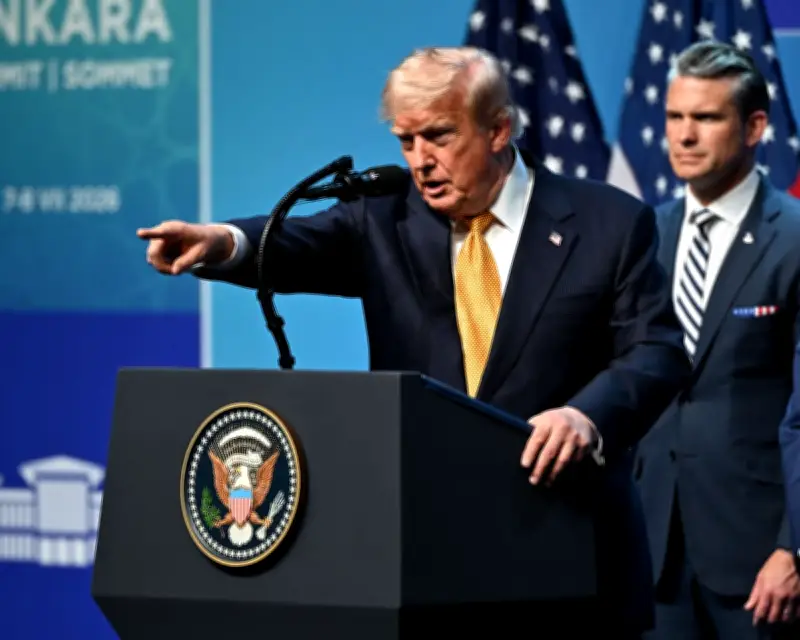
Europe has finally accepted that it can no longer rely on the United States for military protection, a shift driven by Donald Trump's unpredictable presidency. At this week's Nato summit in Ankara, leaders worked to project unity, but behind the scenes, uncertainty reigns about America's commitment.
Summit Highlights Tensions
Trump used the summit to reiterate his desire to annex Greenland, criticise allies for not joining US-Israel strikes on Iran, and call for a trade halt with Spain over low defence spending. Despite these outbursts, Nato Secretary General Mark Rutte emphasised that Europe and Canada were 'stepping up' after US demands, with many members showing increased military expenditure.
According to Dan Sabbagh, the Guardian's defence editor, 'Europe has gone through the five stages of grief and we're certainly arrived at acceptance. We are now at the point where people are starting to plan. They realise that you can't rely on the US as much as before.'
Massive Investment Underway
Britain and 11 other Nato countries have committed to a £37 billion project over the next decade to build new missile capabilities. Joint projects like the next-generation fighter jet involving the UK, Italy, and Japan are progressing. However, critics question the necessity of such massive investment given Russia's weakened state after the Ukraine war, with nearly half a million Russian soldiers dead and fuel shortages from Ukrainian drone attacks.
Sabbagh notes, 'Nato says that Russia might be ready for another war by 2030. But this seems very, very early given that the Ukraine war is still ongoing.'
Can Europe Defend Itself?
With a population of 600 million against Russia's 140 million, Europe has the economic and technological edge. The US plans to reduce its troop and jet presence in Europe by a third, redeploying naval and bomber divisions elsewhere. 'Can Europe compensate? Of course it can, but it comes at a cost to European taxpayers,' says Sabbagh. 'The question is the level of will among governments and electorates.'
Emotional and Strategic Shift
The end of the Cold War saw Europe cut defence spending to fund welfare states, relying on America's military umbrella. Now, 'Europe's recognised that you can't get away with leaning on America any more,' Sabbagh explains. Even after Trump, the US position is unlikely to revert, forcing Europe to become self-reliant. 'People are less certain what the US would do in a crisis,' he adds, underscoring the need for Europe to stand up for itself.




