
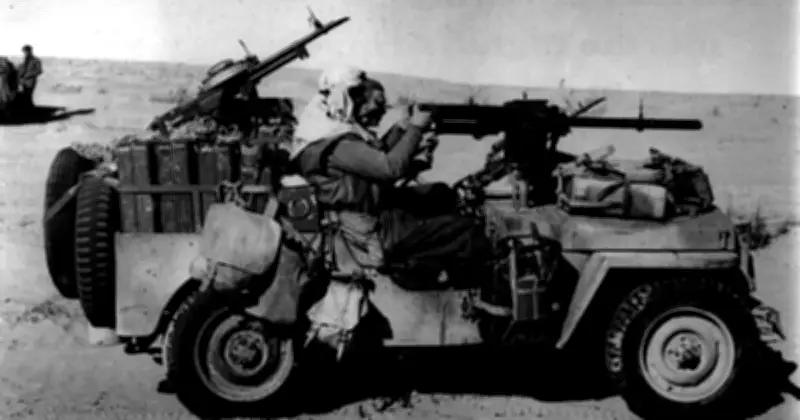
In temperatures up to 50 degrees Celsius, with the ferocious Qibli wind sand-blasting exposed skin with burning hot grains, three ragtag patrols of unwashed, unshaven warriors in bizarrely adapted trucks pushed hundreds of miles behind enemy lines. When the wind finally eased, the men were deep in an uncharted part of the Libyan desert where the Italians would not believe any foe could reach, let alone operate.
They quickly attacked two unoccupied enemy airstrips, destroying equipment and fuel dumps, before they came across two enemy six-ton lorries making their fortnightly supply run south to the Italian garrison at Kufra. A single burst from a British Lewis gun – the very first shots the unit had fired in combat – was enough to bring the shocked Italians to a halt. The piratical patrol had just captured its first booty: two Italian soldiers, five Arabs, a goat and 2,500 gallons of petrol, plus a treasure trove of intelligence in the bag of official mail.
It could have been a classic early attack by the Rogue Heroes of the Special Air Service, but this was North Africa in September 1940, nearly a year before the famed SAS first came to be. Before there was the SAS there were the extraordinary men of the Long Range Desert Group (LRDG). And before there was David Stirling, or Paddy Mayne, of SAS fame, there was Ralph Bagnold.
Don't worry if you've never heard of him, you're not alone. Bagnold hated publicity as much as he loved the deserts of North Africa, but he and his fellow adventurers were the forerunners of the SAS, honing skills that virtually all Special Forces still use today. Now, using his own decade of experience in the Special Boat Service (SBS) – walking in their footsteps and driving in their tyre tracks – Steve Titch Cormack has told the history of Ralph Bagnold and the LRDG in a thrilling new book, SAS 101.
Ex-SBS Operator Titch Cormack Tells Story of LRDG
Much has changed in the many years that separate the LRDG from the present-day SAS and SBS, but much also remains the same, Titch explains. If equipment and weaponry are more sophisticated, they still teach new members the same techniques of desert driving that the LRDG invented, developed and perfected. The deep-penetration, behind-the-lines operations that they pioneered – including covert intelligence gathering, pathfinding for conventional forces and lightning strikes on vital targets – remain the template for Special Forces operations.
Ralph Bagnold: An Unlikely Rogue Warrior
Born in 1896, Ralph Bagnold was an unlikely Rogue Warrior – skinny and shy, with a stutter that made him a target for school bullies at Malvern public school. He dodged school sports by opting to work in the engineering department, learning to operate machine tools, lathes and milling machines. Joining the Royal Engineers after leaving school, he spent three years in the trenches in the First World War, then read engineering at Cambridge before returning to active duty in 1921.
In 1925 he was posted to Egypt where he developed a lifelong obsession with the desert. While others spent their spare time in the bars and brothels of Cairo, Bagnold and a few like-minded individuals – mainly officers from the Royal Engineers, the Royal Corps of Signals and the Royal Tank Corps – made long trips into the desert in Model A Fords. With others, he drove the old caravan road from Cairo to Suez; made a 10-day, 1,000-mile journey across Sinai through Nekhel and Jerusalem to Transjordan; and drove through 400 miles of desert to reach the Siwa Oasis.
In 1930 the adventurers formed the Zerzura Club, dedicated to the search for Zerzura, a lost and possibly mythical oasis in the heart of the Libyan Desert. Bagnold then made the first ever east-west crossing of the entire Libyan Desert in 1932. By 1939, Bagnold and his fellow travellers had perfected their desert techniques so, in true British military fashion, when war broke out, Bagnold was posted not to the desert, which he knew better than anyone alive, but to a Signals unit in East Africa. Fortunately, his ship was involved in a collision in the Mediterranean and, while Bagnold awaited a replacement, he took a train to catch up with old friends in Cairo.
An Egyptian Gazette gossip columnist, assuming the great desert explorer had been posted to Egypt, wrote an article sarcastically praising the military for sending a man to an area where his expertise might actually be useful. British Commander-in-Chief in the Middle East, General Archibald Wavell summoned Bagnold and, within two days, had arranged for him to be posted instead to the 7th Armoured Division – the original Desert Rats.
Bagnold volunteered to assemble a small assortment of desert-worthy American vehicles and train a nucleus of officers and men in the art of cross-country driving but General Henry Jumbo Wilson, commander of British troops in Egypt, rejected the idea. Twice.
When Italy declared war on June 10, 1940, Bagnold was horrified that no preparations had been made to defend against the threat that troops from the Italian garrison at Kufra, with air support, could rapidly advance across the desert, cut the Khartoum to Cairo railway, menace the Suez Canal and open the sluices of the Aswan Dam, catastrophically flooding Cairo.
This time Bagnold got a Brigadier friend to bypass General Wilson and put his suggestion on General Wavell's desk. Wavell again summoned Bagnold who said that, in addition to surveillance of enemy troop movements, the men of his proposed unit might also indulge in piracy on the high desert against enemy convoys. Wavell gave Bagnold six weeks to form a unit and gave him a signed letter authorising him, under strict secrecy, to get whatever he needed for his long range patrol unit.
Bagnold secured a base in the old Fever Hospital Barracks at Abbassia, Cairo; bemused Army quartermasters with demands for Arab shemaghs and dozens of pairs of chaplis (open-toed sandals) instead of boots; and by the time he had equipped his new unit with weapons he had left just three machine guns in reserve for the whole Middle East. He recruited men for their calm and their ability to get on under extreme stress rather than their military skills, and he warned them You must forget everything the Army ever taught you and learn to use your own initiative.
In the LRDG they never had parades or rifle drills and every task, including sentry duty and cleaning the dishes, was shared by officers and men alike. Whatever their rank, men called each other by their Christian names. The only concession to Army dress codes was the wearing of the LRDG emblem – a scorpion – and the most intensive training was reserved for navigation and signalling since Bagnold knew the often featureless desert terrain would be as challenging to his men as the open ocean was to mariners.
Titch Cormack, who spent 11 years in the Royal Marines before passing Special Forces selection, says: I only really came across the LRDG after I became badged (joined the SBS) and then when I was put into Mobility Troop because of my background, racing motorcycles for the military. I met some wonderful older generation SF guys and they started to tell me about the LRDG and I began to learn about these gentlemen who were doing their stuff two years before Stirling and Mayne.
In the early stages of the Desert War in 1940, British forces were heavily outnumbered and the LRDG played a crucial role repeatedly driving to and fro in the desert to create enough vehicle movements, dust clouds and wheel tracks to bluff Italian reconnaissance aircraft that the British had a far larger force in Egypt.
They also began lightning attacks to disrupt enemy communications and supplies. Long before the SAS, they were carrying out beat-up attacks on enemy bases and convoys, but their real value was in crossing the impassable desert and getting into covert positions to carry out vital surveillance of enemy troop movements. They were happy to help the young SAS – earning the disparaging nickname of the Desert Taxi Service – and a number of LRDG men were later poached by the SAS.
But Titch reveals: There was obviously a little bit of friction between the two units. I came across multiple examples, like when the LRDG had been diligently watching a target airfield for days and knew the best time to hit it – say, on a Thursday morning – when numerous aircraft would be on the ground. And then on the Wednesday the SAS would show up and destroy the three planes they found and the LRDG guys would be, like, No! No! No! If you had waited, we could have destroyed 30 planes, not three. While the SAS would get lots of credit for destroying three aircraft, it would bring a lot of heat and the LRDG guys watching from their hidden ops would have to extract quickly to avoid being discovered.
Titch, who became a Chief Mobility Instructor within UK Special Forces, says: I perhaps feel a special connection to the LRDG because, as a member of Mobility Troop, I was using the skills they had developed to navigate, drive and fight in the deserts. The more I discovered, the more my respect, admiration and awe of them grew.
At the end of the desert campaign in March 1943, it was the LRDG who pioneered a route through the previously impenetrable Matmata Mountains – Wilder's Gap – and a route north from there, which allowed General Bernard Montgomery to execute his famous left hook and attack the flank of the German Afrika Corps, bringing a swift victory.
Despite its successes, the LRDG was disbanded at the end of the war and the unit's remarkable exploits have been largely overshadowed since. Titch, who since leaving the military has set up the S-Bomb vintage workshop, building customised motorbikes and cars, and starred in the BBC TV series The Speedshop, says: The reason the LRDG is not spoken about so much is because Bagnold was such a humble character. He very rarely boasted about the LRDG's achievements. They just quietly went about their business. He was much happier staying under the radar, whereas David Stirling was very outspoken about the SAS and was a very good self-promoter, as it were. That is not meant to be derogatory of the SAS. They were brilliant guys and they achieved a hell of a lot, but the LRDG was the forerunner and they, and Bagnold, deserve much greater recognition than they have received.
SAS 101 by Titch Cormack (Penguin Michael Joseph, £22) is out now.




