Defense Secretary Pete Hegseth has issued a stark warning that the United States military campaign in Iran is in its early stages, with President Donald Trump poised to exert significant influence over the nation's future leadership. The remarks come nearly a week after the initiation of 'Operation Epic Fury,' a joint US-Israeli offensive that has resulted in the deaths of Ayatollah Ali Khamenei and several other high-ranking Iranian officials.
Military Operations Intensify
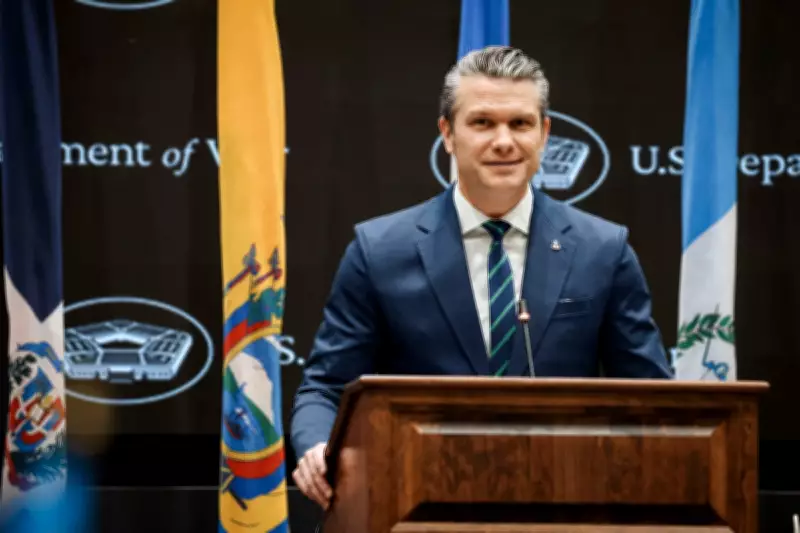
Admiral Brad Cooper, the commander of US Central Command, provided a detailed update during a press conference held on Thursday alongside Secretary Hegseth. He revealed that American bomber forces have executed strikes on approximately two hundred targets deep within Iranian territory over the past seventy-two hours, including numerous sites in and around the capital city of Tehran.
The scale and persistence of these attacks underscore a determined military posture. "We have only just begun to fight and fight decisively," Hegseth emphatically stated to assembled reporters. He added a foreboding note, suggesting the conflict will escalate further: "If you think you've seen something, just wait."

Uncertain Duration and Strategic Aims
While the Pentagon has not provided a definitive timeline for the conclusion of Operation Epic Fury, Hegseth's comments strongly indicate that an immediate cessation is not anticipated. The ongoing strikes represent a sustained effort to degrade Iranian military and leadership capabilities, creating a volatile and unpredictable situation in the region.
The vacuum left by the elimination of Iran's supreme leader has introduced profound uncertainty regarding the country's political future. This instability forms a critical backdrop to the continued military engagements and the broader strategic calculations of the US administration.
Trump's Role in Post-Conflict Iran
A particularly significant aspect of Hegseth's briefing was his assertion regarding President Trump's prospective role in shaping Iran's next government. "I think the president's having a heck of a say in who runs Iran, given the ongoing operation we have," Hegseth declared.
This statement signals an unprecedented level of intended US involvement in the internal succession process of a sovereign nation, directly linking the military campaign to long-term political objectives. It suggests the administration views the current conflict as an opportunity to fundamentally alter Iran's governance structure, with President Trump positioned as a key arbiter in determining its new leadership.
The combined military pressure and explicit political ambition outlined by the Defense Secretary point to a complex and evolving situation, where battlefield actions are intrinsically tied to ambitious geopolitical redesign. The coming days and weeks are likely to see continued developments as Operation Epic Fury progresses and the future of Iran hangs in the balance.