
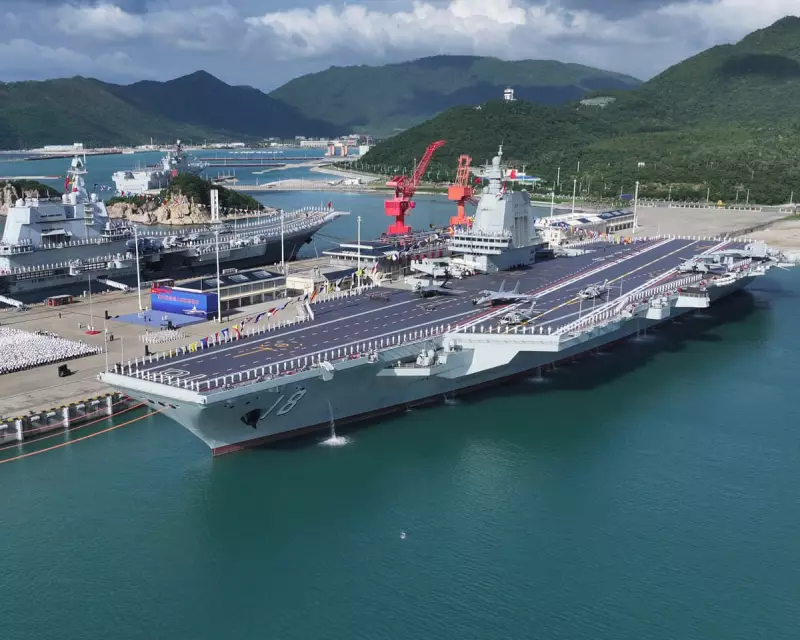
China's Naval Ambition Sails Forth with Fujian Aircraft Carrier
Docked at a naval port in Sanya city in southern China, the colossal 80,000-tonne Fujian aircraft carrier represents a monumental step in Beijing's military expansion. Costing an estimated £5.4bn, this 300-metre-long super-vessel can carry approximately 60 aircraft, formally launching China into a select group of global naval powers.
The Global Aircraft Carrier Race
The introduction of the Fujian places China second in the world for aircraft carrier numbers, with three vessels now in its fleet. However, it remains a considerable distance behind the United States, which maintains a formidable force of 11 aircraft carriers. This development is not merely about military hardware; it is a clear statement of intent in the growing rivalry between Beijing and Washington.
Analysts observe that for nations like China and the US, these massive warships are valued as much for their role in hard-edged diplomacy and global influence as for their direct combat capabilities. A recent demonstration of this was when former US President Donald Trump ordered the USS Gerald R Ford, the world's largest and most expensive warship at $12.8bn, to sail towards Venezuela in a show of force against the regime of Nicolas Maduro.
Contrasting Realities in Modern Naval Warfare
While the Fujian signifies great power projection, a concurrent conflict nearly 5,000 miles away presents a contrasting picture. In the Black Sea, Ukraine successfully achieved a functional defeat against Russia's naval fleet using swarms of targeted sea drones, suggesting that size alone does not guarantee naval supremacy.
Yet, this contradiction is more apparent than real. According to Nick Childs of the International Institute for Strategic Studies, aircraft carriers remain unrivalled in their flexibility and are incredibly useful in a whole range of potential conflict scenarios. For China, which has also heavily invested in anti-ship missiles for coastal defence, carriers are seen as an indispensable tool for independent global power projection. A primary strategic concern remains a potential future scenario involving Taiwan.
The UK's Position and Carrier Vulnerabilities
The United Kingdom, which completed the build and deployment of two aircraft carriers for £6.2bn four years ago, occupies a different position. With far less global power to project, the military necessity of its carriers is less obvious. Their use has been predominantly for floating diplomacy, as seen with the HMS Prince of Wales's visit to Tokyo to impress allies, rather than for intimidation.
Modern carriers are designed to be resilient. The Soviet cold war rule of thumb suggested it would take 12 conventional missiles to sink a super-carrier. A 2005 test on the USS America took four weeks to finally sink the vessel. They are protected by destroyers like the Royal Navy's HMS Diamond, which specialise in shooting down incoming drones. However, incidents like the Houthi rebel attack on the USS Harry S Truman in the Red Sea, which led to a $70m F/A-18E Super Hornet fighter jet being lost overboard, highlight that threats are persistent, even if the carriers themselves are hard to sink.
The situation in the Black Sea also underscores that Ukraine's success came against a weaker, poorly organised navy. Russia has not possessed a functioning aircraft carrier since the Admiral Kuznetsov went in for repair in 2017, a symbol of its broader geopolitical and economic challenges. In the new era of state competition, the massive investment in vessels like the Fujian underscores that for superpowers, the aircraft carrier remains a central, if expensive, pillar of global strategy.