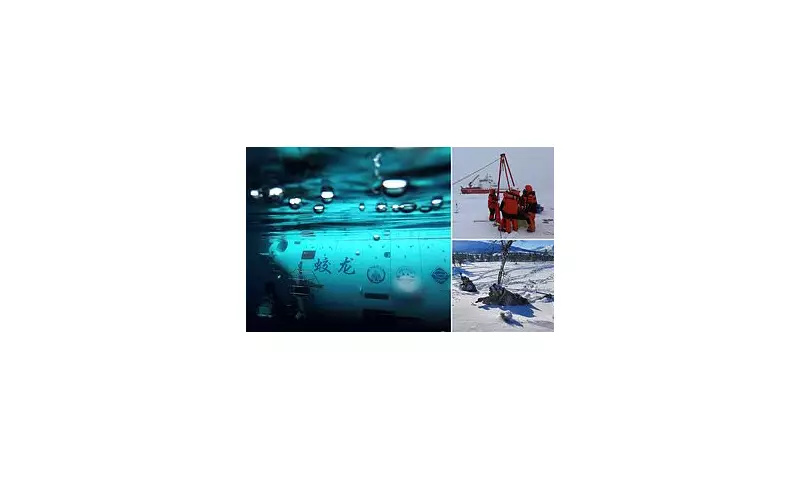
Senior US military and NATO officials are sounding the alarm over China's expanding activities in the Arctic, following the first successful transit of Chinese research submarines thousands of feet beneath the polar ice this past summer. According to a report in the Wall Street Journal, these expeditions are viewed as a strategic move with significant military and economic implications.
Scientific Research or Military Cover?
While Beijing insists its Arctic operations are "reasonable and lawful" and contribute to regional peace, US experts are deeply skeptical. US Air Force General Alexus Grynkewich, NATO's top military leader, stated that Chinese vessels on research missions frequently provide cover for military objectives. This view is supported by a November Department of Homeland Security memo noting unprecedented Chinese military and research activity in the 'High North' region of the Arctic.
Naval strategist Hunter Stires, a former adviser to the US Secretary of the Navy, was blunt in his assessment: "China doesn't field the world's largest fleet of oceanographic survey ships because they want to save the whales." He argues China's drive to lead in marine and climate science is a critical enabler for naval operations, especially anti-submarine warfare.

The Strategic Advantages of an Icy Frontier
The potential benefits for China are threefold. Firstly, the missions gather invaluable data on natural resources beneath melting ice caps. Secondly, they chart new sea lanes; a Chinese cargo ship's summer voyage to Poland via the North Pole was twice as fast as using the Suez Canal. China now plans expanded trans-Arctic cargo traffic with Russia.
Most concerning to Western security officials is the military advantage. Detailed mapping of ocean topography and conditions allows China to build computer models to guide its own submarines and evade detection. The Arctic environment itself provides stealth: thick ice hampers airborne detection, while water temperature layers and salinity disrupt sonar. The proximity of the North Pole to other nations means nuclear-armed submarines could be positioned closer to potential targets.
A Deepening Partnership with Russia
The challenge is magnified by China's growing cooperation with Russia. Officials suggest Moscow may be repaying Beijing for electronics and components used in the Ukraine war by sharing advanced undersea warfare technologies. Russia, which boasts over 40 icebreakers compared to China's five and America's two, has also advocated for greater Chinese involvement in governing Arctic international waters.
This partnership has already manifested in joint military patrols. In 2024, Chinese and Russian military planes were seen flying near Alaska, with Chinese long-range bombers operating from a Russian base. Retired Dutch Admiral Rob Bauer, a former senior NATO official, noted China is now sailing coast guard vessels that resemble warships near Alaskan waters.
French Admiral Pierre Vandier, overseeing NATO's future warfare preparations, warned that melting ice could allow China to move its navy from the Pacific to the Atlantic via the Arctic, bypassing traditional chokepoints. "If we have Asian forces in the Atlantic, it would be a huge game changer," he stated.
The Western Response
In response, the US and its allies are bolstering their Arctic posture. NATO has placed Denmark, Sweden, and Finland under its Atlantic and Arctic command. The US is training more Arctic troops and increasing sub-hunting patrols from Iceland. Furthermore, former President Donald Trump sought to acquire more icebreakers and struck a shipbuilding deal with Finland to expand defences around Greenland.
The stage is now set for the High North to become a new arena of geopolitical competition, where scientific exploration and national security are becoming inextricably linked.